
The effect of irrigation on the productivity and adaptation of vineyard plantations
12 min read
How grapevines consume moisture and why they need irrigation
A grapevine consumes water very wastefully: more than 99% of the absorbed moisture is spent on transpiration and respiration, and only 0.25% is used for the direct formation of organic matter. Water demand strongly depends on the climate of the region. For example, to produce 100 kg of grape harvest, the Don region requires 20–30 m³ of water, Crimea requires 44 m³, and Central Asia requires 50 m³.
By nature, the grapevine belongs to the mesophytes but possesses high biological plasticity and responsiveness to the water regime. The vine is capable of growing and fruiting both in conditions of severe water deficit in Central Asia and under heavy waterlogging in Western Georgia. In river floodplains, the bushes can even withstand the complete submergence of their trunks in flowing water for 20–30 cm during the summer months.
The plant's adaptability is ensured by a well-tuned mechanism of self-regulation. According to research, in the irrigated conditions of Uzbekistan, grapevines spend 22–51% of water on transpiration, while in rain-fed areas, due to stomatal regulation, this consumption is reduced to 8–9%. The hydration of grapevine leaves varies by only 5–7% (at most 10–12%) under the most contrasting conditions, whereas for most other crops this indicator varies by 35–40%.
The high biological plasticity of the grapevine to extreme conditions helps the bushes survive, but does not allow for high yields. For stable and productive fruiting, the plant requires a controlled water regime.
Irrigation improves the microclimate and phytoclimate of the vineyard, increasing air humidity in the canopy zone by 6–16% and lowering the air temperature during critical periods. As a result, the hydromechanical properties of the soil are improved, which increases the efficiency of fertilizer application. Furthermore, winter moisture-charging irrigation reduces the likelihood of soil freezing, protecting the roots and above-ground organs of the vine from frost damage.
- Water consumption for transpiration and respiration — more than 99%
- Water consumption for the formation of organic matter — 0.25%
- Moisture consumption during the shoot growth and harvest ripening phases — about 80%
- Share of irrigated vineyards in the country — 43%
- Water losses due to filtration and evaporation in earth channels — 40–50%
How to plan an irrigation system and reduce moisture losses
Water consumption for the formation of 100 kg of harvest is called the water consumption coefficient. This indicator is not constant and fluctuates significantly under the influence of external conditions. It is affected by a complex of factors that an agronomist must consider during planning:
- climatic conditions of the zone (precipitation, sum of active temperatures, hydrothermal coefficient, air humidity);
- soil indicators (soil type, its physical and mechanical composition, depth of groundwater table);
- biological characteristics of cultivars (highly, moderately, and weakly vigorous);
- plant condition (age of bushes, planned yield);
- agrotechnics (planting pattern, methods of soil management and tillage);
- irrigation system (moisture-charging and vegetation irrigation) and the method of its implementation (furrow, slot, sprinkling, subsurface or drip irrigation).
Grape water consumption changes sharply throughout the growing season of the bush. The plant consumes the largest amount of moisture (about 80%) during the period of shoot growth, formation, and harvest ripening. These peak periods are decisive when drawing up irrigation schedules and calculating application rates.
Artificial irrigation of vineyards is the foundation for a guaranteed harvest in arid regions. In our country, the total area of irrigated plantations is about 540 thousand hectares, or 43% of all vineyards. The share of irrigated areas varies significantly depending on the region of cultivation:
| Region | Share of irrigated areas |
|---|---|
| Kazakhstan | 96.3% |
| Armenia | 93.9% |
| Turkmenistan | 93.3% |
| Uzbekistan | 89.5% |
| Tajikistan | 66.7% |
| Azerbaijan | 57.1% |
| Russia | 41.8% |
| Georgia | 40.6% |
| Ukraine | 12% |
The composition and configuration of the irrigation system are designed for the specific topography of the area. Engineers and agronomists evaluate the hydrological, soil, climatic, and economic conditions of the site. A typical irrigation system consists of several main links:
- irrigation source;
- head regulating structures controlling water supply;
- main canals conveying water to the irrigated plots;
- distribution canals, including irrigation furrows and discharge furrows.
The main problem in the operation of irrigation systems is water loss. In earthen main and on-farm canals, 40–50% of water is lost due to filtration and evaporation, and over 10% evaporates directly from the surface of the irrigated plots.
Irrigation regimes: rates and timing for different growing season phases
- Moisture-charging rate — 1200–1500 m³
- Vegetation irrigation rate — 400–800 m³
- Lower humidity limit — 65–70% of field capacity
- Furrow cutting depth — 20–25 cm
In viticulture practice, irrigation is divided into two key types: moisture-charging and vegetation irrigation. Moisture-charging irrigation is carried out in winter by flooding, usually in 2–3 passes. They are necessary for the maximum accumulation of moisture in the deep soil horizons up to 2 meters. Since the root system of the grapevine reaches a depth of 2–3 meters or more, this supply allows the vine to survive drought periods and reduces the demand for moisture during the active growing season.
Growing season irrigation is carried out more frequently but with lower rates—from 400 to 800 m³ depending on the soil moisture capacity. In hot climates, on light sandy and gravelly soils, the irrigation rate is reduced to 300–400 m³, increasing the frequency of application. Frequent irrigation is also required for young vineyards with undeveloped surface root systems. In bearing blocks with well-developed deep roots, the number of irrigations is reduced.
The number of growing season irrigations is determined individually for each site. When calculating, the agronomist must take into account the cultivation zone, soil moisture and soil properties, vine age, target yield, and intended use, as well as the biological characteristics of the cultivar.
The main benchmark for scheduling irrigation is the field capacity (FC) index. Irrigation is carried out when the moisture content of the one-meter soil layer drops to the lower threshold of optimal hydration. According to field trial results, for high bush productivity before the berry ripening stage, soil moisture must be maintained within specific ranges.
| Soil type | Moisture rate (% of FC) |
|---|---|
| Sandy soils | 100—50% |
| Southern sandy loam chernozems | 60% |
| Common light loamy soils | 70% |
| Southern heavy loamy chernozems | 75% |
The water requirements of grapevines change according to developmental phases. During the period of shoot and berry growth, soil moisture must be maintained at a level of 80–85% of FC. During shoot lignification, this indicator is reduced to 65–70% of FC.
Do not allow soil moisture to fall below 65–70% of FC. With more severe dehydration, the frost and winter hardiness of grape bushes drops sharply.
In the European region, the first irrigation is usually carried out after flowering, in mid-June. If the spring is hot and dry, irrigation begins earlier—before flowering. The second irrigation is generally carried out in the second ten-day period of July.
For early and mid-season ripening cultivars, two growing season irrigations are usually sufficient. For late cultivars, a third irrigation is applied in early August. In regions with hot climates, irrigation frequency increases: in Azerbaijan, an average of 6 irrigations are carried out, in Armenia—10, and in Uzbekistan—from 4 to 10–12 irrigations.
Irrigation methods and furrow cutting parameters
The choice of the irrigation method depends on the topography, plot slope, water source, cultivation technology, and the technical equipment of the farm. Four main methods are used in vineyards:
- surface—water supply via furrows or slots;
- overhead—sprinkling and fine-mist spraying;
- subsurface—supplying water directly to the root zone;
- drip—localized irrigation of each bush using emitters.
The surface irrigation method is suitable for plots with flat terrain and an optimal slope of 0.002–0.005 to 0.008. Furrow irrigation remains the most common method. To cut the furrows, the PRVM-19000 attachment for the PRVM-3 plough is used. The number of furrows depends on the row spacing and the age of the vineyard.
| Row spacing | Number of furrows |
|---|---|
| 2.5 m or less | 2 furrows |
| 3–3.5 m | 3 furrows |
| 4.5–5 m | 4 furrows |
The outer furrows are cut at a distance of 0.6–7 m from the row of bushes. The distance between furrows is set according to the soil type: on light soils—0.6 m, on medium soils—0.7–0.8 m, on heavy soils—0.9–1 m.
The depth and length of the furrows depend on the slope of the plot and the water permeability of the soil. On gentle plots with a small slope, deeper furrows (20–25 cm) are made; on steep slopes, the depth is reduced to 20 cm. On heavy soils with low water permeability, the length of the furrows is extended to 200 m, sometimes up to 300 m. On light sandy loam and sandy soils with high filtration, the furrow length is reduced to 100 m.
Surface methods: furrow and slot irrigation
Furrow irrigation is organized according to one of two schemes: with or without residual water drainage. In the scheme with drainage, a transverse furrow is cut at the bottom of the plot, which collects excess water and diverts it into the irrigation canal of the downstream plot. When irrigating without drainage, the volume of water supplied is strictly measured so that it is completely absorbed by the soil. The quality of irrigation depends directly on the correct calculation of the irrigation rate, the initial water flow rate in the furrow, and the time of its application.
- Rate on light soils—600–800 m³/ha
- Rate on heavy soils—400–500 m³/ha
- Pre-winter recharge irrigation—300–400 m³/ha
- Labor costs for furrows—22.3 man-hours/ha
- Labor costs for sprinkler irrigation—2.8 man-hours/ha
For precise water dosing during furrow irrigation, rubber siphon hoses 80–100 cm long are used. They are primed from a temporary irrigation ditch laid across the irrigation furrows at the top of the plot. This method is simple to implement and allows for easy regulation of the water flow rate by changing the number of simultaneously operating hoses.
- Place one end of the siphon hose into the temporary supply channel and direct the other into the irrigation furrow.
- At the start of irrigation, provide an increased water flow rate (up to 0.3 l/s) by placing two siphons into a single furrow at once.
- After initial filling, reduce the flow rate by half (to 0.15 l/s), leaving one hose with a diameter of 15 mm in operation.
- Maintain water supply for 12–36 hours until the target soil layer is fully saturated.
In southern viticultural regions, furrow irrigation during the growing season is tied to the vine's development phases. Water supply is completely stopped 15–20 days before the start of Harvesting harvesting. The season concludes with a moisture-charging irrigation before covering the vines for the winter. This facilitates covering the vineyards with soil and optimizes tissue humidity in the plants before wintering.
- 10–15 days after bud burst (period of intensive shoot growth);
- 5–7 days before the start of flowering;
- 2 weeks after flowering ends (period of intensive berry growth);
- An additional 1–2 times during the berry growth period for late-ripening cultivars;
- Before covering the vines for the winter.
Furrow irrigation is simple to organize and requires no capital construction costs. However, this method has significant disadvantages: high water consumption due to evaporation in channels and furrows, as well as a high share of manual labor. An alternative surface method is slot irrigation. With this method, a slot 50–65 cm deep is cut in the middle of the row spacing, and water is supplied directly to the root zone. This reduces unproductive water losses due to evaporation and increases the yield gain compared to furrow irrigation.
When cutting slots to a depth of 50–65 cm, there is a risk of damaging the vine's root system. To reduce the number of equipment passes through the row spacings, combine slot cutting and irrigation with fertilizer application and subsoiling.
Sprinkler and fine-mist irrigation
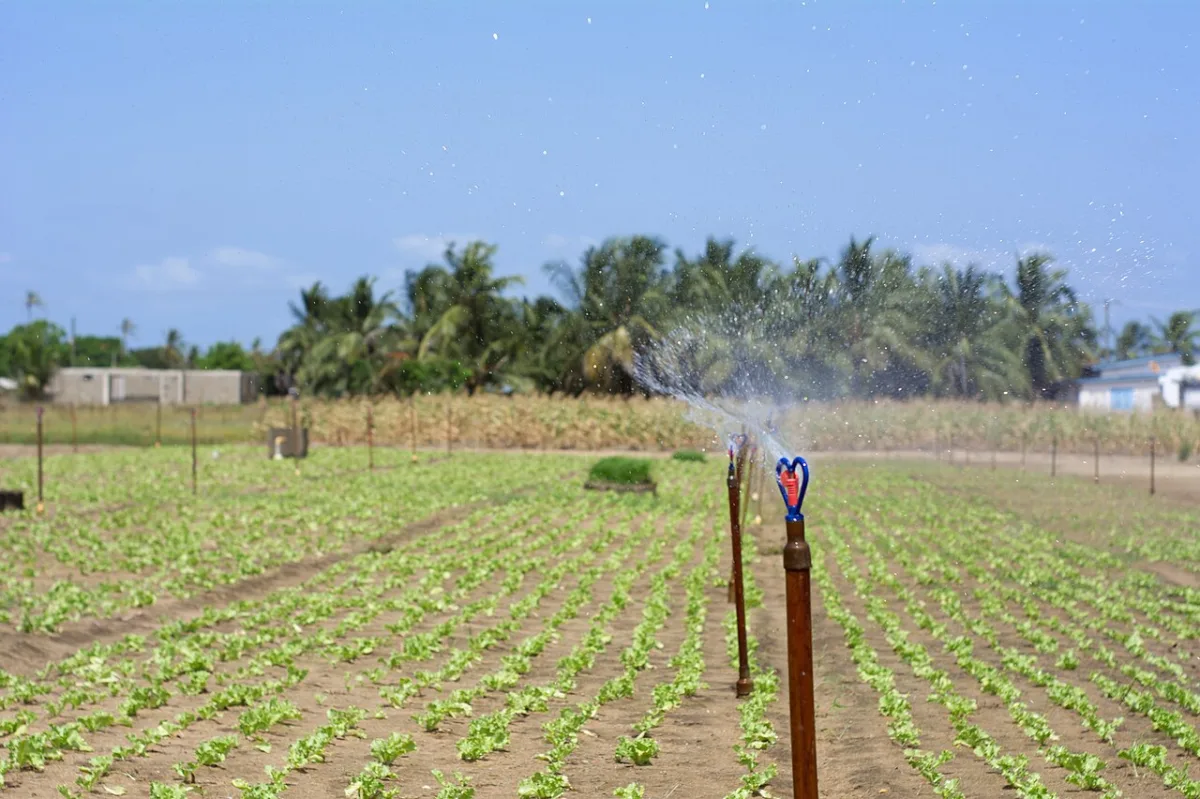
With sprinkler irrigation, water is sprayed over the vineyard using mobile sprinkler machines or stationary systems mounted on trellis supports. This method allows not only for the optimization of the soil moisture regime but also for the regulation of the microclimate and phytoclimate within the plantations. Sprinkler irrigation saves up to 30% of irrigation water and drastically reduces labor costs per hectare compared to furrow irrigation. The method is effective even in areas with complex topography where cutting furrows is impossible.
Before sprinkler irrigation, be sure to perform soil chiseling to a depth of 25–30 cm. This will prevent surface runoff and ensure rapid water absorption into the root-inhabited layer.
Stationary sprinkler systems are mounted directly in the vineyard. Water supply pipes are attached to trellis posts every 3–4 rows, with spray nozzles installed at intervals of 8–10 m. Pressure in the system is created by pumps, and irrigation control can be manual or automated. The design of stationary systems allows for the combination of irrigation with foliar top dressing by introducing soluble fertilizers directly into the irrigation water.
A variation of this method is fine-mist irrigation. Special nozzles create an artificial fog from ultra-fine water droplets. Such irrigation is used to regulate the micro- and phytoclimate directly in the vineyard. Increasing air humidity and lowering temperatures facilitate the optimal progression of physiological processes in plants: photosynthesis, respiration, and transpiration.
According to A. M. Adzhiev (1978), the use of this irrigation method in the conditions of Dagestan, by optimizing the micro- and phytoclimate, allows for eliminating the "dip" in the daily curve of photosynthetic leaf activity during midday hours, which is caused by excessively high daytime temperatures and low air humidity. A significant increase in the intensity of photosynthesis has a positive effect on improving the growth and development of the grape plant and significantly increasing its productivity.
Overhead irrigation is of particular importance in southern regions with high temperatures and low (less than 40%) relative humidity of the air during daytime hours, which have a depressing effect on plants. To increase the humidity of the root-inhabited layer, it is advisable to combine this irrigation method with:
- furrow irrigation;
- slot irrigation;
- subsurface irrigation;
- drip irrigation.
Read next
Irrigation For agronomists
Methods for planning and operational management of crop irrigation regimes
Irrigation For agronomists
Calculation of the irrigation regime for alfalfa based on meteorological data from Kolomna
Irrigation For agronomists