
Morphological features of the seeds and fruits of the buffalo bur (Solanum rostratum)
1 min read
Buffalobur nightshade (Solanaceae family — Solanaceae Juss.) poses a serious threat to grain and row crops, as well as to forage grasses. The weed is actively spreading in the south of the European part of the Russian Federation and in the Caucasus. Due to its high harmfulness, controlling it requires special oversight from agronomic services.
Buffalobur nightshade is included in the "List of pests, plant diseases, and weeds of quarantine significance for the Russian Federation." The weed possesses poisonous properties.
Morphological features of the weed's fruits and seeds
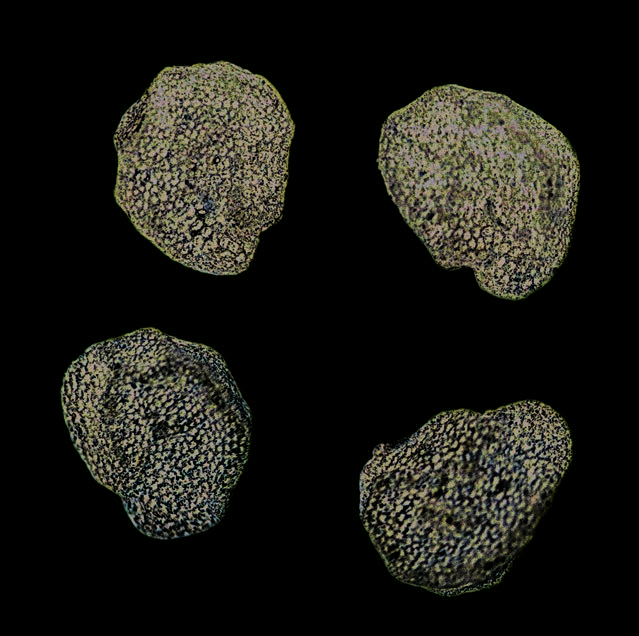
For timely detection of the weed, it is necessary to know the characteristics of its fruiting. The berries of the buffalobur nightshade are enclosed in a dense leathery calyx of a greenish-yellow or brown color, which usually has an oval shape. At the top of the calyx, there are two tooth-like projections, and at the base, the remnant of the pedicel remains. The entire surface of the calyx is covered with woody thorns directed perpendicular to it. Each berry contains up to 5075 seeds.
The weed's seeds have a rounded-compressed or slightly kidney-shaped form. Their color varies from grayish-black to dark brown. For accurate identification of the weed in seed material or green mass, one should pay attention to the structural features of the seeds:
- lateral sides are almost parallel;
- the apex is more or less rounded;
- a small projection is present at the base;
- the seed hilum is small, rounded, and deeply indented;
- the surface is tuberculate-wavy, deeply pitted, and matte.
| Seed parameter | Value |
|---|---|
| Length | 2,53 mm |
| Width | 22,25 mm |
| Thickness | 11,25 mm |
Read next
Seeds and varieties For agronomists
Characteristics of Solanum elaeagnifolium seed and risks of its spread
Seeds and varieties For agronomists
Botanical description and quarantine status of Solanum triflorum
Seeds and varieties For agronomists