
Morphological description and characteristics of the seeds of the weed Galeopsis speciosa
1 min read
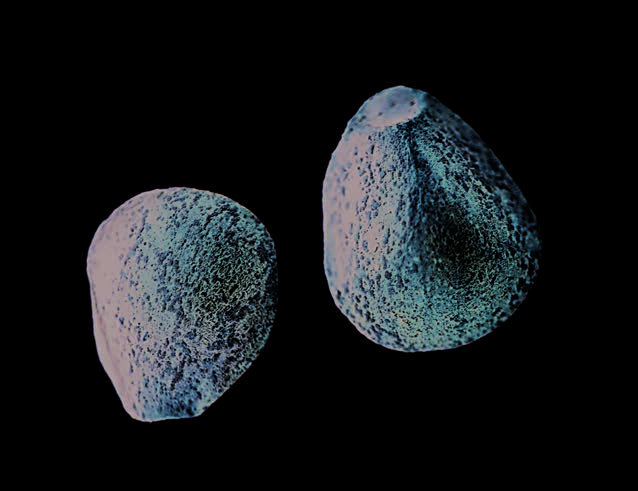
Galeopsis speciosa (family Lamiaceae Lindl.) is one of the most common weeds in plant production. It actively infests vegetable gardens and crops of grain crops, especially spring-sown ones, and also grows in meadows and pastures. For an agronomist, it is important to identify this weed in seed material and feed in a timely manner.
Galeopsis speciosa has poisonous properties, so its presence in fodder and food grain is strictly limited.
Morphological features of fruits and seeds
The presence of the weed can be determined by its single-seeded fruitlets. They have an obovate shape, a narrowed base, and a rounded apex. The fruitlet shells are quite thin, shell-like, and crack easily under physical impact.
- Shape and edges: in cross-section, the fruitlet is scalene-triangular, and closer to the base — indistinctly triangular. The dorsal edge is convex-oval, and the two narrower edges on the ventral side form a raised rib extending from the middle to the base. The side edges are pointed.
- Surface and color: the rough surface is covered with mottled warts. The color can be mottled dark gray or yellowish-brown with a lighter coating.
- Fruit scar: obliquely directed, it is a light rounded area with a thread-like rim along the edges.
- Fruitlet length — 33.5 mm
- Fruitlet width — 22.5 mm
- Fruitlet thickness — 1.25–1.5 mm
The weed seeds are obovate in shape; they are slightly compressed, with a rounded apex and a narrowed base. The thin-filmed whitish seed coats are easily rubbed off, revealing the seed itself of a bright yellow or yellow color. The seed surface is punctate-tuberculate and oily-lustrous, and a dark protrusion is visible in the center of the oblong-concave seed scar.
The geography of the weed's distribution covers vast territories. It occurs almost everywhere in the European part, as well as in Western and Eastern Siberia.
Read next
Seeds and varieties For agronomists
Botanical description and toxicity of Aquilegia vulgaris seed
Seeds and varieties For agronomists
Botanical characteristics and distribution area of stickseed (Lappula squarrosa) in crops
Seeds and varieties For agronomists