
Morphological characteristics and harmfulness of catchweed bedstraw in agriculture
1 min read
Cleavers (Rubiaceae family — Rubiaceae Juss.) belongs to the most common weeds contaminating finished crop produce. This harmful object is found everywhere, and in the Asian part of the country, it is classified as an introduced species. It actively infests crops of grain crops, vegetable gardens, orchards, and also grows abundantly in meadows. Controlling it is complicated by the fact that the weed contaminates the harvest with difficult-to-separate single-seeded fruitlets.
Besides reducing grain purity, the weed poses a serious threat to livestock farming. When cows eat cleavers grass, their milk turns red. Hay mixed with this plant can lead to the death of sheep, and the pecking of its seeds causes acute poisoning in poultry.
Morphological features of fruits and seeds
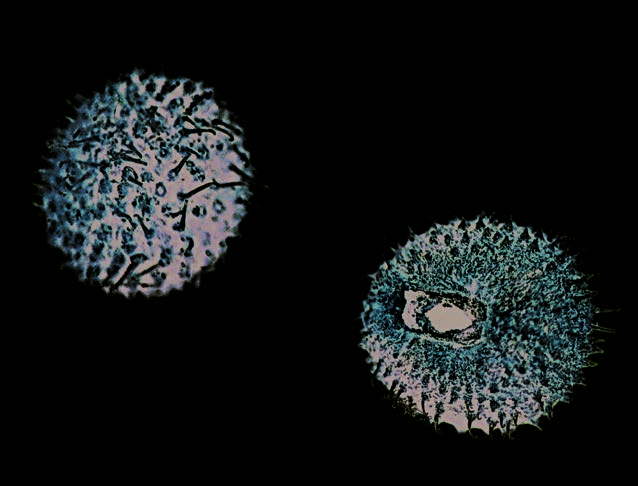
The schizocarp of cleavers splits into two fruitlets upon ripening. They are kidney-shaped from the side, look globular from the dorsal side, and have a concavity with a deep notch on the ventral side. In this notch, there is an oval hilum bordered on the sides by a characteristic ridge. The seeds of the weed completely replicate the shape of the fruitlets; they have a finely dotted structure, a brownish color, and a wide notch on the inner side.
The surface of fresh nutlets is covered with small bristles with tiny warts at the base, which gives them their clinging ability. Fallen nutlets without bristles have a dotted-tuberculate texture and a darker color. The color of fruitlets with bristles varies from grayish-brown and brown to greenish, while the bristles themselves are colored light gray.
- Fruitlet length — 1,753 mm
- Fruitlet width — 1,252,25 mm
- Fruitlet thickness — 1,51,75 mm
Read next
Seeds and varieties For agronomists
Botanical characteristics and harmfulness of the weed viper's bugloss
Seeds and varieties For agronomists
Seed morphology and geographical distribution of Ranunculus sceleratus
Seeds and varieties For agronomists