
Technological regimes of poultry egg incubation and quality assessment of day-old chicks
14 min read
"The air speed promotes heat dissipation and increases water evaporation from the eggs. Enhanced air exchange is especially necessary during the last days of incubation. The incubation regime for eggs is shown in tables 28 and 29.
S.I. Smetiev 193 Table 28.
Temperature with full cabinet loading, °C
Temperature with partial cabinet loading, °C
Opening of ventilation holes at up to 50% loading, mm
Opening of inlet holes with full cabinet loading, mm
Opening of top automatic shutters at up to 50% loading, mm
The same, with full loading, MM
Number of egg tray turns per day
Temperature when transferring to hatching, °C Temperature during hatching, Relative humidity, %: when transferring to hatching during hatching Opening of inlet holes, mm: when transferring to hatching during hatching at the end of hatching Opening of top ventilation shutters, mm
317.4—31.5 37.5—87.7
37.4—31.5 37.5—31.7
37.4—31.5 37.1—31.8
* In IKP-90 "Kavkaz" incubators, the incubation regime is maintained within these same limits.
Chicks are removed from the incubator twice. The first time when 19—80% of chicks have hatched, and the second time after 12—18 additional hours of incubation. It is possible to remove hatched chicks, ducklings, and goslings from the incubator several times (3—4 times). Duration of egg incubation!
Evaluation of day-old poultry. Newly hatched poultry is inactive, and its down is damp. It is left in the incubator for 3—4 hours so that it can dry and become stronger. One should not keep the young poultry in the incubator for too long.
Table 29. Incubation regime for simultaneous setting of the entire cabinet with eggs from meat-type poultry breeds (Baltic Zonal Station)
Air tem- | Air | Temperature on Days of incubation perature °C humidity % wet bulb °C 1 — 3 38.3 61 32 4 — 7 37.8—37.7 54—49 30—29 8 — 10 37.5—37.6 49—50 28—29 From day 11 to transfer 37.0—37.2 44—42 27 to hatching Hatching 36.9—37.1 64—70 32
Table 30. Duration of egg incubation for different poultry species (according to M. V. Orlov)
Poultry species Start of hatching Mass hatching End of hatching
Egg-type chicken breeds End of the 20th day | First half of the | End of the 21st day
21st day Ducks and turkeys 26th day 27th day End of the 27th, beginning of the 28th day Geese 29th day 30th day Beginning of the 31st day
Chicks are placed in special boxes 60 cm wide, 60 cm long, and 18 cm high. Such a box is divided inside into four square compartments, in each of which 25 chicks, 15 ducklings and turkey poults, or 10 goslings are placed. There are ventilation holes on the outer wall of the box.
For every 6 hours of sitting, the weight of chicks decreases by 0.6–0.9 g. Weak chicks lose weight 1.5—2 times faster. The residual yolk decreases rapidly, and at the same time, the gallbladder increases in size, filling with bile. Grown-out wing feathers and a greatly enlarged yolk sac are signs of overstaying chicks in the incubator. Day-old poultry has imperfect thermoregulation, meaning that the chicks cannot yet maintain their body temperature. Changes in temperature quickly affect their health. The weight of day-old poultry depends on the weight of the eggs. It is 65—67% of the egg weight before incubation.
When evaluating, chicks are divided into two main groups — those suitable for rearing and those unsuitable, which are to be culled in the incubation facility.
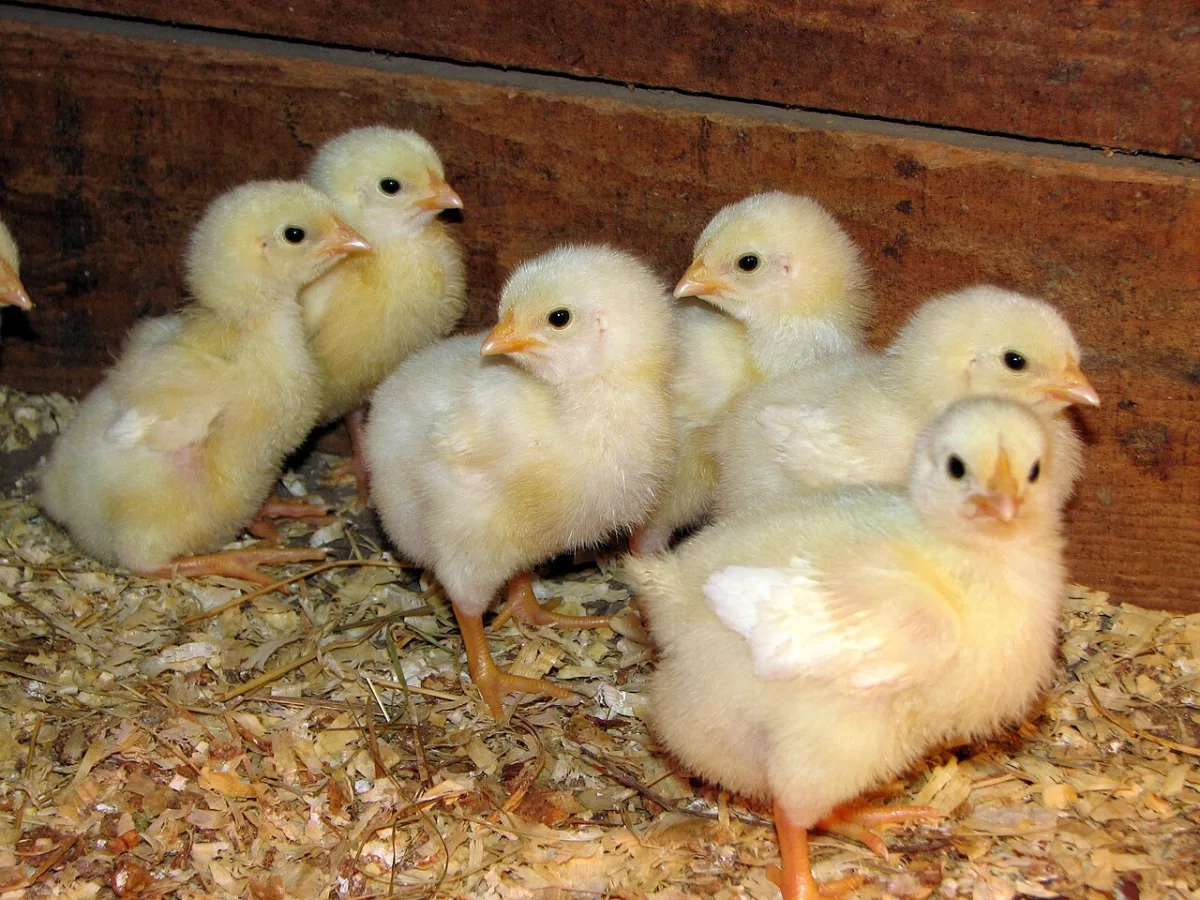
Chicks suitable for rearing. Category I — standard. Chicks of this group are characterized by the following features: they are active, mobile, respond to sound; they have smooth, shiny, well-pigmented down; strong legs, colored pink-yellow (in breeds with white plumage); eyes are clear and shiny;
9» 195 head is large, broad; beak is short, thick; wings are pressed tightly to the body. The keel of the breastbone is elastic; the abdomen is soft and tucked; the navel is closed, without traces of bleeding; the cloaca is pink and clean.
Category II — chicks with minor defects. Such chicks stand well on their feet, are active, but have small deviations from the norm: slight enlargement of the abdomen, a dried blood clot on the navel no more than 2 mm in diameter; somewhat loose, dull, weakly pigmented down. This category also includes late-hatching chicks from the last pull, as well as small ones, but not below 32 g in weight.
Chicks unsuitable for rearing. Category III — weak. Chicks of this group are inactive, sluggish; they have a pendulous abdomen, enlarged due to a large intrauterine yolk, or a very small, tucked abdomen. Chicks have dull eyes covered by eyelids, drooping wings, and short, faded, unevenly distributed down. The body is loose; the back is long, narrow; the keel is short and soft.
Category IV — cripples. Chicks have defects, each of which is already a reason for culling the poultry: head deformities, unabsorbed yolk, etc.
Incubation of eggs from a breeding poultry flock. Immediately after the eggs arrive at the hatchery storage, they are prepared for setting by being carefully inspected using an ovoscope. Eggs unsuitable for incubation are culled. The numbers of the hens from which inferior eggs were obtained are recorded in a special logbook. During incubation, the eggs are inspected by ovoscope twice: on the 1st or 6th day and on the 20th day. After each inspection, the numbers of eggs that proved to be infertile, had "blood rings," or contained dead embryos are recorded in the logbook.
How to organize biological control in a hatchery
Biological control helps the poultry farmer manage embryo development and obtain viable offspring. With its help, substandard eggs are culled before setting, embryo growth is monitored during incubation, and the quality of hatched chicks is assessed. This method is mandatory for hatchery-poultry stations, poultry farms, and large agricultural enterprises.
- Assessment of egg quality before setting in the incubator.
- In vivo monitoring of embryo development according to incubation periods.
- Analysis of the quality of hatched offspring and pathological anatomical examination of incubation waste.
Before setting, eggs are sorted by appearance (size and shape) and candled using an ovoscope. During candling, the color and mobility of the yolk, the size of the air cell, and the integrity of the shell are evaluated. Selective opening of eggs allows for the determination of protein stratification, albumin and yolk indices, the condition of the germinal disc, and the presence of blood or meat spots.
- Ovoscope lamp power — 500 W
- First visibility of the germinal disc — after 8 hours
- Evaluation schedule for chicken embryo development — 1st, 4th, 10th, and 20th days
To conduct control in the hatchery, a workspace is allocated with a table, an ovoscope, counting trays, and a chamber for opening eggs. The tool kit includes an egg stand, sharp scissors, a magnifying glass, an eye glass for pouring out contents, a caliper, a micrometer, tweezers, Petri dishes, and weighing bottles. The desktop portable ovoscope I-11, with a powerful 500 W incandescent lamp, allows the operator to quickly inspect eggs with both hands without damaging the shell, thanks to rubber-rimmed tubes. The device's condensers provide a strong light flux, at which the developing germinal disc is visible after just 8 hours of incubation.
A micrometer fixed vertically on a tripod is used to determine the height of the yolk and albumin when calculating indices and Haugh units.
Egg candling schedule and embryo status assessment
In vivo biological control is carried out by the method of candling eggs at fixed intervals. It is extremely important to inspect eggs at the same age to accurately assess the dynamics of embryo development. Under production conditions, standard evaluation is conducted according to a schedule adapted for each bird species.
| Bird species | 1st inspection (days) | 2nd inspection (days) | 3rd inspection (days) |
|---|---|---|---|
| Chickens | 6 | 11 | 19 |
| Ducks or turkeys | 7 | 13 | 25 |
| Geese | 8 | 15 | 28 |
During the first candling, a healthy embryo is completely immersed in the yolk, and its vascular system is well-developed. If the embryo is pressed against the shell and the vessels are weakly developed, development is lagging. By the second candling, the allantois should close at the sharp end of the egg and encompass the entire albumin. By the third inspection, the boundary of the air cell becomes wavy, and the sharp end of the egg darkens completely, which indicates the complete assimilation of the albumin.
The appearance of a blood ring on the yolk during the first candling indicates the death of the embryo. Eggs without a visible embryo are infertile or contain an embryo that died at the very earliest stage.
Under production conditions, a methodology for assessing chicken embryo development on the 1st, 4th, 10th, and 20th days of incubation is also used. This method has been successfully tested in practice on several million eggs. With this schedule, indicators are evaluated according to the following criteria:
- 1st day: viability is determined by the condition and diameter of the germinal disc;
- 4th day: development quality is assessed by the circulatory system of the yolk circulation circle;
- 10th day: the condition of the embryo is monitored by the development of the allantoic blood vessels;
- 20th day: the standard is determined by the position of the embryo in the egg, the fullness of albumin utilization, and the curved boundary of the air cell.
When conducting in vivo biological control, it is not always necessary to inspect eggs on the days specified above. For example, one can inspect and select eggs on the 1st and 20th days of incubation, or on the 4th and 10th days. The number of inspections depends on the quality of the incubation eggs. Likewise, it is not necessary to inspect the entire batch of eggs set. It is sufficient to take a sample (10–15%) and carry out a thorough assessment. It is better to take eggs for the sample from different parts of the incubator to ensure that embryos from all batches are developing equally.
Pathoanatomical analysis. This analysis is conducted to investigate pathological changes that have led to embryonic death. With the help of pathoanatomical analysis, developmental disorders are detected and the causes of embryonic death are established. During the autopsy of dead embryos, pathological developmental changes are observed: hyperemia, anemia, hemorrhage, edema, and many others.
Egg quality control. Eggs are evaluated before incubation by external appearance, candling, and dissection. A long or round shape, small size, thin, fragile, and rough shell, "marbling," runny albumen with poorly defined layering, pale yolk, detached chalazae, and foreign inclusions are the main signs of eggs unsuitable for incubation. The main indicators of hatching egg quality are fertility and hatchability. The higher the fertility and the better the hatchability, the more young stock will be obtained during incubation. Increasing egg fertility raises the utilization rate of incubators and reduces the cost price of chicks, ducklings, etc. High egg fertility indicates the good health and condition of breeding poultry, proper feeding, and appropriate housing conditions. A large number of infertile eggs in a batch provides grounds to consider the quality of hatching eggs low.
Increasing egg hatchability is achieved by improving feeding and poultry housing conditions, which quite quickly reflects on egg quality, and by selection — the selection and pairing of males and females that not only have good hatchability themselves but also come from families whose ancestors were also noted for high hatchability rates. In this case, the genetic characteristics of the eggs are determined by the breeding merits of the flock's males and females.
In cases of disturbances in the feeding of the breeding flock, characteristic diseases called embryonic dystrophies are observed in embryos. Embryos with such diseases lag in growth; they may have shortened legs, thickened joints, sometimes an underdeveloped lower jaw and the upper part of the beak bent downward ("parrot beak"), the skin is edematous, the down does not fluff out and appears as bumps and rings ("curly down"). In such embryos, the albumen is poorly utilized and the entire body is covered with sticky fluid; the yolk is often thick and viscous. The main causes of embryonic dystrophies are a lack of vitamins D, B1, B12, H, trace elements in the diet, or protein poisoning. Prolonged and improper storage of eggs before incubation increases embryonic mortality in the first days of development. In this case, the germinal disc grows irregularly over the yolk.
Control of the incubation regime. In case of violations of the temperature, humidity, and air exchange regime, the embryos develop abnormally.
Strong and even short-term temperature increases kill the embryos. In this case, hemorrhages in the heart, brain, and skin are observed. A less severe but prolonged temperature increase increases mortality mainly during hatching. With overheating, unevenness in embryo development is noticeable; along with large ones, there are also small ones that have lagged in development and growth. Pipping and hatching start prematurely with overheating, but the hatch finishes later than the normal time.
Prolonged underheating retards the growth and development of embryos. Pipping and hatching are significantly delayed. A great many embryos die. Severe mucous edema of the head and neck is noted, often with hemorrhages. The embryos do not utilize the albumen. The hatched young are lethargic, hold themselves poorly on their legs, and their abdomen is large and distended.
With insufficient humidity, the egg mass decreases. The shell membranes become dry. Pipping and hatching occur early. Hemorrhage in the allantois is found at the site of shell pipping. Excessive humidity retards the evaporation of moisture from the egg. The intestinal tract of the "dead-in-shell" embryos is overfilled with fluid. Hatching is delayed. A crust of dried mucus forms at the site of shell pipping, sticking to the beak and preventing the chick from exiting the shell.
Insufficient air exchange leads to the embryo occupying an incorrect position in the egg. Hemorrhages are observed in the amnion, and pipping occurs at the pointed end of the egg.
Control of egg mass loss during incubation. From the first day of incubation until transfer to hatching trays, eggs lose on average 11—13% of their initial mass. However, the viability of embryos strongly depends on the mass loss by eggs, or more precisely, on their water evaporation by incubation periods. During incubation, water first evaporates from the albumen and later from the allantois. It is as important to preserve water and reduce its evaporation from eggs in the first days of incubation as it is necessary that after the closure of the allantois, as much water as possible evaporates from the egg.
Table 32. Estimated weight loss of eggs from various poultry species
Egg weight loss (%) Eggs 6 days | d | 18 days | 24 days Chicken 2.5—4.0 1.0—59.0 11.0—13.0 — Turkey 2.5—3.5 5.0—6.0 7.0—9.0 10.5—13.5 5.. 2E ec 55 p ya pp TT O-AA Goose 2.6—3.0 | 4.5—6.0 8.0—9.0 | 10.5—12.0
Egg trays are weighed before incubation. First, the empty tray is weighed, then the eggs are weighed before setting, and the average weight of one egg is determined. During subsequent weighings, the weight loss of the entire group of eggs and the average loss per egg are determined, expressed as a percentage of their initial weight. Chapter VII ®
Read next
Poultry For agronomists
Development of extraembryonic organs and the economics of industrial egg incubation
Poultry For agronomists
Technological processes and automation of modern industrial poultry farming
Poultry For agronomists