
Influence of hydrothermal conditions on the development of eyespot root rot in winter grain crops
13 min read
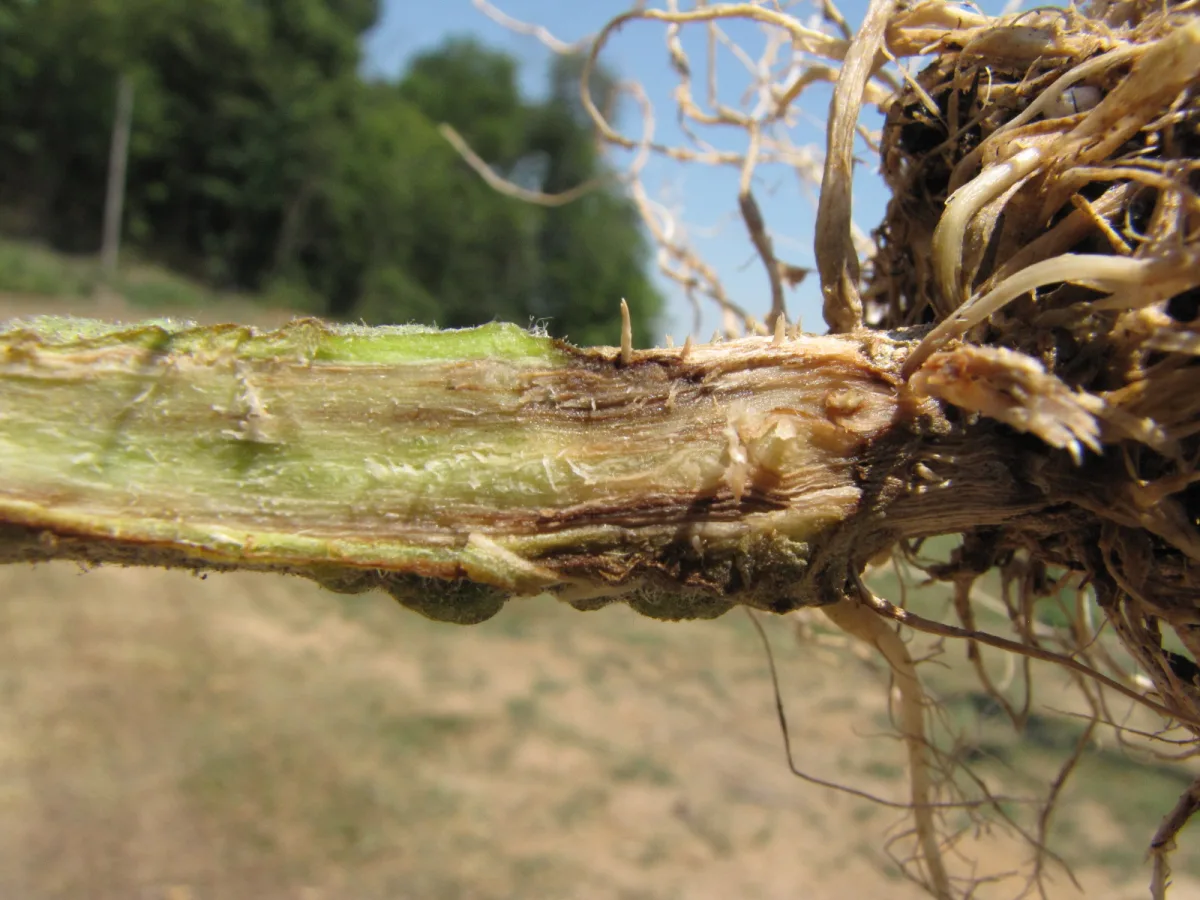
Cercosporella eyespot (causative agents are the fungi Oculimacula yallundae (Wallwork & Spooner) Crous & W. Gams and O. acuformis (Boerema, R.Pieters & Hamers) Crous & W. Gams) is one of the main causes of lodging and reduced harvest of winter cereals. The disease was first discovered in 1907–1908 in France while studying the causes of lodging in winter rye plants. Since the second half of the 20th century, eyespot has been regularly reported in all countries around the world: in Europe (Germany, France, Poland, Lithuania), America, South Africa, and in the south of Australia and New Zealand.
The causative agents of the disease clog the plant's conductive vessels, blocking the movement of nutrients and water. In cases of severe eyespot infection, not only the conductive but also the mechanical tissues are destroyed, causing the stems to break and lodge haphazardly during rainy periods even before ripening. The harmfulness of the disease directly depends on the stage of infection and the degree of plant damage.
- Grain losses — 20–50%
- Yield reduction per 1% of stem infection — 0.5–0.6%
- Optimal infection temperature — +5…+10 °C
- Minimum air humidity — 80%
The infection is not transmitted through seed. The main source of infection is the stubble of the previous cereal crop. The risk of disease development is significantly higher on heavy, moist soil.
How to recognize and assess the severity of infection
The disease affects the basal part of the stem starting from the seedling stage, forming honey-brown, eye-like spots with a blurred margin. The closest spots gradually merge and, by the heading stage, girdle the base of the affected stem. With early sowing dates, a dark stroma of the fungus that has penetrated into the stem forms on the affected plants at the site of the initially appeared spots. When broken, the stem cavity within two, sometimes three, lower internodes is found to be filled with smoke-gray, and eventually brown, fungal mycelium, while the affected part becomes necrotic.
Eyespot most severely affects winter wheat, rye, triticale, and barley. Spring barley and wheat suffer from it slightly less, and oat crops are not affected by the disease at all. In some years, the development of the pathogen in crops in the Republic of Belarus reaches significant levels.
| Crop | Disease development, % |
|---|---|
| Winter wheat | 47.5 |
| Winter triticale | 58.3 |
To assess the development of eyespot in winter wheat crops, starting from the heading period, the following scale is used:
- 0 — no signs of infection;
- 1 — on the base of the stem or the first internode — separate whitish or light-brown spots;
- 2 — dark yellowish-brown spots with a pronounced margin cover up to half of the stem;
- 3 — spots girdle the stem, the tissue in the center of the spot is partially destroyed, the stem breaks;
- 4 — absence of productive stems in the presence of symptoms according to score 3.
Disease development (%) is calculated using the formula: R = (∑ (n × b) × 100) / (N × K). In this formula, R is the disease development, ∑ (n × b) is the sum of the products of the number of diseased plants (n) and their corresponding infection score (b), N is the total number of examined plants in the sample (pcs.), and K is the highest score of the assessment scale for converting the score assessment into percentages. This calculation allows for an accurate assessment of the scale of the pathogen's harmfulness in a specific field.
Influence of weather and soil conditions
Hydrothermal conditions have a significant impact on the development of eyespot pathogens. The higher the hydrothermal availability of the year, the higher the level of eyespot spread. Infection of winter grain crops begins in the autumn period. High Relative humidity of the air"relative humidity (at least 80%) and a temperature in the range of +4...+13 °C for 15 hours or more are required for fungal sporulation and plant infection.
When the temperature rises above +16 °C, further plant infection practically does not occur. If the temperature drops below 0 ºC or rises above +25 ºC, the growth and development of the pathogen cease completely.
The dynamics of disease development were studied in field trials in 2014–2022 on the winter wheat cultivar Bogatka. The agricultural practices for growing winter wheat were those generally accepted for cultivating the crop in the Central agroclimatic zone of the Republic of Belarus. The trials were conducted on sod-podzolic medium loamy soil.
The soil of the experimental plots was characterized by a humus content at the level of 1.89–2.0%. The content of available phosphorus (P2O5) was 293–334 mg/kg, exchangeable potassium (K2O) — 268–375 mg/kg, and boron — 0.51 mg/kg of soil with a pH of 5.5–6.1. These data allow for the comparison of monitoring results with soil properties in specific farms.
∑t where R represents the sum of precipitation in millimeters for the period with mean daily temperatures above +10 °C; Σt defines the sum of temperatures (°C) for the same time. The identification of hydrothermal factors influencing the development of eyespot in winter wheat crops was carried out based on correlation and regression analysis using the MS Excel software package. The periods when plants are most vulnerable to infection by the disease were analyzed: the autumn period and the period after overwintering until the beginning of heading. Results of studies and their discussion. When studying the infection of winter wheat crops with eyespot, it was noted that the disease reached its greatest development in 2014 and 2021. The weather conditions of 2014 were characterized by an increased temperature regime throughout the entire growing season. The average annual temperature was +7.8 ºC, which is 2 ºC above the climatic norm. 567 mm of precipitation fell during the year (86% of the climatic norm). Excessive moisture was observed in May, while the remaining months of the spring-summer season were characterized by a precipitation deficit.
In 2021, there was a fairly cool spring and a hot summer. The mean daily temperature in spring averaged +9.4 ºC. Temperature regime throughout the season was non-uniform: the average air temperature in March exceeded the norm, while April and May were cold. In general, the year was characterized by sufficient moisture availability. In all seasons, the precipitation norm or more was recorded.
According to literature, the optimal temperature for the development of the causal agents of eyespot (cercosporella root rot) is +5...+10 ºС; therefore, the conditions in 2014 and 2021 were favorable for the development of the disease. Thus, in 2014, the development of eyespot by the milk-wax ripeness stage reached 50.4%, and in 2021 – 64.8%. In other years, the degree of plant infestation was at a depressive level.
Figure 1. Development of eyespot in winter wheat crops (RUE "Institute of Plant Protection", cultivar Bogatka, GS 83–85) Weather conditions during the years of research varied, which allowed for an objective assessment of their impact on the development of eyespot in winter wheat crops. Since, according to literature, infection of plants with eyespot can occur in autumn and spring, and the disease develops more intensively during the stem elongation and heading stages, the impact of weather conditions was assessed specifically during these periods.
As a result of correlation and regression analysis of the obtained data, it was established that the air temperature in the autumn period and precipitation in May (total precipitation and number of days with precipitation) play a decisive role in the increase of eyespot development. Table 1 – Impact of hydrothermal conditions on the development of eyespot in winter wheat crops (RUE "Institute of Plant Protection", cultivar Bogatka, 2014–2022)
Indicator Correlation coefficient (r)
Autumn period from sowing to the onset of sub-zero temperatures mean temperature 0.77* total precipitation 0.50 humidity 0.40 number of days with precipitation 0.18
Spring period after crossing +5 ºС to the 3rd decade of May mean temperature -0.16 total precipitation 0.31 humidity 0.47 number of days with precipitation 0.58
Spring period after crossing +10 ºС to the 3rd decade of May mean temperature 0.30 total precipitation 0.39 humidity 0.46 number of days with precipitation 0.36
May mean temperature 0.07 total precipitation 0.73* humidity 0.62 number of days with precipitation 0.79* HTC 0.56
May–June mean temperature –0.36 total precipitation 0.64 humidity 0.52 number of days with precipitation 0.60 HTC 0.64 * p < 0.05.
The dependence between eyespot development and mean daily air temperature has also been identified in the studies of other authors. Thus, M. Vanova et al. (2005) also note that the mean daily air temperature in October and early spring (April) influences the development of the disease. The optimal temperature is +4...+10 ºС. This may be related to the features of the life cycle of eyespot pathogens. In the autumn period, plants are infected by pathogens that have survived on crop residues. And the warmer and longer this period is, the higher the probability that the pathogen will penetrate the plant tissue. Other researchers also point to the influence of the year's moisture availability on eyespot development. The peak of conidia formation by the disease pathogens occurs in the period of April–May. In May, winter wheat passes the stem elongation stage, and during this period, plants are susceptible to infection. For the successful completion of this process, high humidity at the soil level is required, which is ensured by frequent and abundant precipitation.
Conclusion. Thus, during the years of research, the highest degree of winter wheat infestation by eyespot was noted in the conditions of 2014 and 2021. The development of the disease reached the level of an epiphytotic. The determining factors for the development of eyespot pathogens and the nature of the disease progression are the temperature in the autumn period, as well as the amount of precipitation and the number of days with precipitation in May.
Gritsyuk, N. V. Influence of agrotechnical practices on the harmfulness of eyespot in winter wheat / N. V. Gritsyuk, T. N. Timoshchuk, A. A. Derecha // Consolidarea capacităților regionale pentru aplicarea tehnologiilor ecologice în sistemele integrate de gestionare a dăunătorilor: сonf., Chişinău, 10-12 decembrie, 2018 ulei / In-l de Genetică, Fiziologie şi Protecţie a Plantelor. – Chişinău, Moldova, 2018. – P.105–108.
Dzhumabaev, P. Eyespot of cereals in the USSR: abstract of thesis … Cand. Biol. Sci. / P. Dzhumabaev; VNIIZR. ‒ Borovsk; L., 1966. ‒ 28 p.
Zheltova, K. V. Root rots of winter wheat and their harmfulness / K. V. Zheltova, V. I. Dolzhenko // Vestn. OrelGAU. – 2017. ‒ No. 1 (64). ‒ P. 45–51.
Diseases of cereal crops / S. D. Zdrozhevskaya [et al.] // Methodological guidelines for registration tests of fungicides in agriculture / Scientific and Practical Center of the NAS of Belarus for Agriculture, Institute of Plant Protection; ed. by S. F. Buga. – Nesvizh,
2007. – P. 61–101.
Pilat, T. G. Prevalence and development of root rot in winter cereal crops in Belarus / T. G. Pilat // Youth in Science 2020. Agrarian, biol., humanit., med., phys.-math., phys.-tech., chemistry and Earth sciences: abstracts of the XVII International Conference of Young Scientists (Minsk, Sept. 22–25, 2020) / National Academy of Sciences of Belarus, Council of Young Scientists; ed. board: V. G. Gusakov (chief ed.) [et al.]. – Minsk, 2020. – P. 62–63.
Tyuterev, S. L. Brief characteristics of the most dangerous diseases / S. L. Tyuterev // Seed treatment of cereal crops / All-Russian Research Institute of Plant Protection. – M.: [s. n.], 2005. – P. 91(3)–99(11). – (Supplement to the journal "Plant Protection and Quarantine"; № 3).
Phytopathological situation in cereal crops in Belarus / N. A. Krupenko [et al.] // Plant protection: collection of scientific papers / Scientific and Practical Center of the National Academy of Sciences of Belarus for Agriculture, Institute of Plant Protection; editorial board: S. V. Soroka (editor-in-chief) [et al.]. – Minsk,
2023. – Iss. 47. – P. 86–94.
14. Isolation of R-type progeny of Tapesia yallundae from apothecia on wheat stubble in England / P. S. Dyer [et al.] // Plant Pathology. – Vol. 43. – P. 1039–1044.
16. Glazek, M. Occurrence of eyespot on winter wheat in the central-southern region of Poland / M. Glazek // J. of Plant Protection Research. – 2009. – № 49. – P. 426–433.
18. Robbertse, B. Revision of Pseudocercosporella-like species causing eyespot disease of wheat / B. Robbertse, C. F. Campbell, P. W. Crous // South African J. of Botany. – 1995. – Vol. 61. – P. 43–48.
T. G. Pilat, N. A. Krupenko RUE «Institute of Plant Protection», Priluki, Minsk region
INFLUENCE OF HYDROTHERMAL CONDITIONS ON
THE DEVELOPMENT OF EYESPOT ROOT ROT IN
Annotation. The article presents the results of long-term research (2014–2022) to study the infestation of winter wheat crops by eyespot root rot. It was established that the disease was most developed in the conditions of 2014 and 2021. Research has shown that the development of the disease is decisively influenced by air temperature in the autumn and moisture availability in May.
Key words: eyespot root rot, disease development, hydrothermal conditions, precipitation, temperature.
Read next
Plant protection For agronomists
Species composition of Fusarium root rot of spring triticale and the influence of climate
Plant protection For agronomists
Diagnosis and prevention of root rots in tomato seedlings in greenhouses
Agrochemistry For students