
Efficacy of new fungicides in the control of grey mold on strawberry
11 min read
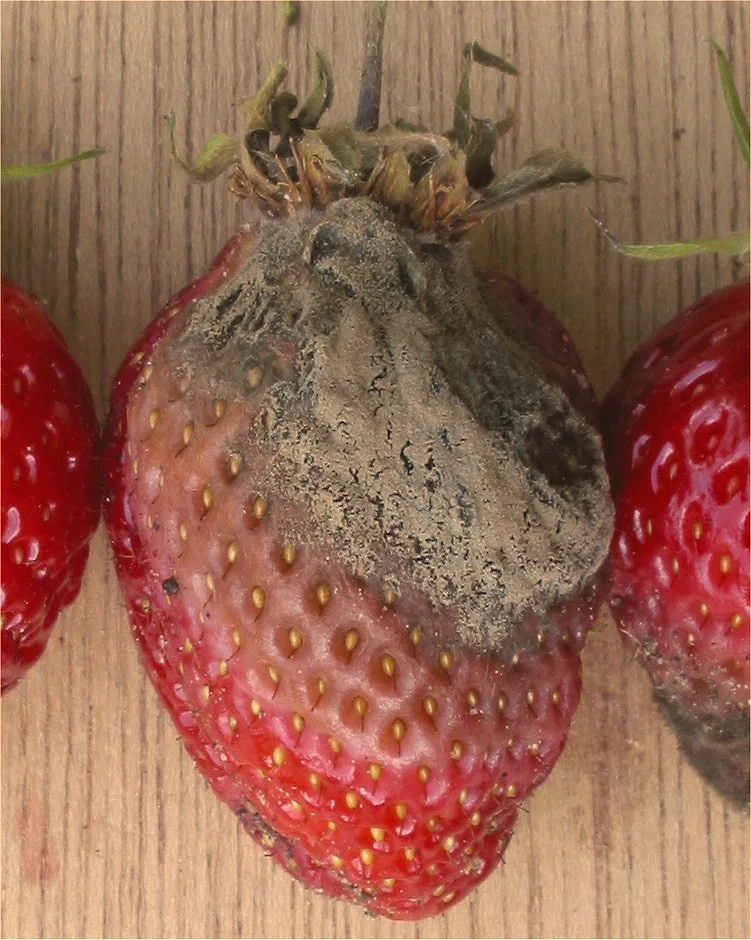
Gray mold (Botrytis cinerea Pers.) affects leaves, flowers, flower stalks, and fruit set of strawberries, but causes the greatest damage during the ripening of berries. In normal years, the disease takes away 10–20% of the harvest, and during prolonged precipitation, losses can reach 80%. Furthermore, the pathogen continues to actively develop and infect healthy berries during transportation and storage.
Symptoms of the disease appear as early as the budding and flowering period. In humid weather, brown, weeping spots appear on the flower stalks and green fruit set, and the leaves become covered with a gray mold. During dry periods, the disease localizes on the berries: first, softened spots appear, then the fruits are covered with a gray, felt-like coating of conidia and gradually dry out. The fungus overwinters in the form of mycelium and sclerotia on plant residues, producing a new generation of conidia in the spring, which are spread by wind and raindrops.
Until 2022, only 3 fungicides were registered in the registry of products for the protection of strawberries. A limited selection of agents increased the risk of the pathogen developing resistance to active ingredients. The emergence of new mono- and dual-component products allows for an expanded protection scheme.
Application schemes for new fungicides
In small-plot field trials on strawberry plantings of the Vima Zanta cultivar, single-component and dual-component preparations from different chemical groups were tested. All applications were carried out with a CHAMPION SA 12 knapsack battery sprayer on test plots of 10 m² with 4-fold replication. Efficacy was evaluated using the complete method during harvesting" title="harvesting">harvesting, by counting the proportion of infected berries.
| Preparation, formulation | Active ingredients, concentration | Application rate | Timing and frequency of applications |
|---|---|---|---|
| Chorus, WDG | cyprodinil, 750 g/kg | 0.7 kg/ha | Once before flowering (BBCH stage 60) |
| Luna Tranquility, SC | fluopyram, 125 g/l + pyrimethanil, 375 g/l | 0.8 and 1.0 l/ha | Once before flowering (BBCH stage 60) |
| Miravis Prime, SC | pydiflumetofen, 150 g/l + fludioxonil, 250 g/l | 0.8 and 1.0 l/ha | Once before flowering (BBCH stage 60) |
| Switch, WDG | fludioxonil, 250 g/kg + cyprodinil, 375 g/kg | 1.0 l/ha | Twice: before flowering (BBCH stage 60) and at the beginning of fruit ripening (BBCH stage 81) |
The preparations Chorus, Luna Tranquility, and Miravis Prime were applied strictly once during the early flowering stage. A two-stage protection scheme with repeated spraying at the beginning of berry ripening was tested only for the Switch fungicide.
Influence of weather conditions on protection efficacy
The first ten days of June in both years of observation were cool. In the first year, the middle and end of the month were warm with an average temperature of +20.7 ºС, while in the second year, the temperature was 2 °C below normal. The second application of the Switch fungicide coincided with the beginning of berry ripening (18.06.2021 and 29.06.2022). Dry weather in early June gave way to moderate precipitation in the second ten-day period, and in the third ten-day period, the amount of rainfall exceeded the norm by 4 times (in the first year) and 2 times (in the second year), triggering an outbreak of gray mold.
In the first year, the berries began to ripen on 18.06, and in the second, on 29.06. During harvesting, hot weather set in with average temperatures for the third ten-day period being 2.5 ºС above normal and daytime peaks of up to +30...+32 ºС. This accelerated ripening, so the harvest was collected in just two passes (first harvests — 25.06.2021 and 04.07.2022, second — 02.07.2021 and 11.07.2022).
Weather in early July contributed to the completion of fruiting by the middle of the month. In the first year of the trial, July began with dry weather with an average daily temperature of +22.6 ºС and only one rainy day (2.0 mm of precipitation). In the second year, the average temperature was +19.3 ºС, and the first dry pentad was followed by downpours that brought 39.7 mm of precipitation.
- Harvest losses without protection — from 10 to 80 %
- Exceedance of rainfall norm at the end of June 2021 — by 4 times
- Exceedance of rainfall norm at the end of June 2022 — by 2 times
- Maximum air temperature during harvest — up to +30...+32 ºС
- Frequency of replication in the trial — 4-fold
The total number of harvested berries in 2021 across trial variants fluctuated on average per test area from 420.0 (variant with the application of Luna Tranquility, SC fungicide at a rate of 1.0 l/ha) to 520.6 berries (variant - Switch, WDG), and in 2022 — from 805.8 (variant with the application of Luna Tranquility, SC at a rate of 0.8 l/ha) to 950.3 berries (variant - Miravis Prime, SC at a rate of 1.0 l/ha).
The first berries affected by gray mold were noted during the first harvest: 3.1 % in the control variant in 2021 and 5.2 % in 2022; in variants with the application of fungicides, 0.9-2.8 % depending on the year and the preparation. During the second harvest, the number of rotten berries in the control variant increased by 9 times and amounted to 40.2 % in 2021 and 28.7 % in 2022. At the same time, in the experimental variants, the incidence of gray mold did not exceed 37.4 % and 15.9 %, respectively, by year.
The highest protective effect was obtained in the variants using the fungicides Switch, WDG (1.0 kg/ha) in 2021 and Miravis Prime, SC (1.0 L/ha) in 2022, the effectiveness of which averaged 67.2% and 70.9% over two harvests, respectively. Table 1 – Biological effectiveness of fungicides in protecting garden strawberry from gray rot (Farm "Antey-sad", Myadel district, Minsk region, field trial, cultivar Vima Zanta)
Total berries on average Biological
Infection of berries per 2 harvests, pcs/10 m2 effectiveness
Variant healthy diseased total of gray rot, % effectiveness, %
2021 Control 354.7 107.4 462.1 23.2 Luna Tranquility, SC – 0.8 L/ha 402.4 49.0 451.4 10.9 53.0 Luna Tranquility, SC – 1.0 L/ha 383.6 36.4 420.0 8.7 62.5 Miravis Prime, SC - 0.8 L/ha 378.7 43.8 422.5 10.4 55.2 Miravis Prime, SC – 1.0 L/ha 438.0 47.5 485.5 9.8 57.8 Chorus, WDG – 0.7 kg/ha 447.3 38.7 486.0 8.0 65.5 Switch, WDG – 1.0 kg/ha 481.0 39.6 520.6 7.6 67.2
2022 Control 807.8 100.0 907.8 11.0 − Luna Tranquility, SC – 0.8 L/ha 767.8 38.0 805.8 4.7 57.3 Luna Tranquility, SC – 1.0 L/ha 777.5 34.5 812.0 4.2 61.8 Miravis Prime, SC - 0.8 L/ha 896.5 39.5 936.0 4.2 61.8 Miravis Prime, SC – 1.0 L/ha 919.8 30.5 950.3 3.2 70.9 Chorus, WDG – 0.7 kg/ha 881.0 38.0 919.0 4.1 62.7 Switch, WDG – 1.0 kg/ha 900.5 32.0 932.5 3.4 69.1
In the variant using the fungicide Luna Tranquility, SC with an application rate of 0.8 L/ha, the lowest biological effectiveness was noted – 53.0 and 57.3%, respectively, by year. In the control variant, the quantity of berries infected with gray rot reached a total of 23.2 and 11.0% over 2 harvests, depending on the year.
The application of the above fungicides effectively influenced the yield: in 2021, in the variant using the fungicide Miravis Prime, SC with an application rate of 1.0 L/ha, a maximum of 7.2 centners of berries per 1 ha were saved compared to the control. In 2022, the harvest was 2 times higher, and a significant increase was obtained in variants using the fungicides Switch, WDG, Miravis Prime, SC (both rates) and Chorus, WDG, which ranged from 22.2 to 26.4 centners/ha; table 2). The lowest saved yield was obtained in the variant using the fungicide Luna Tranquility, SC with an application rate of 0.8 L/ha – from 3.4 to 7.6 centners/ha in 2021 and 2022, respectively. Table 2 – Economic effectiveness of fungicide application against gray rot on garden strawberry (Farm "Antey-sad", Myadel district, Minsk region, field trial, cultivar Vima Zanta, 2021-2022).
Average yield, Saved yield
Variant Application rate, c/ha 2021 2022
L, kg/ha 2021 2022 c/ha % c/ha % Control - 49.8 106.2 − − − − Luna Tranquility, 0.8 53.2 113.8 3.4 6.8 7.6 7.2 SC 1.0 56.8 114.8 7.0 14.1 8.6 8.1
0.8 56.6 130.6 6.8 13.7 24.4 23.0 Miravis Prime, SC
1.0 57.0 130.0 7.2 14.5 23.8 22.4 Chorus, WDG 0.7 55.6 132.6 5.8 11.6 26.4 24.9 Switch, WDG 1.0 56.4 128.4 6.6 13.3 22.2 20.9 LSD05 − 4.84 9.73 − − − −
Conclusion. The prevalence of gray rot on garden strawberry in 2021 and 2022 was 23.2 and 11.0%, respectively. As a result of the research, it was established that the fungicides Luna Tranquility, SC, Miravis Prime, SC and Chorus, WDG with a single application, and Switch, WDG with a double application are effective against strawberry gray rot. In field trials, the reduction in the number of infected berries ranged from 53.0 to 70.9% depending on the preparation and the year of research.
The assessment of the economic effectiveness of fungicide application showed high results – from 5.8 to 26.4 centners/ha were reliably saved depending on the preparation and year of research, which exceeded the yield in the control by 11.6–14.5% in 2021 and by 8.1–24.9% in 2022.
The range of preparations for use on garden strawberry against gray rot in industrial plantations and for retail sale to the population in the territory of the Republic of Belarus has been expanded. Based on the conducted research, the fungicides were included in the "State Register...":
- Miravis Prime, SC (0.8–1.0 L/ha);
- Switch, WDG (1.0 kg/ha).
Meleshko, N. I. Assessment of the garden strawberry cultivar Vima Zanta for disease susceptibility / N. I. Meleshko // Prospects for the development of modern berry growing in changed climatic conditions: abstracts of the International scientific conference, (ag. Samokhvalovichi, July 17-19, 2019) / Nat. Acad. of Sciences, RUE "Institute of Fruit Growing"; editorial board: A. A. Taranov (editor-in-chief) [et al.]. – Samokhvalovichi, 2019. – P. 54–55.
Govorova, G. F. Fungal diseases of garden strawberry, breeding for immunity and other protection methods: monograph / G. F. Govorova, D. N. Govorov; Ministry of Agriculture of the Russian Federation, Russian State Agrarian University – Moscow Timiryazev Agricultural Academy. – M.: RGAU-MSHA, 2015.− 168 p.
Methodological guidelines for registration trials of fungicides in agriculture / Nat. Acad. of Sciences of Belarus, Scientific and Practical Center of the NAS of Belarus for Agriculture, Institute of Plant Protection; ed. by A. G. Zhukovsky, N. A. Krupenko, S. F. Buga. − Minsk: Kolograd, 2024. —P. 425–442.
N. I. Meleshko RUE «Institute of Plant Protection», Priluki, Minsk region
EFFICIENCY OF FUNGICIDES FOR PROTECTION OF GARDEN STRAWBERRY FROM GRAY ROT
Annotation. The paper presents two-year data on biological and economic efficiency of fungicides from different chemical groups in protection of garden strawberry from gray rot. In field experiments, with the application of mono- and two-component preparations the reduction in berry disease was from 53.0 to 70.9 %, which made it possible to preserve up to 26.4 c/ha of yield, depending on the year of the research.
Key words: garden strawberry, gray rot, fungicide, biological efficiency, yield.
Read next
Plant protection For agronomists
Disease and viral infection protection system for greenhouse strawberries
Plant protection For agronomists
Methods for controlling Fusarium wilt and diagnosing tomato grey mould
Plant protection For agronomists