
Tomato pest control and pepper cultivation in a greenhouse
5 min read
Protecting tomatoes from pests: from whiteflies to slugs
The whitefly is one of the most dangerous pests for tomatoes in protected soil. This small white insect, resembling an aphid, is capable of producing 10 to 12 generations during a growing season. The pest sucks juices from the leaves, weakening the plants, while mold fungi actively develop on its sugary secretions. As a result, the leaves turn black and fall off, which leads to a sharp decrease in yield or the complete death of the crops. To combat whiteflies in greenhouses, sticky traps made of thick yellow or orange paper with a layer of non-drying glue applied to it are hung up.
For aphids and spider mites on tomatoes, plant-based preparations that can be made at home are effective:
- Infusion of potato or tomato haulms: 12 kg of fresh haulms (or 800 g of dry ones) are soaked for 3–4 hours in 10 liters of hot water with the addition of 40 g of laundry soap.
- Infusion of curly dock: 300 g of raw material is infused for 3–4 hours in 10 liters of boiling water.
- Decoction of hot pepper fruits: 100 g of fruits are boiled in 1 liter of water for 2 hours and left to infuse for 2 days. The working solution is prepared at a rate of 150 ml of the resulting decoction, 10 liters of water, and 40 g of laundry soap.
Infusions and decoctions of wormwood, common tansy, black alder cones and leaves, black nightshade, and jimsonweed are also suitable for controlling these pests.
To eliminate slugs that eat tomato fruits, a mechanical method is used. Wet rags, scraps of boards, plywood, burdock or rhubarb leaves are laid out in places where the pests congregate. During the day, slugs hide under these covers, from where they are collected by hand and destroyed.
It is also effective against slugs to perform a two-time dusting of their paths with slaked lime mixed with superphosphate or tobacco dust in a ratio of 8 (10) : 2 (3). The application is carried out in the evening hours when the pests come out onto the plants.
Peculiarities of growing pepper in a greenhouse
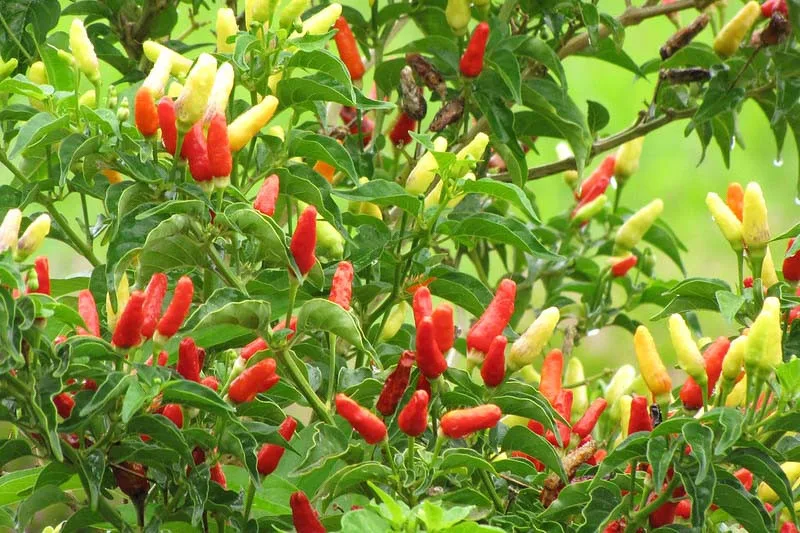
In gardening, two types of pepper are grown: sweet and hot. This crop is extremely demanding regarding light. With a lack of light, the plants shed flowers and fruit sets, their leaves turn yellow, and growth slows down significantly. Pepper is very heat-loving, so it is necessary to strictly observe the temperature regime in the greenhouse.
| Development stage | Temperature, °C |
|---|---|
| Seed germination | not lower than 13 |
| Emergence of seedlings | 22—25 |
| Day (sunny weather) | 20—30 |
| Night | 15—18 |
At frosts of –0.3 °C, pepper plants die. Overheating the air above 35 °C is no less dangerous: at such temperatures, flowers set poorly, and already formed fruit sets fall off.
The moisture regime of the soil and air directly affects yield. Excessive air humidity provokes outbreaks of fungal diseases and impairs the pollination of flowers, while air that is too dry leads to leaf drop. Pepper develops best in light sandy-loam soils with high organic content, but it is extremely sensitive to increased salt concentration.
Mineral fertilizers are applied to the crop in small doses. With a potassium deficiency, the leaves of the plants wilt, fruits ripen unevenly, and overall cold tolerance decreases. A sign of nitrogen deficiency is the death of lower leaves.
- Optimal soil moisture — 70–80%
- Optimal air humidity — 60%
- Water consumption for irrigation — 2.5–3 l/m²
- Consumption of cow manure solution — 5 l/m²
- Technical maturity period — 30–40 days after fruit set
- Sort the seed and soak them in a solution of microelements. After sprouting, sow them in boxes with a soil mixture of humus and soddy soil (or a mixture of peat and humus). For every 10 kg of the mixture, pre-add 40 g of superphosphate and 20 g of potassium salt. Sowing depth — in furrows with a spacing of 2 cm. Water and place the boxes near a radiator.
- When seedlings emerge, lower the temperature to 12–15 °C. For strengthened seedlings, maintain a daytime temperature of 20–22 °C in cloudy weather and 25–29 °C in sunny weather. If the transplants become leggy, add soil mixture up to the level of the cotyledonary leaves.
- After the formation of the first true leaf, prick out the seedlings into pots 5–7 cm in diameter and provide shade. To harden off, the transplants are regularly ventilated or taken out to a balcony.
- Apply the first top dressing 15 days after pricking out: dissolve 10 g of ammonium nitrate, 15 g of potassium chloride, and 25 g of superphosphate in 10 liters of water. Repeat subsequent top dressings every 10 days. Carry out all irrigation and top dressing of seedlings strictly in the morning hours.
Do not plant pepper in fresh manure. This will trigger rapid vegetative growth and delay the ripening of fruits. As organic matter, use only well-rotted manure or humus.
Before planting transplants, the soil is dug over and the following is applied per 1 m²: 8–10 kg of humus, 30–60 g of superphosphate, 30–40 g of potassium chloride, and 10–20 g of ammonium nitrate. The prepared planting holes are watered abundantly. Transplants are planted according to a 40x30 cm pattern; a denser spacing of 30x20 cm is permissible.
Before the start of fruiting, the peppers are watered with warm water every 6–7 days; after fruit set appears, the irrigation frequency is increased to once every 3–4 days.
The root system of pepper lies close to the soil surface. When loosening the inter-row spaces, be extremely careful not to damage the roots.
The plantings are treated with top dressing every two weeks with a mullein solution (1:10) with the addition of 20–30 g of superphosphate per 10 l of liquid. This application must be alternated with the application of wood ash at a rate of 150 g per 1 m², followed by mandatory irrigation.
Sweet pepper is harvested once a week as it reaches technical maturity. Fruits of hot cultivars are harvested only after the seed is fully ripened.
Read next
Greenhouses and covers For gardeners
Prevention and treatment methods for major tomato diseases
Greenhouses and covers For gardeners
Technology of growing pepper transplants for greenhouse and open soil
Nutrition and fertilizers For gardeners