
Growing high-quality cabbage seedlings in greenhouse conditions
7 min read
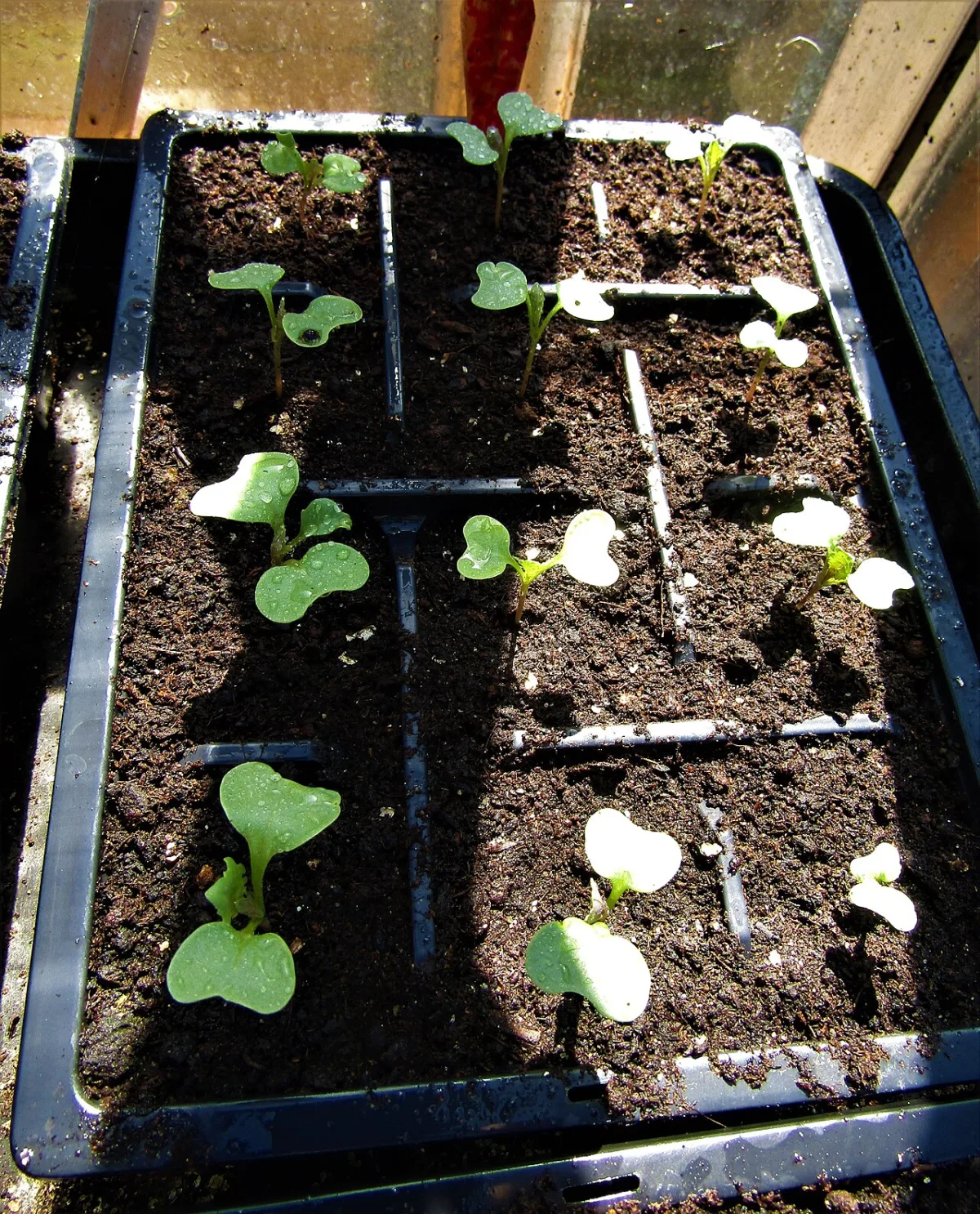
Intensive use of greenhouses allows for growing cabbage seedlings, beet and flowers even before planting heat-loving crops — tomatoes, peppers, and eggplants. Cabbage is very demanding regarding light; it requires humid air and cool temperatures.
| Parameter | Optimal value |
|---|---|
| Air humidity | 60–70 % |
| Temperature | 16–18 degrees |
Growing cabbage in an apartment makes no sense: it is too hot, dark, and dry there (humidity only 45–50 %). Early sowing in open ground in March will also not yield results, as seedlings will not withstand frosts below 4 degrees. Cauliflower and broccoli are especially sensitive to cold. In the conditions of the North-West, the optimal solution is sowing in a greenhouse at the end of April.
- Air humidity for seedlings — 60–70 %
- Cabbage growing temperature — 16–18 degrees
- Seed sowing depth — up to 1.5 cm
- Soil acidity for cabbage — 6–6.5 pH
- Frost for cabbage seedlings — no lower than 4 degrees
Preparing planting spots and sowing cabbage
Cabbage does not tolerate overcrowding well, so it is better to grow seedlings in individual cells. To do this, prepare a seedbed in the greenhouse in the spring according to the following scheme:
- Dig the crates from seedling containers without trays or individual bottomless cups into the soil to their full depth.
- Fill the cells with greenhouse soil.
- Generously water each cell with a solution of calcium nitrate.
- Make indentations in the soil of no more than 1.5 cm (use a pen with a mark, as deep sowing will prevent seed emergence).
- Place one seed into each hole and press the soil with your finger.
- Cover the sowings with a narrow strip of polyethylene film.
On the acidic soils of the North-West, cabbage is severely affected by clubroot. To prevent the disease, seedlings are watered exclusively with a calcium nitrate solution at a rate of 1 tablespoon per 10 l of water. Before emergence, sowings are not watered. Seeds germinate quickly, in 4–5 days. After emergence, the film is removed, and seedlings are covered with one layer of lutrasil.
Transplanting seedlings to open ground and growing beet
In the phase of 2 true leaves, cabbage seedlings are moved to open ground. During planting, 1 tablespoon of calcium nitrate is added to each hole, at least 1 l of water is poured, and the soil around the stem is slightly firmed. Plants are set deep up to the level of the true leaves, completely burying the cotyledonary leaves. If transplanting is delayed until the 3–4 leaf phase, the lower leaves are removed, leaving only the top two, and the stem is buried up to them.
Curvature of the stem in overgrown seedlings is not critical — it is buried in the soil entirely, without trying to straighten it. After planting, the bed is dusted with wood ash: the plant will receive nitrogen from the nitrate, and the ash will provide potassium and calcium. For normal head formation, cabbage needs good lighting throughout the day.
Before planting, carefully inspect the roots of the cabbage seedlings. If you detect swellings, it is clubroot. Such plants must not be planted.
Under no circumstances should you pull off healthy wrapper leaves of the cabbage. The plant draws nutrients from them to form the head. When the supply is exhausted, the leaves will turn yellow and fall off on their own.
Cabbage grows well only in limed soils. It requires fertile, loose, as well as air- and moisture-permeable soil. The optimal acidity parameters for the crop's development are provided below:
| Soil indicator | Optimal value |
|---|---|
| Acidity (pH) | 6–6,5 |
When growing on hydrogel and immediate mulching with green organic matter, cabbage irrigation can be reduced to once every 2 weeks. It is important to meet the following conditions:
- plant directly onto the hydrogel;
- mulch the bed with green organic matter immediately after planting;
- regularly add fresh mulch during weeding.
Additionally, plants are periodically watered at the root with a solution of calcium nitrate (1–3 tablespoons per 10 l of water) or lime or dolomite (1 cup per 10 l of water), at 1 l per plant. During the head formation phase, cauliflower absolutely requires the micronutrient molybdenum.
Beet in the North-West region is also grown via seedlings. Sowing in the greenhouse is carried out in mid-May. Seedlings appear after 4 days, usually several plants from one fruit cluster. In 2–3 weeks, when the beet has developed 2–3 true leaves, the seedlings are transplanted to open ground.
Beet seedlings at a young age absolutely do not tolerate cold snaps down to 4–5 degrees Celsius. At lowered positive temperatures, the plants will subsequently fail to form a root crop.
Overcrowding cabbage sowings leads to the rapid spread of root rot and damping-off. With these diseases, the root collar turns black and withers, which inevitably causes the death of young plants. To avoid losing seedlings, sowings must be thinned out in a timely manner.
If the seedlings have emerged too densely, they should be thinned or pricked out at the stage of up to 2–3 true leaves. Alternatively, if there is not enough time for a full pricking out, the transplants can be hilled up. High hilling protects the root collar from rotting and requires minimal time.
Pathogens of blackleg and root rot are activated by excessive soil moisture combined with high plant density.
Preparing transplants for planting and protection against pests
Planting annual flower transplants into open soil begins after the threat of spring frosts has passed. Before this, plants must undergo a comprehensive protective treatment. Preventive measures help to prevent the loss of transplants due to diseases and pests in the new location.
- Water the soil with a mixture of "Fitosporin" and "Gumi" preparations to destroy disease pathogens, especially blackleg in annual asters.
- Spray the plants with the insecticide "Fitoverm" or carbophos for protection against flea beetles.
- Add anti-stress preparations "Ecoberin" or "Epin-extra" to the working solution to accelerate transplant establishment.
The lower leaves of planted transplants often become targets for slugs and snails. Without timely protection, pests can completely destroy young plantings. To combat mollusks, both specialized chemical preparations and traditional remedies are used.
| Protection method | Application technology |
|---|---|
| Metaldehyde | Place 3 granules in a triangle around the stem at a small distance. Slugs die upon contact with the preparation. |
| 9% vinegar solution | Water the plantings in the evening with a working solution (1 cup of vinegar per 5 l of water). |
Read next
Greenhouses and covers For gardeners
Agrotechnology for cultivating broccoli and Chinese cabbage in greenhouses and open soil
Greenhouses and covers For gardeners
Technologies for growing cucumbers via transplants and direct sowing
Greenhouses and covers For gardeners