
Propagation technologies for ornamental plants using stem and leaf cuttings
9 min read
Cuttings allow for the rapid production of a large volume of high-quality nursery plants, which fully retain the cultivar characteristics of the parent plant. The success of rooting depends on the age of the mother plant, the degree of shoot lignification, and adherence to cutting techniques. Stem, leaf, or root cuttings are used for the work, depending on the biological characteristics of the crop.
Preparation of Material and Types of Cuttings
Only young and healthy mother plants are suitable for harvesting cuttings. The use of old plantings significantly reduces the survival rate. Shoots of herbaceous crops are cut from plants under 3–5 years old, and woody species up to 10 years old.
| Type of cutting / material | Mother plant age, years | Cutting length, cm |
|---|---|---|
| Herbaceous and green shoots | Up to 3–5 | 7–10 |
| Semi-lignified shoots | Up to 10 | 10–15 |
| Sections of old stem without leaves | Up to 10 | About 5 |
Herbaceous cuttings are used for propagating most ornamental crops. The method is suitable both for conditionally annual plants (petunia, ageratum, antirrhinum) and for perennials (phlox, carnation, chrysanthemum). This method is also used to propagate evergreen indoor species such as Kalanchoe, Tradescantia, and Peperomia.
Green cuttings are harvested in the spring or early summer during active shoot growth. Harvesting is also carried out from June to mid-July, when the wood begins to harden but the color of the bark has not yet changed. Leaves must be removed from the lower half of such shoots to reduce the transpiration surface.
Semi-lignified cuttings are taken from the current year's growth, where the lower part has already hardened but the tip is still growing. This type of material is used for the propagation of ornamental shrubs and vines, including Aucuba, Codiaeum, Monstera, Tetrastigma, and Philodendron. Leaves from the lower half of the shoots are also removed before planting.
To conserve material, leaf-bud cuttings with a single leaf, a bud, and a short piece of stem are used, harvesting them at the end of summer from semi-lignified ivy shoots. Evergreen plants (Dracaena, Dieffenbachia, Aglaonema) can be propagated using leafless sections of an old stem with 1–2 nodes. For carnations and stonecrop (Sedum), stem tips — so-called closed-type cuttings — root well.
For some crops, such as carnations, it is better to snap off the cuttings rather than cut them. This significantly speeds up work in the greenhouse and prevents the transfer of viral and bacterial infections via sap on cutting tools.
Cutting Technology and Preparation for Planting
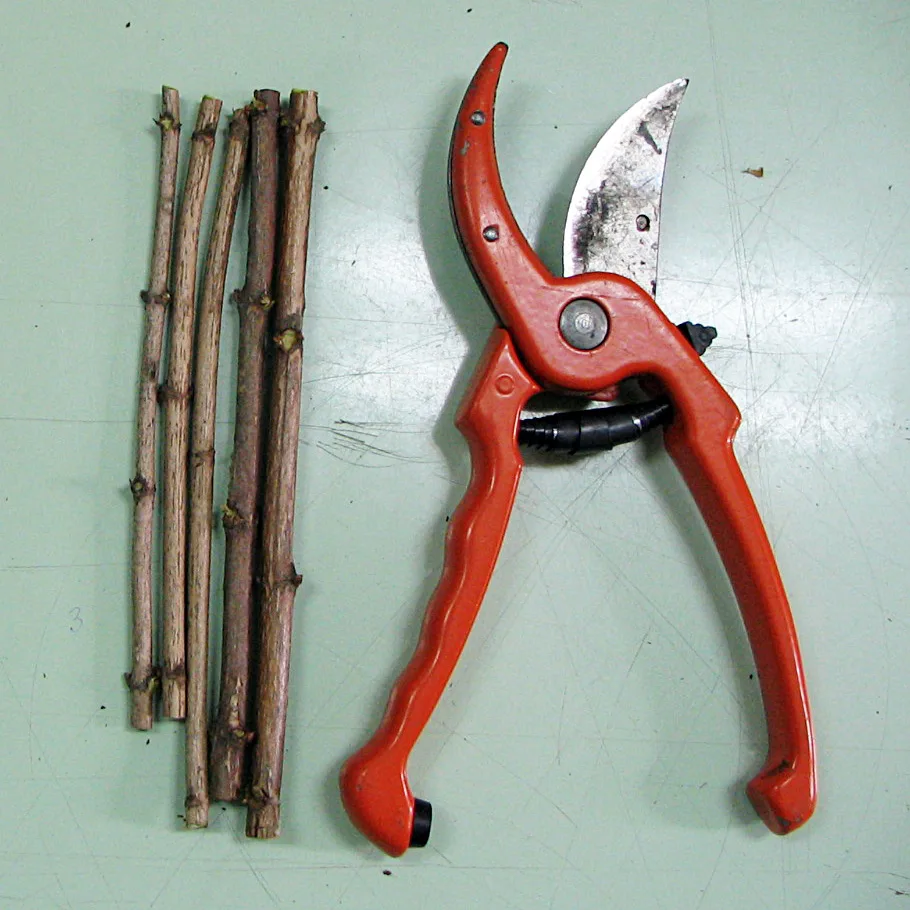
Cuts are made in one motion with a very sharp tool — a razor blade, knife, or pruner. A smooth cut surface protects tissues from rotting and facilitates rapid healing. Plants with a fleshy rhizome (iris, daylily), thick root (lupine, oriental poppy), or fibrous root system (peony) are taken as cuttings with a "heel". Such a thickening at the base of the cutting has maximum capacity for root formation.
- Make the upper cut perpendicular to the shoot axis 6–10 mm above a node or bud.
- Make the lower cut at an angle of 50–70° to the cutting axis at a distance of 3–4 mm from the node (for immature shoots) or in the middle of the internode (for lignified ones).
- Shorten leaf blades by 1/3 or 1/2 for moisture-loving species with large or highly transpiring leaves (rose, peony, hydrangea, garden phlox). Propagate drought-tolerant and small-leaved crops (myrtle, stonecrop, arabis, wall rock-cress) without leaf trimming.
- Conduct special processing of cuts for species with milky sap or succulents before planting in the substrate.
- Lower cut angle — 50–70°
- Upper cut above the bud — 6–10 mm
- Lower cut from the node — 3–4 mm
- Water temperature for washing off milky sap — 40–45 °C
Cuttings with milky sap (Codiaeum, poinsettia, Ficus) should be dipped in warm water (40–45 °C) immediately after cutting until sap flow stops, otherwise it will clog the vessels. Succulents (cacti, stonecrop, Echeveria) and pelargonium must be air-dried before planting to protect against rot.
The timing for taking cuttings is selected individually for each species and cultivar of ornamental plants. The harvest period depends on the type of cutting, the region's climatic conditions, and the development phase of the mother plant. Open-ground crops are propagated primarily in the spring-summer period.
Timing and Methods of Propagation by Leaf and Root Shoots
Under protected ground conditions, the propagation period for plants increases and depends on the biological characteristics of the specific crop:
- Mass propagation — from early spring to mid-summer
- Easy-to-root crops — year-round
- Evergreen woody plants — second half of summer
Leaf cuttings are used to propagate plants capable of forming adventitious or dormant buds on the leaf blade or at the expanded base of the petiole. The method is suitable for open-ground perennials (New York aster, monkshood, oxeye daisy, goldenrod, alpine fleabane, garden phlox, some species of lilies) and indoor evergreen plants (begonia, gloxinia, sansevieria, African violet).
Whole leaves with a petiole or parts thereof are used for the work. The cutting method is chosen based on the specific crop:
- Leaf-petiole cuttings. Young leaves that have recently finished growing are taken (begonia, peperomia, saintpaulia), leaving a petiole about 5 cm long.
- Vein incision. For royal begonia, large veins are incised on the underside of the leaf at the points where they diverge. The leaf is laid on moist sand and pressed down with wooden pins or lightly covered. New plants develop at the incision sites. A begonia leaf can also be cut into pieces so that each has a large vein and a bit of the petiole base.
- Leaf segments with a midrib. For gesneria, gloxinia, or streptocarpus, a fully formed leaf is cut into transverse strips up to 5 cm wide so that each part contains a fragment of the midrib and two lateral wings. They are planted vertically with a spacing of 2–3 cm.
- Leaf segments with longitudinal veins. Sansevieria leaves are cut into pieces 6–8 cm long. When planting, they are buried in the substrate to 1/3 of their length. New shoots form after several months.
The physiological state of the mother plant directly affects the result. Leaf cuttings of evergreen crops taken during the active growth phase produce vegetative buds. However, if leaves are cut from plants in the budding or flowering phase, they will only form flower buds (for example, in achimenes).
Root cuttings are used to propagate maranta, dracaena, and garden perennials: Japanese anemone, bleeding heart (Dicentra spectabilis), oriental poppy, lupine, and common peony. Roots are harvested in August–September by carefully uncovering or completely digging up the mother plant.
| Harvest parameter | Size |
|---|---|
| Root thickness | 0.3–2 cm |
| Cutting length | 5–7 cm |
Substrates, stimulants, and planting technology
Rooting is carried out in trays on greenhouse benches or in hotbeds. It is optimal to use bottom heating of the substrate and fogging systems. In the absence of artificial fog, plantings are covered with translucent film to maintain air humidity. For garden perennials, hotbeds or shaded raised beds 10–12 cm high are suitable.
The substrate must be loose, moisture-retentive, and have an optimal pH for the specific crop. The work involves using clean river sand (washed 2–3 times), mixtures of sand with peat or leaf soil, ionite substrates, as well as artificial components (perlite, expanded clay, vermiculite) and mixtures based on them.
The surface of the substrate is leveled and compacted; in hotbeds, it is mandatory to add a top layer of sand or perlite 3–5 cm thick and water it abundantly. Difficult-to-root crops are treated before planting with growth stimulants — heteroauxin or indole-3-butyric acid.
Observe the standard planting density — 900 cuttings per 1 m². Shallow planting improves air access to the lower part of the cutting, while an inclined position during planting facilitates shading and helps maintain uniform moisture.
When planting, follow this sequence of operations:
- Make a depression in the substrate with a wooden peg so as not to damage the surface tissues of the cutting.
- Place the cutting into the hole at the required depth, depending on its type.
- Firm the substrate around the cutting with your hands for stable fixation in the soil.
- Water the plantings abundantly. When working with root cuttings, lay them horizontally on a leveled surface, cover with sand (0.5 cm), then a layer of soil (2 cm), compact, and water.
| Cutting type | Planting depth |
|---|---|
| Stem and leaf (herbaceous) | 0.5–2 cm (the leaf blade is left above the surface) |
| Green and semi-lignified (woody) | 5 cm |
Care technology for cuttings after planting
After planting the cuttings, the main task of the agronomist is to create conditions for rapid callus and root formation. The main factors for success at this stage are strictly regulated humidity, correct temperature regime, and diffused lighting. Any deviation from technological parameters leads to rotting or drying out of the fragile planting material.
- Air humidity — 90% or more
- Temperature for most crops — 18–22 °C
- Temperature for thermophilic plants — 30 °C
- Bottom substrate heating — 3–5 °C higher than air temperature
- Rooting period for stem and leaf cuttings — 20–60 days
- Thickness of winter cover in hotbeds — 30 cm
To maintain optimal humidity in the greenhouse, automatic fogging systems with water-spraying nozzles are used. If professional equipment is unavailable, the cuttings must be sprayed manually 2 to 5 times a day, depending on the weather. Pay special attention to light: although it is necessary for photosynthesis and the production of natural growth stimulants in the leaves, excess sun is fatal.
Direct sunlight can completely destroy the cuttings. Ensure access only to diffused light: shade the plantings with cheesecloth, burlap, paper, or whitewash the hotbed frames.
Temperature regime directly affects the rate of cell division. For hard-to-root crops, bottom heating of the substrate is mandatory. The difference between air and soil temperatures stimulates the flow of nutrients to the base of the cutting, where the root system is formed. This accelerates the emergence of adventitious roots and increases the survival rate of the planting material.
The transition from the rooting phase to independent growth requires gradual adaptation of the plants. As soon as the cuttings develop their first roots, the care technology is smoothly adjusted in preparation for planting.
- Stop spraying and reduce the frequency of irrigation immediately after root formation begins.
- Increase ventilation in the greenhouse or hotbed.
- Gradually increase the light level for the plants.
- Start opening the cover, and then remove it completely.
- Transfer the rooted plants from the boxes to a hotbed for final hardening.
The rooting period for stem and leaf cuttings takes from 20 to 60 days, while root cuttings take longer to establish — sometimes until spring. In November, rooted plants in hotbeds must be prepared for winter. They are covered with a 30 cm layer of dry leaves, which is removed completely only in the spring.
Read next
Floriculture For students
Technology of vegetative propagation of ornamental plants by layering and grafting
Viticulture For agronomists
Effective technologies for the rapid propagation of rare grape cultivars
Plant protection For agronomists