
Anatomy and physiology of the digestive organs of the honey bee
9 min read
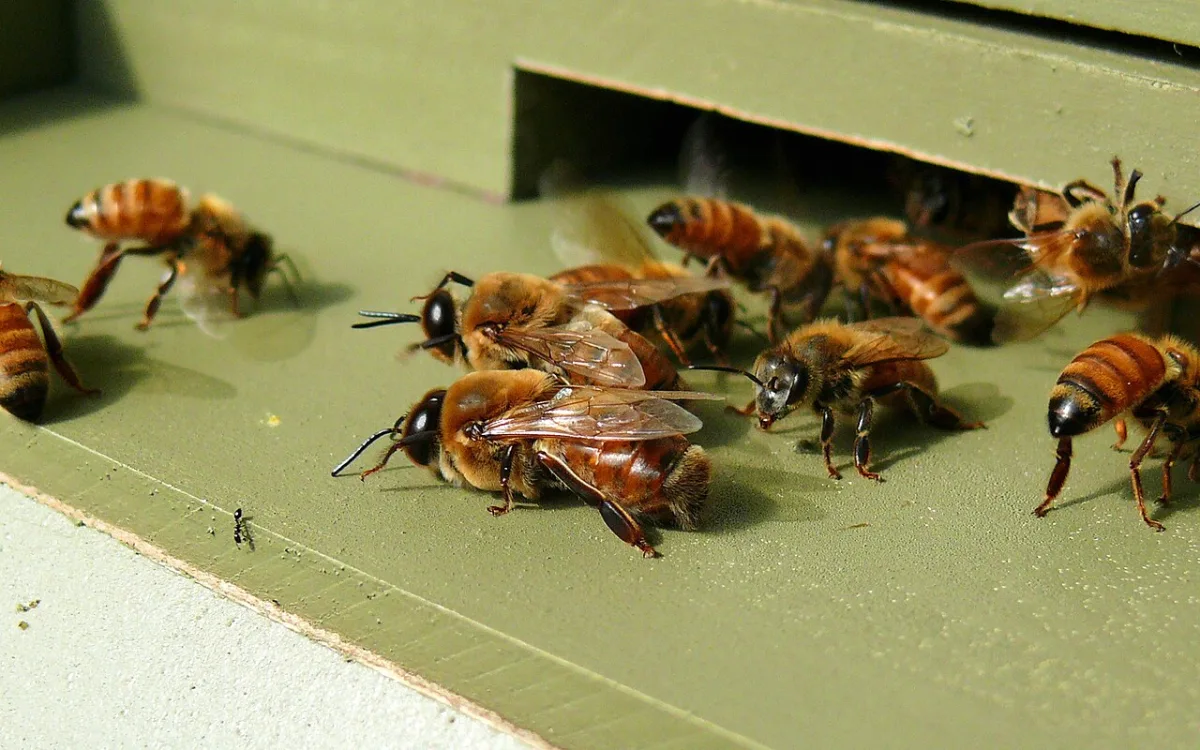
The internal organs of a bee, queen, and drone consist of digestive organs, the circulatory system, respiration, and reproductive organs.
The digestive organs (see appendix, Fig. 10) are a collection of organs that ensure the processing of food necessary for the vital functions of the bee's organism. The digestive tract begins at the mouth and ends at the anus. The intestine is divided into three sections: foregut, midgut, and hindgut. The foregut includes the mouth, pharynx, esophagus, honey stomach (crop), and proventriculus, which form the foregut. The mid-section includes the midgut, and the hind section includes the small and large intestines, which form the hindgut. Food enters through the proboscis into the mouth, and then into the pharynx – the expanded part of the foregut. The pharynx narrows into a thinner tube – the esophagus. By contraction of the peripharyngeal muscles, food is pushed into the esophagus. The muscles of the esophageal walls push the food into the honey stomach, where the digestive process begins. The honey stomach reaches its greatest development in worker bees and is relatively less developed in queens and drones. In addition, the honey stomach serves for the temporary storage of nectar; in it, a worker bee can carry nectar, water, or honey over significant distances (the volume of an empty honey stomach does not exceed 14 mm³, and one filled with nectar – 55-60 mm³). Next, food enters the proventriculus, which connects the honey stomach to the midgut, where the process of digestion and absorption of nutrients occurs. This is the longest part of the digestive tract (in a worker bee its length is 10 mm, in a queen 13 mm, in a drone 19 mm); the midgut has thick walls forming numerous (50-90) folds.
The hindgut consists of the small, large, or rectum. The small intestine, in the form of a thin tube, bends into a loop and connects the midgut to the large intestine. Undigested food remains, passing through the hindgut, are expelled outward. Six rectal glands, located uniformly along the perimeter of the intestine, secrete the enzyme catalase, which prevents the harmful effect of fecal substances during prolonged retention in the intestine. The rectum has a large capacity of up to 70 mg. This allows bees not to defecate inside the nest and not to contaminate the feed. On the other hand, the overfilling of the rectum, especially in the winter period, leads to the wear and tear of bees, and sometimes the death of honey bee colonies. Therefore, high-quality honey is necessary for a successful wintering.
The hindgut consists of the small, large, or rectum. The small intestine, in the form of a thin tube, bends into a loop and connects the midgut to the large intestine. Undigested food remains, passing through the hindgut, are expelled outward. Six rectal glands, located uniformly along the perimeter of the intestine, secrete the enzyme catalase, which prevents the harmful effect of fecal substances during prolonged retention in the intestine. The rectum has a large capacity of up to 70 mg. This allows bees not to defecate inside the nest and not to contaminate the feed. On the other hand, the overfilling of the rectum, especially in the winter period, leads to the wear and tear of bees, and sometimes the death of honey bee colonies. Therefore, high-quality honey is necessary for a successful wintering.
Excretory organs. At the junction of the midgut and the small intestine, there is a cluster consisting of many thin and long tubes. These are Malpighian tubules. The anterior end of each tube is closed, and the posterior end opens into the lumen of the small intestine. The tubes are closely intertwined with each other and surround the internal organs of the abdominal cavity. The walls of the tubes are bathed in hemolymph (blood), which removes uric acid, its salts, and other metabolic products from the organism. These substances are released into the lumen of the tubules and are excreted from the organism through the hindgut. Thus, Malpighian tubules in insects perform the role of kidneys in vertebrate animals. Urate cells also possess excretory functions.
The respiratory system (see appendix, Fig. 11) is the organs that ensure respiration (gas exchange between the bee's organism and the surrounding environment). It consists of tracheal trunks, branches, and air sacs. It opens to the outside via spiracles, or stigmata (openings through which the intake of air into the tracheae, the exit of used air, and the partial release of water by the organism are regulated). On the thorax of a worker bee and queen, there are three pairs of spiracles, on the abdomen six pairs, and on the abdomen of a drone seven. Each spiracle has an internal closing apparatus equipped with two muscles (one of them is a closer, the other an opener), and an air filtration system, which consists of many branched setae forming a filtering sieve.
Bees have two types of respiration: external, carried out through mechanical ventilation of air, and internal (diffuse). Ventilation of air through the respiratory system is performed by tracheae and air sacs – through special respiratory movements (contraction and expansion of the abdomen and telescopic sliding of its segments over one another). The transport of oxygen and carbon dioxide through the tracheal system is carried out due to gas diffusion, which arises as a result of the difference in partial gas pressures in the atmosphere and the terminal branches of the tracheae.
Air enters the tracheoles from the tracheae, from where oxygen enters the tissue cells via diffusion, where oxidative processes occur, accompanied by the release of carbon dioxide.
The intensity of gas exchange in a honey bee directly depends on air temperature and physical exertion. During cooling in a state of rest, an individual consumes a minimum of energy, but during flight or active work inside the hive, its need for oxygen increases hundreds of times. This compels the beekeeper to carefully monitor the quality of ventilation in the hives, especially during periods of the main nectar flow, comb building, and active brood rearing.
Respiration and circulation: hive ventilation and energy exchange
Effective hive ventilation directly determines the productivity of the entire bee colony. When carbon dioxide accumulates in an unventilated nest, the activity of the insects decreases sharply, and work processes slow down. To maintain a normal pace of colony work, the hive must be designed for a constant influx of fresh air.
The intensity of a bee's respiration fluctuates depending on its activity and air temperature. An increase in ambient temperature by just 10 °C activates metabolism and increases oxygen consumption by 2–3 times. In flight or during active movement, the insect's energy needs increase many times over.
- O₂ consumption at rest at 11 °C — 0.4 cm³/h
- O₂ consumption at rest at 18 °C — 0.9 cm³/h
- O₂ consumption during movement at 11 °C — 65 cm³/h
- O₂ consumption during flight — 440 cm³/h
Overheating and stuffiness in the hive overload the bees' respiratory system. Ensure sufficient supply ventilation to prevent a drop in colony productivity due to an excess of carbon dioxide.
The delivery of oxygen and nutrients to the organs is provided by the bee's open circulatory system. Hemolymph flows freely into the body cavity, bathing the internal tissues, and circulates through vessels only in a separate section of the path. The movement of the fluid is supported by the ventral and dorsal diaphragms, as well as by the pulsation of the five-chambered tubular heart located under the abdominal tergites. When it relaxes, hemolymph is sucked in through the lateral openings (ostia), and upon contraction, it is pushed forward into the aorta, which opens directly into the head cavity.
Hemolymph accounts for about 10% of the insect's body mass and acts as the main nutrient reservoir. It contains up to 8% proteins, amino acids, fats, sugars, and mineral salts. Due to the lack of fibrinogen, this fluid is not capable of clotting, and upon contact with air, it quickly darkens. In young worker bees, hemolymph is completely transparent, but with age, it acquires a characteristic yellow tint.
Reproduction and coordination: colony reproduction and reflexes
The queen's reproductive system is adapted for continuous egg-laying to rapidly increase colony strength. Her ovaries, located under the 2nd–5th tergites, consist of ovarioles that flow into paired oviducts, which then connect into an unpaired duct and a muscular vagina. The queen reaches sexual maturity 7–10 days after emerging from the queen cell. During the mating flight, she attracts males using an ectohormone — trans-9-oxo-2-decenoic acid, secreted by her mandibular glands.
The drone's anatomy ensures the maturation of millions of spermatozoa by the 12th–14th day of his life. To do this, the male reproductive system has a complex internal structure. It includes the following key elements:
- two testes containing up to 200 seminal tubules;
- vasa deferentia, which transition into seminal vesicles;
- two accessory glands that produce secretion to preserve the viability of the spermatozoa;
- an ejaculatory duct with a bulb and cornua.
During mating, the queen receives sperm from 5–7 drones, after which the males die immediately due to damage to their chitinous cover. Semen material enters the queen's spherical spermatheca, which is about 1.5 mm in diameter, where a special gland keeps the spermatozoa alive. The queen uses the received supply for the rest of her life, laying up to 1500–2000 eggs per day.
In worker bees, the reproductive organs remain underdeveloped. In the event of a prolonged absence of a queen in the colony, they can become laying workers and lay unfertilized eggs. From such brood, exclusively small and deformed drones develop, incapable of proper mating.
Timely replacement of old or defective queens is critically important for an apiary. Without a queen, worker bees turn into laying workers, which leads to rapid degeneration and the death of the entire bee colony.
| Reproductive parameter of the individual | Indicator |
|---|---|
| Number of ovarioles in the queen's ovary | up to 250 |
| Daily egg-laying capacity of the queen | 1500–2000 eggs |
| Number of ovarioles in a worker bee | 6–22 |
| Number of spermatozoa produced by one drone | exceeds 10 million |
The complex behavioral responses of the bee are coordinated by a developed nervous system divided into three sections. The central system consists of the supraesophageal ganglion, which functions as the brain, the subesophageal ganglion, and the ventral nerve cord. The subesophageal ganglion gives rise to a nerve chain consisting of two thoracic and five abdominal ganglia. The peripheral system consists of nerves extending to the sensory organs, while the vegetative (sympathetic) system regulates the functioning of internal organs.
Bee behavior is entirely based on reflexes: innate (unconditional) and acquired during life (conditional). The latter are developed on the basis of the former and allow bees to adapt to changing nectar flow conditions. Conditional reflexes are formed very quickly, but fade just as quickly in the absence of reinforcement.
Read next
Beekeeping For students
Composition of a bee colony and biological characteristics of individual development
Beekeeping For students
Biology of honey bees and technology of honeycomb construction in the hive
Beekeeping For students