
Physiological and biochemical processes and effective storage regimes for grain mass
7 min read
Freshly harvested grain has an increased content of low-molecular-weight substances, high enzyme activity, and a high rate of respiration, and it has low germination.
During storage, there is a gradual decrease in enzyme activity and the rate of respiration, synthesis of high-molecular-weight substances from low-molecular-weight ones, and an increase in germination and germination energy. This process is called post-harvest ripening and takes one and a half to two months.
To accelerate post-harvest ripening, it is recommended to:
- dry the grain at a drying agent temperature of 45°C;
- subject it to active ventilation with dry air.
Upon reaching full physiological maturity, the respiration rate decreases and germination increases to its maximum value; such grain stores well. Before being put into storage, the grain must be cleaned and disinfected to create conditions for post-harvest ripening (thermal drying, active ventilation with dry air, etc.).
The dry grain storage regime is based on the principle of product storage called xeroanabiosis. It is not necessary to remove all moisture from the product. Since only free water is available to microorganisms, microorganisms stop reproducing and gradually die off.
The chilled storage regime is based on the principle of product storage called psychroanabiosis. The product remains chilled if its temperature is below 10°C, but not lower than 0°C (i.e., freezing is excluded).
At a temperature of 10°C, the respiration rate of the grain mass decreases, and many insects become sluggish and stop reproducing. Further cooling leads to the fact that all insects and mites stop reproduction and die after some time. Death occurs faster the lower the temperature. This regime yields good results for maintaining grain quality during short-term storage. For long-term storage, grain should be dried.
The grain storage regime without air access is based on the principle of product storage called anoxyanabiosis. In a hermetic storage facility, oxygen is consumed due to the respiration of the grain mass, and carbon dioxide accumulates. As a result, pests of stored grain and aerobic microflora are destroyed.
Anaerobic storage conditions can be created by introducing inert gases (carbon dioxide, nitrogen) into the grain mass. This storage method has not become widespread, as it is difficult to create hermetic conditions in modern storage facilities. Furthermore, hermetic storage leads to a complete loss of grain germination.
Grain warehouses (grain elevators) are structures with a horizontal or sloped floor intended for storing bulk grain, which is placed directly on the floor and against the walls.
- Strength and durability, preventing dangerous deformations from the pressure of the grain mass, snow, and wind.
- Sufficient capacity for accommodating all grain with consideration.
- Reliable protection of grain from soil moisture and the destructive action of brick (stone) walls and reinforced concrete walls.
- For active ventilation.
- For active ventilation.
Ensuring the safety, quantity, and quality of stored grain.
3. Low thermal conductivity and good hygroscopicity, ensuring the minimum possible temperature fluctuations and preventing moisture condensation on building structures.
Possible sealing at minimal costs for conducting
Exclusions for the development and vital activity of stored product pests
Good connection with access roads.
Convenience for operation during the period of monitoring the grain and during
Ensuring safe and standard sanitary and hygienic conditions
Minimum possible construction and operating costs.
Active ventilation is called the forced blowing of air through grain without moving it, which is possible due to the porosity of the grain mass.
Depending on the purpose, there are several types of active ventilation:
Modes of active grain ventilation
Initial preparation of freshly harvested damp grain heap begins with its cleaning from plant residues. Then the mass is treated with an airflow to lower the temperature and equalize humidity. Such a technique allows for increasing the safe storage life of grain by 3–4 times before it is sent for drying.
In floor storage practice, several modes of active ventilation are applied. Preventive ventilation prevents hotspots of self-heating, reduces the respiration rate of the grain, and suppresses microflora. This procedure is carried out periodically, mainly during nighttime hours, focusing on the parameters of the pile and the weather.
To completely stop physiological and microbiological processes, the grain is cooled, lowering its temperature from 10 to 0 °C. Under such conditions, pests of stored grain enter anabiosis and stop feeding. If self-heating has started in the pile, ventilation is started immediately, at any time of day and in any weather.
Ventilation of seed material helps accelerate post-harvest ripening and increases germination energy. In spring, the seed of spring crops is blown with warm air for heating. This treatment must be completed one week before the start of sowing.
- Increase in storage life before drying — by 3–4 times
- Cooling temperature range — from 10 to 0 °C
- Air flow rate for self-heating prevention — from 100–200 m³/(h·t)
- Length of the TVU-2 unit in operation — up to 10 m
When eliminating self-heating hotspots, a high specific air flow rate is required — from 100–200 m³/(h·t) or more. During the blowing process, it is essential to compare the condition of the cooled bulk with the atmospheric humidity to avoid accidental wetting of the grain.
Design features of ventilation systems
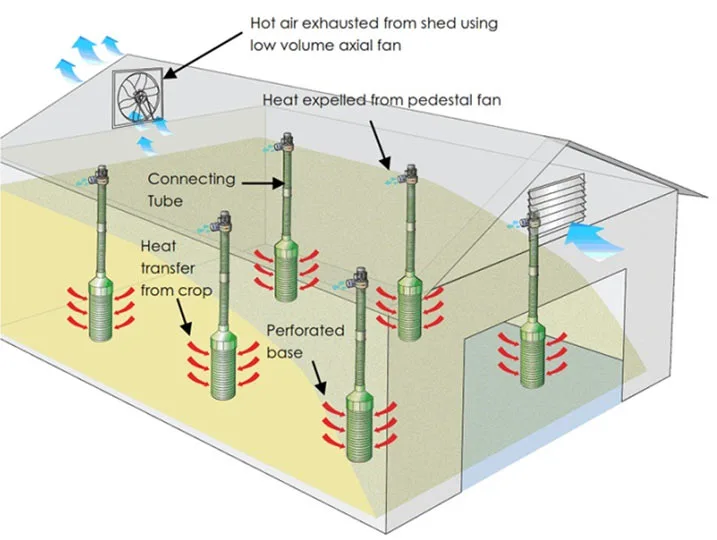
For grain ventilation, stationary, floor-portable, and portable pipe units are used. In stationary systems, air is supplied by an external fan through a nozzle into special underfloor channels of the warehouse. These channels are covered from above with wooden boards with slits on the sides, through which the air flow penetrates into the grain mass.
Farms use stationary units of the SVU and USVU series. SVU-1 and SVU-2 models differ in the layout scheme and the number of channels. In SVU-3, USVU-62, and USVU-63 systems, the air distribution network consists of large main channels and side channels extending from them, integrated into sections.
The TVU-2 telescopic unit is a sliding metal pipe consisting of five segments. The first segment, adjacent to the fan, is made with solid walls, while the remaining four segments are perforated. In its collapsed state, the structure's length is 2.5 m, and when extended in the bulk, it increases to 10 m.
| Unit model | Channel scheme | Dimensions and element parameters |
|---|---|---|
| SVU-1 | Transverse channels from wall to wall of the warehouse | Width: 40 cm (at the bottom), 90 cm (at the top). Depth: from 50 cm at the beginning to 7 cm at the end. |
| SVU-2 | Paired transverse channels (number increased by 2 times) | Each section runs across the warehouse to the middle of its width. |
| SVU-3 (USVU-62, USVU-63) | Main and side channels in the floor, integrated into sections | For a warehouse with a capacity of 3200 tons, 20 sections are used. 1 main channel (length 8 m, width 0.7 m) and 10 side channels (5 on each side, length 2.1–3.7 m, width 0.5 m). |
| TVU-2 | Five-segment telescopic metal air duct | Length when assembled — 2.5 m, in extended state — about 10 m. First segment is solid, the rest are perforated. |
Proper selection of the mode and timely ventilation allow not only to preserve the grain mass without losses but also to improve the quality of the final product — flour or groats, as well as to increase the grade of the batch.
Read next
Storage and processing For students
Fundamentals of proper storage and post-harvest processing of grain crops
Storage and processing For students
Organization of grain reception and batch formation at grain elevators
Storage and processing For students