
Morphological characteristics of the fruits and seeds of common lambsquarters
1 min read
Common lambsquarters is one of the most common weeds in plant production throughout Russia. It infests all field, vegetable, and melon crops, reducing yield and contaminating the harvested crop. To effectively adjust the cleaning of seed material, an agronomist must accurately identify the morphological characteristics of the fruits and seeds of this weed.
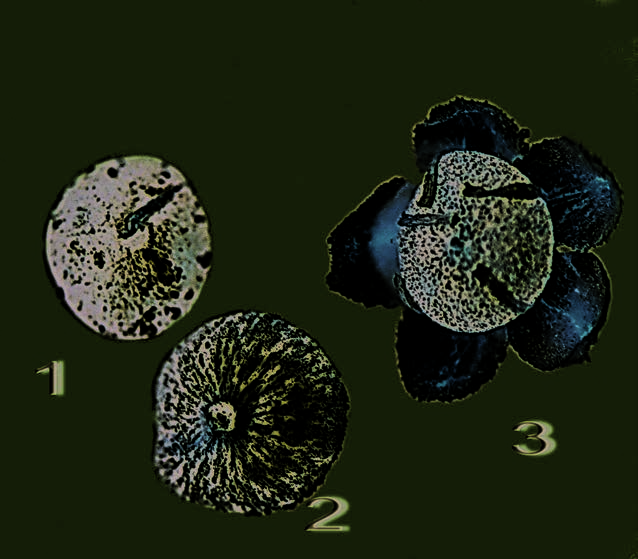
How to identify common lambsquarters fruits and seeds in a seed pile
Common lambsquarters fruits can be found in a cleaned seed pile in three states: within the perianth, without it, or as naked seeds. Within the perianth, the fruit is positioned horizontally, meaning it lies on its broad side. The perianth itself consists of five yellowish-brown leaflets that tightly enclose the fruit, forming a rounded-compressed shape with a matte, coarsely rough surface of a grayish-green color.
The thin pericarp of common lambsquarters is easily rubbed off during mechanical processing. Because of this, a single batch of seeds may simultaneously contain matte dark-gray fruits and naked shiny black seeds, which complicates the visual quality control of the material.
Without the perianth, the fruits appear rounded-compressed, slightly convex on the dorsal side and flatter near the fruit scar. Their pericarp is thin, membranous, and translucent, with characteristic radial folds radiating from the center. In the very center of the fruit, the fruit scar is clearly visible as a small wart with a rounded rim. The surface of such fruits is matte and finely tuberculate, and the color varies from dark gray to light reddish-gray.
Seeds released from the shell completely repeat the shape of the fruits but have a smooth, shiny surface with a faint reticulated pattern. Their color is intensely black or intensely dark cherry, and the seed scar is located at the base of the groove. The dimensions of all elements of this weed are stable, which allows for the adjustment of seed cleaning machines according to basic geometric parameters.
- Diameter of fruits in the perianth — up to 22.25 mm
- Diameter of nutlets and seeds — 1.5–1.75 mm
- Thickness of nutlets and seeds — 0.75 mm
Read next
Seeds and varieties For agronomists
Botanical description and distribution patterns of Salsola collina
Seeds and varieties For agronomists
Botanical characteristics of seeds and harmfulness of water pepper (Persicaria hydropiper)
Seeds and varieties For agronomists