
Botanical characteristics and identification methods for yellow hornpoppy seeds
1 min read
Yellow hornpoppy (Papaveraceae family — PAPAVERACEAE Juss.) infests crops of cereals and row crops. The weed is distributed in the European part (mainly in the southern regions, rarely in the central ones), in Crimea, the Caucasus, and Central Asia. For an agronomist, the appearance of this weed in fields is critical not only due to a decrease in yield but also because of its high toxicity.
All parts of the plant contain toxic substances. Contamination of commercial grain or feed with it is dangerous to the health of humans and livestock animals, as the yellow hornpoppy contains the following alkaloids:
- glaucine
- protopine
- sanguinarine
- chelerythrine
How to identify the weed by seeds
For timely cleaning of seed material, it is important to accurately identify the weed at early stages. The capsules of the yellow hornpoppy are bilocular, linear-pod-shaped, more or less curved, and covered with bristles. The seeds have a unilaterally oval, slightly compressed shape with a rounded-broad back and a straight or concave ventral side. The seed seam is narrow, linear, located on the side, and reaches half of the seed.
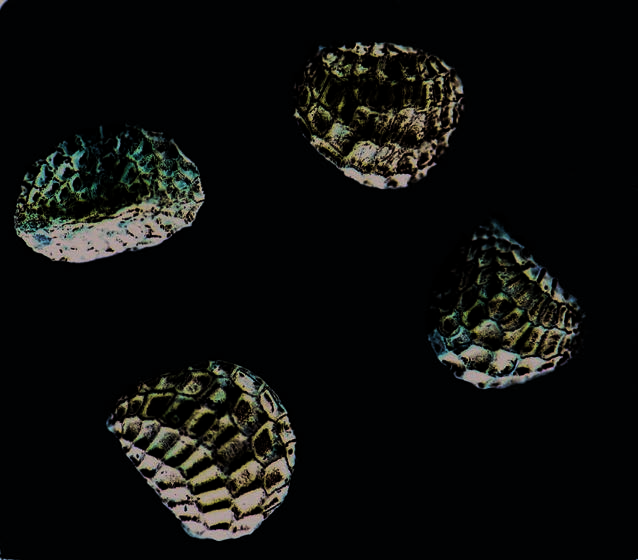
The surface of the seed is dark brown or black, with a lighter seed hilum. It has a large-celled structure with cells arranged radially in four rows, directed parallel to the outer edge, and on the back, the cells lie in regular rows. The inner surface of the cells is punctate-pitted and features a faint luster.
| Seed parameter | Size |
|---|---|
| Length | 11,5 mm |
| Width | 0,751 mm |
| Thickness | 0,5 mm |
Read next
Seeds and varieties For agronomists
Morphological characteristics of seeds and distribution area of Eruca sativa
Seeds and varieties For agronomists
Seed morphology and distribution range of Erysimum cheiranthoides
Seeds and varieties For agronomists