
Technological systems for keeping poultry in industrial poultry farming
11 min read
Cage rearing: increasing stocking density and automation
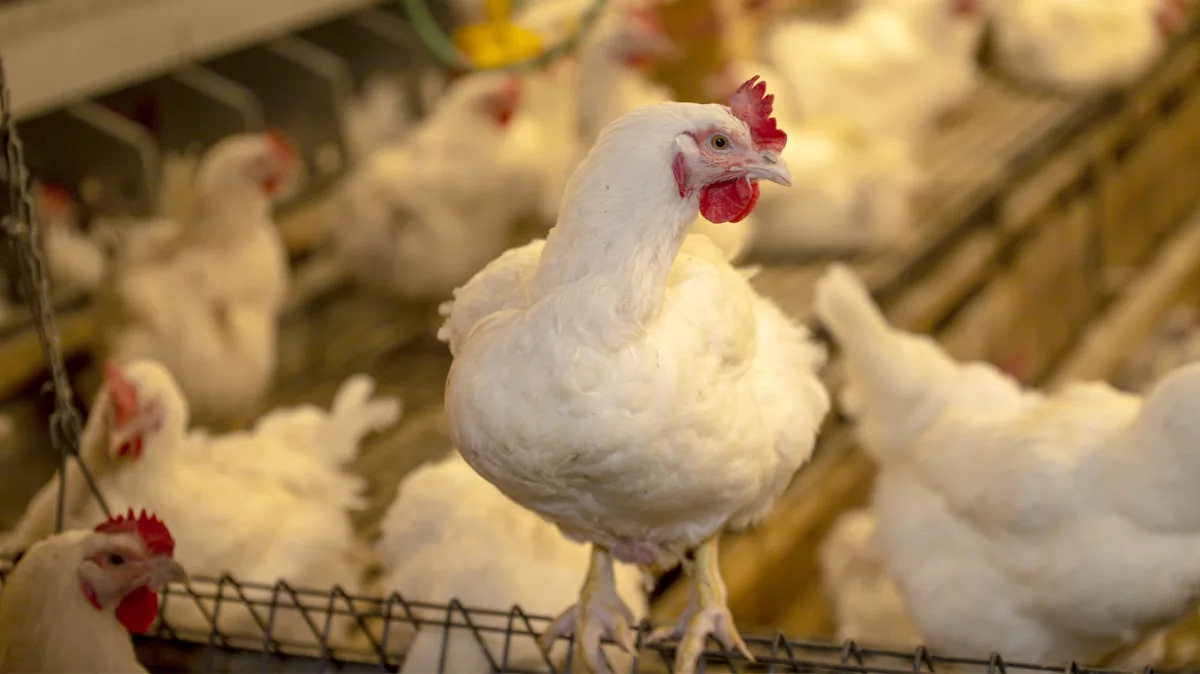
In industrial poultry farming, the choice of rearing system determines the economic performance of the facility. Cage batteries allow for the most efficient use of the poultry house area, increasing the stocking density of laying hens by 3–4 times compared to floor rearing. This makes it possible to eliminate the seasonality of egg production and regulate poultry molting through climate control and lighting management.
- Increase in cage stocking density — by 3–4 times
- Depth of deep litter at initial placement — 20–30 cm
- Height of slatted floor supports — 80–85 cm
- Maximum mesh size of wire floors — 3.5 × 3.5 cm
For housing chickens, batteries with 1 to 5 tiers are used. Depending on the type of bird placement, cage batteries are classified into the following types:
- individual housing;
- small-group housing (2–6 birds per cage);
- large-group housing (several dozen laying hens).
Most cage batteries come with integrated mechanisms for feed distribution, water supply, egg collection, and manure removal. For example, when installing single-tier OBN-1 batteries, all processes are fully mechanized, allowing a single operator to manage the entire poultry house. Such lines are suitable for buildings with standard configurations.
| Poultry house parameter | Permissible dimensions for OBN-1 |
|---|---|
| Building width | 6 m, 12 m, 18 m |
| Building length | up to 102 m |
In closed-type poultry houses for industrial laying hen flocks, multi-tier integrated-mechanized batteries are also used. These include three-tier double-sided KBN-3 batteries and four-tier KBN-4 batteries.
Floor systems: deep litter, slatted and wire floors
Various modifications of floor rearing remain a popular alternative to cages. The most common method for keeping laying hens and young stock is on deep litter. It is laid out once before the birds are introduced at a depth of 20–30 cm and is subsequently replenished periodically. Due to natural biothermal processes, the litter generates heat, helping to maintain the temperature in the poultry house.
Chopped straw, wood shavings, sawdust, or fibrous peat are used as litter material. In large-scale poultry houses, the litter is removed once a year after the flock vacates the facility. To completely eliminate contact between hens and manure, farms are switching to slatted or wire floors.
Slatted floors are assembled from wooden slats 1.5–2 cm thick and 4–5 cm wide, laid with a gap of 2.5–3 cm. The slats are attached to removable frames 2.2–3 m long and 1–2 m wide, which are installed on supports 80–85 cm high across the poultry house. Such a system eliminates the need for litter and the installation of perches.
Wooden slatted floors wear out relatively quickly. When planning this system, it is necessary to account for regular costs for renovating the wooden structures.
When using wire floors, hens lay fewer eggs on the floor, and contact with manure is also excluded. The flooring mesh must be dense, durable, and have an anti-corrosion coating so that it does not sag under the bird's weight. The maximum mesh size is 3.5 × 3.5 cm. In such poultry houses, manure is removed daily by mechanical means, and perches are installed for the birds to rest at night.
The experience of farms shows that both cage and floor rearing make it possible to achieve high laying hen productivity and increase the profitability of poultry farming, provided that the technology is strictly followed.
Table 1 – Room dimensions and capacity of poultry houses for laying hens Brand, cage Equipment Dimensions of poultry house Number of chickens
Capacity, birds width × length, m in cage, birds
BKN 3/4 12×84 5 20160
BKN 3/6 18×84 5 30240
KBN – 1 12×84 19 birds/m2 18012
KBN – F - 4 18×84 19 birds/m2 26728
Assignment 3. Describe the organization and technology of poultry farming in
Methodology. The description of the organization and technology of egg production is carried out according to the following scheme:
Breeds or crosses of chickens used
Methods of stocking the poultry farm
Methods of poultry housing
Feeding and watering of poultry
Mechanization of labor-intensive processes in poultry farming
Indicators of poultry productivity
Sanitary condition of the poultry farm
Egg collection
Assignment 4. Familiarize yourself with the phenomenon of the edible egg.
Methodology. An egg as a food product is a phenomenon; it contains all the nutrients necessary for a person.
It is recommended to eat them daily, according to some researchers 1 piece, others – 6–7 pieces.
- can be used as a product and as an ingredient for many dishes;
- provide a person with 12% of the daily protein requirement, supply vitamins A, B6, B12, iron, phosphorus, and zinc;
- used as a standard for assessing protein quality in other products;
- beneficial unsaturated fatty acids make up 2/3 of the fat, which facilitates the absorption of vitamins A, D, E, K;
- suitable for consumption at any time of the day;
- the yolk is rich in choline – a nutrient important for the formation of brain tissue, memory improvement, and prevention of heart disease;
- contains lutein and zeaxanthin, which reduce the risk of developing cataracts in people over 65 years of age;
- consuming eggs together with low-carbohydrate foods contributes to weight loss in people and stabilization of diabetes while simultaneously saturating the body;
- beneficial for people of all ages, especially for children, as they promote muscle tissue growth;
- on weekends, they can be part of an elegant brunch or dessert;
- artificially add extra valuable qualities.
Table 2 – Quality of enriched eggs in the Nizhny Novgorod region
| "Molodilnye" | "Seimovskie" | "Table" | |
| Carotene, mg/100g | 0.20 | 0.46 | 0.17 |
| Vit. A, mg/100g | 0.46 | 0.70 | 0.44 |
| Vit. E, mg/100g | 5.2 | 5.40 | 4.40 |
| Selenium, mcg/egg | 47.0 | 14.00 | 12 |
The daily human requirement for selenium is 60–150 mcg; consuming 1 egg enriched with selenium will provide 23 – 78% of a person’s selenium requirement.
Egg brands in the Leningrad region:
– "Happy Chicken" – from cage-free hens;
– "Omega-3 Active" – with an increased content of omega-3 fatty acids;
– "Aktiva" – with an increased content of Se and J2;
The world observes "World Egg Day" on October 14.
Eggs of other types of poultry are used for human consumption, with average egg productivity indicators presented in Table 3.
In the Russian Federation, GOST R 52121-2003 "Edible chicken eggs" has been adopted, according to which eggs are divided into: dietary eggs – storage life up to 7 days, and table eggs – from 8 to 25 days. Storage is at a temperature of 0 to 20°C, at a humidity of 85–88% for different categories.
Table 3 – Average egg productivity of different species
Laying hens 300 62 Quail 270 11
Muscovy meat ducks 140–200 95
Geese 60 160 Pheasants 55 32
Table 4 – Categories of edible eggs according to Russian GOST
Mass of one Mass of 10 eggs, g Mass of 360 eggs, egg, g (not less) kg (not less) Highest 75 and above 750 and above 270 and above Select 65–74.9 650–749.9 234–269.9 First 55–64.9 550–649.9 198–233.9 Second 45–54.9 450–549.9 162–197.9 Third 35–44.9 350–449.9 126–161.9
Egg category Egg size Egg mass, g XL very large 75 and above L large 63–75 M medium 53–63 S small below 53
Task 5. Study the technology of chicken egg incubation.
Methodology. While in natural incubation the bird creates the conditions for obtaining chicks from fertilized eggs itself, in artificial incubation these conditions are created in the incubation department by special cabinets – incubators.
Incubation eggs are obtained from hens and roosters of the parent flock, used for a 52-week (364-day) productive period, with an average laying rate of at least 220 eggs. Eggs are taken from hens no younger than 7 months old. The yield of incubation eggs is more than 70% of the collection, and the hatching of healthy chicks is at least 80% of the eggs set for incubation.
In the incubation department, the planned number of chicks is hatched to replenish the replacement young stock of the parent and commercial flock.
In accordance with technological hatching schedules, large batches of same-age young stock are accepted for rearing. The incubation department operates for 11 months a year, with one month used for sanitation and machine repairs. The number of incubators at a poultry farm depends on its capacity.
The main types of modern, domestically produced incubators are large-capacity cabinets "Universal-55" and "Kavkaz" – model "IKP-90" (for incubating eggs of meat poultry species).
The eggs arriving at the hatchery are sorted by weight, their fertility is checked on an electric ovoscope, they are placed in trays, irradiated with ultraviolet rays, fumigated with formaldehyde vapors in a disinfection chamber, and placed in incubators according to the schedule. If temporary storage of eggs is necessary, they are kept for up to 6 days in the hatchery egg storage under optimal conditions.
The hatchery regime must ensure the hatching of standard chicks in quantities not lower than planned. Biological control of the incubation qualities of eggs is systematically carried out – by monitoring embryo development in control trays.
In the hatchery, in addition to evaluating day-old chicks, the chicks are sorted by sex (using a chick-tester device), irradiated, and part of the beak and comb is trimmed.
For ultraviolet irradiation, PRK-2 or PRK-7 lamps are used. To enrich the body with vitamin D and for disinfection, the chicks are irradiated once or twice.
Chicks are removed from the incubator 6–14 hours after hatching and transferred for rearing at the age of 12–24 hours. Prolonged holding of young stock in the incubator without water and feed negatively affects their rearing.
Task 6. Using the data from the option appendix to topic 4, calculate:
– Average monthly and average annual poultry population in the department, heads;
– Gross egg production for each month and year, in pieces;
– Egg production per average laying hen in the department per year, in pieces.
Methodology. Poultry factories, farms, and peasant holdings are engaged in the production of edible eggs. They purchase replacement young stock from state poultry breeding plants or multipliers. The age of replacement pullets is 105–119 days. They are reared until 150 days of age and transferred to the "adult bird" category.
To ensure the planned final population at 150 days of age after rearing, it is necessary to determine how much replacement young stock needs to be purchased. This depends on the survival rate of the young stock during the rearing process.
Example. It is necessary to have laying hens aged 150 days – 1000 heads.
Table 6 – Calculation of the yield of 1000 heads of replacement pullets at 150 days of age
The average monthly number of poultry is determined by summing the number of poultry at the beginning and end of the month and dividing the sum by 2.
The average annual number of poultry is determined by dividing the sum of the average monthly number of poultry for the year by 12.
Gross egg production per month is determined by multiplying the average number of poultry per month by the egg production per layer for that month.
Gross egg production per year is determined by summing the gross egg production for all months.
Egg production per initial flock size is determined by dividing the gross annual egg production by the initial number of poultry.
Egg production per average layer is determined by dividing the gross annual egg production by the average annual number of poultry.
The number of feed-days per month is determined by multiplying the average monthly flock size by the number of days in the month.
Table 7 – Livestock movement and egg production plan in the laying hen unit over 11 months (Cross UK – Kuban – 456)
1 5–6 0.1 27.9
3 7–8 0.2 28.6
4 8–9 0.3 28.5
5 9–10 0.4 28.3
6 10–11 0.5 28.2
7 11–12 0.7 28
9 13–14 1.0 27.4 10 14–15 1.1 26.9 11 15–16 1.3 26.4
16–17 1.4 25.5
Date and student signature Date and instructor signature
Read next
Poultry For agronomists
Technology of floor-rearing of young poultry and egg production
Poultry For agronomists
Technological features of keeping laying hens in battery cages
Poultry For agronomists