
Selection of technologies and technical means for rational irrigation of lands
7 min read
For the rational use of water, land, material-technical, and energy resources, the choice of irrigation technologies and equipment adapted to various natural and economic conditions is of great importance. When justifying these, it is necessary to consider the fulfillment of environmental and economic requirements imposed on technologies and technical means of irrigation:
- creation and maintenance of soil moisture optimal for plant growth and development;
- preservation of soil structure and physical properties;
- ensuring the active work of microorganisms in the soil-forming process and increasing soil fertility;
- prevention of the process of puddle formation and surface runoff in order to avoid water erosion and waterlogging of the soil;
- rational use of natural thermal and water resources;
- calculation of environmentally safe irrigation rates;
- application of mineral and organic fertilizers, microelements, chemical meliorants, and herbicides to the soil with irrigation water;
- prevention of rising groundwater levels, formation of perched water tables and waterlogging, and elimination of water losses due to deep infiltration;
- prevention of salt rise into the upper soil horizons by leaching them into the drainage network;
- rational use of integrated resources.
Thus, the use of particular irrigation methods and technologies should be carried out taking into account specific natural and economic conditions of the region and the availability of water and land resources necessary for obtaining stable crop yields and for preserving and improving soil fertility.
The choice of an irrigation method and technology represents a complex engineering-ecological task, for which it is necessary to consider the following factors:
- soil and climatic conditions (character of moisture, temperature regime of air and soil, water availability, evaporation, wind regime, quality of water sources, depth of groundwater table, etc.);
- cultivated crops (composition of crop rotation, character of plant development, requirements for the irrigation regime, cultivation technology, yield);
- farming system, mechanization of the farm, labor and energy resources, and other organizational and economic conditions.
Currently, the following irrigation methods are used in irrigated agriculture: surface, sprinkler irrigation, subsurface, drip, and aerosol (fine-dispersion sprinkling). In accordance with the accepted classification, each method has varieties determined by the methods of supplying and distributing water during irrigation.
Fig. 26. Classification of irrigation methods
Table 25 shows the approximate proportions of the irrigation rate parts used for soil and air moistening.
| Indicator name | Value |
Each irrigation method is characterized by specific technological processes.
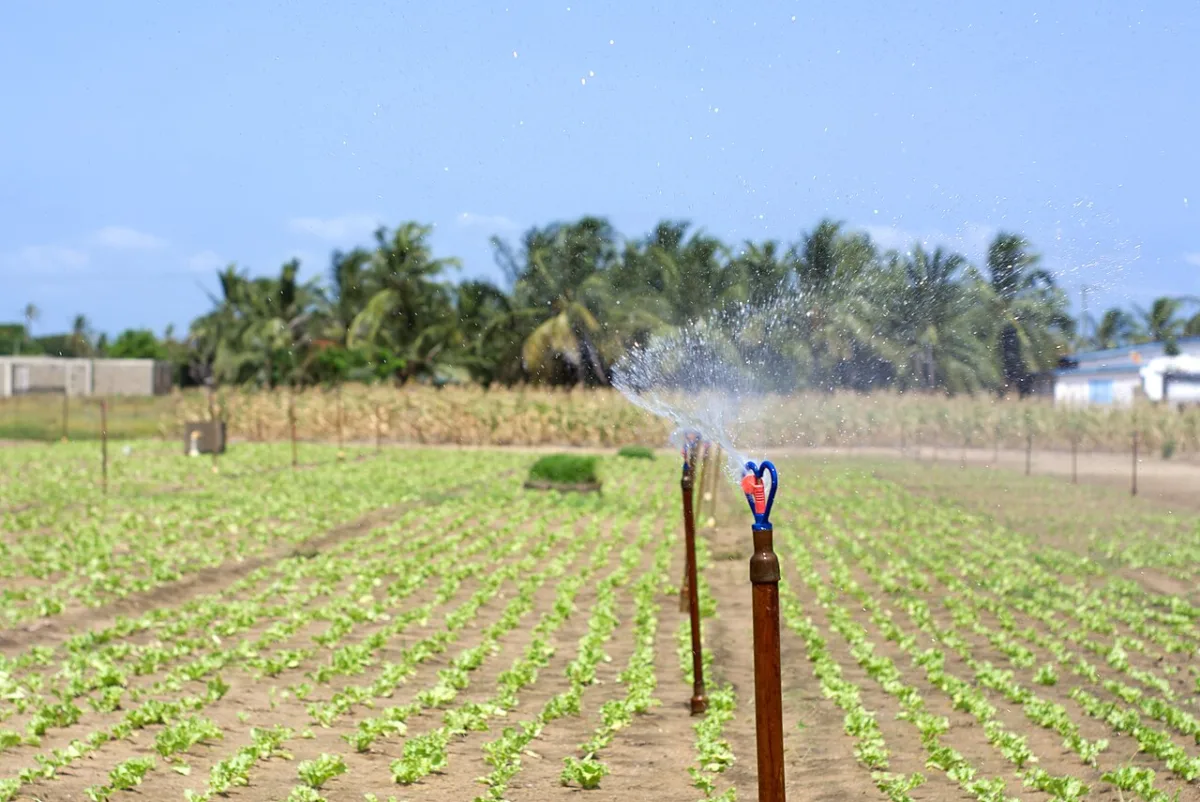
The most common method of mechanized irrigation is sprinkler irrigation. With strict adherence to the technology, this irrigation method is not accompanied by waterlogging and soil salinization and ensures high uniformity of water distribution. This irrigation method does not require thorough field leveling; simultaneously with sprinkling, it is possible to apply chemicals and humidify the surface layer of air, which has a positive effect on plant growth and development.
Currently, irrigation with high-performance wide-span sprinkler machines such as "Fregat" and "Kuban-K", designed for irrigating all crops, including tall ones, and used on any soil type, has become widespread. The technical characteristics of sprinkler machines ensure environmentally safe, resource-saving irrigation of crops, i.e., the permissible rain intensity (without runoff and puddle formation at a given irrigation rate) is: for heavy soils 0.1-0.2 mm/min, medium - 0.2-0.3, light - 0.5-0.8 mm/min.
The features of irrigation with such machines include the need to ensure a uniform rain layer along the length of the water-conducting pipeline. In this case, the irrigation intensity must be coordinated with the soil's infiltration capacity so that the irrigation is not accompanied by the formation of water runoff and other negative consequences.
This technology makes it possible to create controlled moisture conditions and increase the degree of useful utilization of natural precipitation and its accumulation in the upper soil horizons.
The low-intensity sprinkler technology is implemented on low-flow modifications of sprinkler machines operating in motion, as well as on stationary sprinkler systems for intermittent and pulse sprinkling.
A system of sprinkler machines and units for small farm plots provides the possibility of low-intensity sprinkling with a layer up to 10 mm. This class of developments includes the KI-5 irrigation kit with portable wings, which is designed for irrigating industrial, forage, vegetable, and melon crops, hayfields, and pastures on peat, sandy, and medium-loamy soils on an area of 5 hectares.
Under conditions of water scarcity and rising electricity tariffs, the agronomist faces the task of reducing the energy intensity of irrigation and protecting the soil from over-moistening. Technologies of low-intensity sprinkling, micro-irrigation, and subsurface irrigation allow this problem to be solved. They provide plants with moisture strictly according to their water consumption schedule, reduce operating costs, and allow for the automation of crop care processes.
Low-intensity sprinkler irrigation allows for continuous water supply to plants, regulation of soil moisture reserves, and simultaneous application of dissolved fertilizers or soil amendments directly during irrigation.
- Water consumption reduction during subsurface irrigation — 15–40%
- Increase in crop yield with subsurface irrigation — 20–40%
- Water use efficiency for micro-irrigation — 0.96–0.98
- Land use coefficient for subsurface irrigation — 0.98–0.9
Micro-irrigation and drip irrigation technologies
Micro-irrigation doses water supply in strict accordance with the crop's needs. The irrigation regime is calculated individually, taking into account irrigation rates, timing and duration of irrigation, configuration of wetting zones, and the number and characteristics of emitters. Soil characteristics and equipment layout also directly influence wetting parameters.
The following formulas are used for precise calculation of micro-irrigation parameters:
Wetting volume of the soil site (Wlnt, m³):
Wlnt = 100 * y * h * Ant * (WFc - Wpw)
where:
y— soil bulk density, t/m³;h— calculated soil layer depth, m;Ant— wetting area, m²;WFc— field capacity of absolutely dry soil, %;Wpw— pre-irrigation soil moisture (lower limit of optimal moisture), fractions of a unit.
Maximum permissible irrigation duration (tadm, h):
tadm = Wlnt / (Ef * gdr * n)
where:
Ef— water use efficiency (0.96–0.98);gdr— emitter flow rate, l/h;n— number of emitters per 1 ha.
Depending on the technical conditions of the field, one of the options for drip irrigation is selected:
- Classic drip irrigation. Used on plots with a slope of up to 0.35. The operating pressure in the system is 0.1–0.4 MPa with an emitter flow rate of 2–6 l/h. Water is supplied in drops or thin streams strictly to the zone of maximum root development.
- Low-pressure drip irrigation. Suitable for flat, gentle terrain with a slope from 0.03° to 0.35°. Water flow rate is 4–20 l/h. The method maintains the optimal soil water-air regime, completely eliminating surface or deep water runoff, and allows for planned vegetable yields during fertigation.
Subsurface irrigation and equipment selection
Subsurface irrigation (SSI) delivers water directly to the roots through a system of moisteners installed at a depth of 40–60 cm. Sub-irrigation — the artificial raising of the groundwater level — also belongs to this type of irrigation. SSI is divided into three types according to the water supply method: pressure, gravity, and vacuum. Compared to sprinkler and surface irrigation, these systems have the highest efficiency.
Subsurface irrigation requires specific conditions. Soils must have excellent capillary properties, and the underlying layer must have low water permeability. Such systems can only be designed on plots with level terrain (reverse slopes with a rise of no more than 5–10 cm along the length of the moisteners are permissible).
Calculation formulas are used to determine subsurface irrigation parameters:
Irrigation rate (m, m³/ha):
m = 0,65 * h * B * (WFc - WG) * l / n
where:
l— length of the moistener, m;n— number of moisteners per 1 ha (depends on their length and the average width of the wetting strip B);handB— parameters of the wetting contour, determined by the mechanical composition of the soil;WFc— field capacity;WG— pre-irrigation soil moisture.
Irrigation duration (t, h):
t = rw / (vv * vi)^0,5
where:
rw— conditional water layer required to saturate the soil column of the calculated depth, m;vvandvi— average water infiltration rate into the soil over a period of 1 to 12 hours, m/h.
If sprinkler irrigation is chosen for irrigation, it is important to consider the environmental limitations of the area. The table below lists permissible parameters for the operation of standard sprinkler equipment.
| Equipment type | Wind speed, m/s | Max. water mineralization, g/l | Infiltration rate in the 1st hour, mm/h | Depth of the soil underlying layer, kPa | Groundwater depth, m | Maximum terrain slope | Water balance deficit, mm | Required work volume, MJ/ha |
|---|---|---|---|---|---|---|---|---|
| Medium-range systems (KI-50 indicators) | 1–3 | Up to 5 | 15–30 | More than 0.5 | More than 2 | 0–0.1 | Up to 800 | 60 |
| Double-boom short-range machines with intake from an open ditch (DDA-100MA indicators) | 1–5 | Up to 5 | 10–30 | More than 1.5 | More than 2 | 0.001–0.004 | Up to 800 | 60 |
| Multi-span electrified machines with short-range nozzles (in motion from an open network) | 3–6 | Up to 6 | 5–30 | More than 0.5 | More than 2 | 0–0.01 | Up to 400 | 60 |
| Wide-span medium-range positional machines ("Volzhanka" indicators) | 1.5–5 | Up to 7 | 5–30 | More than 0.5 | More than 2 | 0–0.02 | Up to 500 | 20 |
| Wide-span medium-range circular machines ("Fregat" indicators) | 1.5–5 | Up to 8 | 5–30 | More than 0.5 | More than 2 | 0–0.03 | Up to 500 | 160 |
Criteria for choosing sprinkler equipment based on field conditions
When choosing sprinkler equipment, the agronomist's main task is to match the technical characteristics of the machines with the real conditions of a specific field. It is important to consider the slope of the plot, soil water infiltration rate, groundwater depth, and wind conditions. Calculation errors will lead to waterlogging, water erosion, or rapid equipment failure. Listed below are strict limits, the exceeding of which makes irrigation ineffective and dangerous for soil structure.
Exceeding the permissible slope and operating during strong winds destroy soil structure and lead to uneven irrigation. At wind speeds above 5 m/s, the use of long-range and medium-range sprinklers is ineffective due to droplet drift and uneven moisture distribution.
- Permissible wind speed for system operation — Up to 5 m/s
- Soil bearing capacity for hose-reel sprinklers — At least 70 kPa
- Maximum slope for stationary SDI systems — Up to 0.3
- Minimum depth of mineralized water — More than 2 m
| Type of irrigation equipment | Water balance deficit, mb | Wind speed, m/s | Infiltration in the 1st hour, mm/h | Depth of underlying layer, m | Depth of min. groundwater, m | Maximum slope | Volume of land leveling works, m³/ha | Soil bearing capacity, kPa |
|---|---|---|---|---|---|---|---|---|
| Long-range machines with water intake from reservoirs (parameters for DDN-70, 100, 150) | 1–4 | Up to 5 | 15–30 | More than 1.0 | More than 2 | 0.001–0.007 | Up to 300 | 100 |
| Self-propelled medium-range hose-reel sprinklers operating in motion | 1.5–5 | Up to 5 | 5–80 | More than 0.5 | More than 2 | 0–0.05 | Up to 400 | 70 |
| Stationary systems and SDI kits | 1.5–5 | Up to 5 | 1–30 | More than 0.3 | More than 2 | 0–0.3 | Up to 3000 | 200 |
When choosing machinery for farms, environmental requirements for irrigation come to the forefront. Machines must use water efficiently, not destroy the soil structure, and completely eliminate the risk of secondary salinization. For this purpose, it is important to match the sprinkler type with the actual water permeability of the soil and the depth level of fresh or mineralized groundwater. The permissible environmental limits for the application of agricultural irrigation systems are given below.
| Type of irrigation equipment and its characteristics | Natural moisture coefficient / daily moisture consumption, m³/ha | Soil water permeability, cm/h | Groundwater depth (fresh / mineralized), m | Depth of underlying layer, m | Maximum surface slope | Site uniformity (required volume of leveling), m³/ha |
|---|---|---|---|---|---|---|
| Promising sprinkler systems with deflector nozzles and water intake from a pipe network ("Raduga") | More than 0.3 / 30–60 | 1–30 | More than 1 / More than 2 | More than 0.5 | 0–0.05 | Less than 400 |
| Sprinkler systems with medium-range devices and water intake from a pipe network ("Rossiyanka") | More than 0.3 / 30–60 | 1–30 | More than 1 / More than 2 | More than 0.3 | 0–0.05 | Less than 400 |
| Promising positional hose-reel sprinkler with water intake from a network or pressurized water system ("Kooperator") | More than 0.3 / 30–60 | 1–30 | More than 1 / More than 2 | More than 0.5 | 0–0.1 | Less than 400 |
| Hose-reel sprinkler operating in motion with water intake from a pipe network or domestic pump | More than 0.3 / 30–60 | 1–30 | More than 1 / More than 2 | More than 0.3 | 0–0.05 | Less than 400 |
                                                                                                           Continuation of Table 27

    Name of irrigation equipment type,
    irrigation device, technological
             process characteristic
                                          Natural
                                          moisture coef-  Soil water    Groundwater
                                          ficient / daily permeability, depth, m (fresh/  Depth of under-  Max. surface  Surface uni-
                                          moisture con-     cm/h        mineralized)      lying layer, m     slope      formity index,
                                          sumption, m3/ha                                                                 m3/ha

    Pulse sprinkler operating in motion      More than 0.3    1-30        More than 1        More than 0.3     0-0.05     Less than 1000
    with water intake from a pipe network       30-60                     More than 2
    (DShI-3)
    Moveable pulse sprinkler array with      More than 0.3    1-30        More than 1        More than 0.3     0-0.1      Less than 400
    water intake from a pipe network            30-80                     More than 2
    (array with sprinkler drawbar
    "Rosa-3")
    Single-span center pivot sprinkler       More than 0.3    5-30        More than 1        More than 0.5     0-0.03     Less than 500
    machine with water intake from a            30-80                     More than 2
    pipe network ("Karusel", "Mini-
    Karusel-K")
    Multi-span center pivot sprinkler        More than 0.3    5-30        More than 1        More than 0.5     0-0.02     Less than 400
    machine with water intake from a            30-80                     More than 2
    pipe network ("Fermer-Kuban-LK-1",
    "Fermer-Fregat")
Linear move sprinkler machine,           More than 0.3    5-30        More than 1        More than 0.5     0-0.03     Less than 500
operating in motion with water              30-80                     More than 2
intake from a moveable hose fed
by a pipeline network ("Mini-Kuban-
LK", "Mini-Fregat-FSh")
Wheel-move sprinkler pipeline,           More than 0.3    5-20        More than 1        More than 0.5     0-0.02     Less than 400
positional action, with water intake        30-80                     More than 2
from pipe network hydrants (TKA-24)
Stationary seasonal kit for slow           More than 0.3    5-20        More than 1        More than 0.3     0-0.1      Less than 1000
irrigation, including anti-frost             30-60                     More than 2
irrigation
Stationary intermittent sprinkler        More than 0.3    10-30       More than 1        More than 1.0     0-0.05     Less than 400
system with hydraulic automatic              30-80                     More than 2
control (DAU-30)
Stationary micro-sprinkler system        More than 0.3    0.1-25      More than 0.5      More than 0.3     0-0.3      Less than 3000
with water intake from a pipe                20-60                     More than 1
network
        7. FORECASTING METHODOLOGY
Read next
Irrigation For agronomists
Methodology for ecological and economic assessment of modern irrigation technologies in agriculture
Irrigation For agronomists
Operational planning and management of irrigation regimes for crops
Irrigation For agronomists