
Manufacturing hotbed frames and constructing straw mats for cover
4 min read
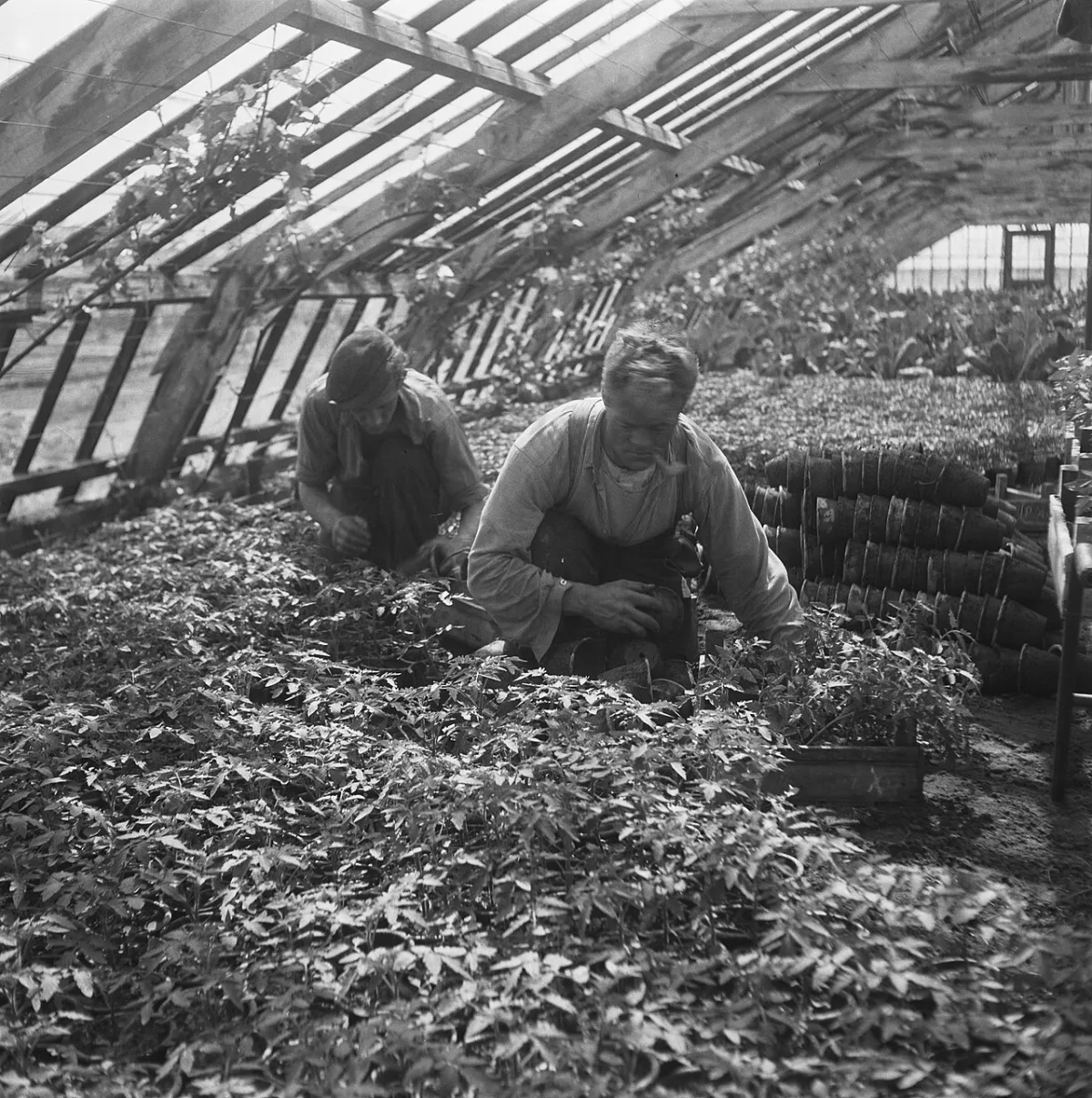
Construction of hotbed frames and glazing rules
The hotbed frame is the main element of the hotbed, which is directly responsible for the thermal, light, air, and humidity regimes. At the same time, the production of frames requires the greatest expenditure of funds and building materials. This is why maximum attention should be paid to high-quality assembly.
- Standard frame size — 106 × 160 cm
- Wood humidity — no more than 18%
- Cross-section of frame bars — 5.5 × 4.7 cm
- Glass consumption per frame — 1.5 m
Well-dried softwood lumber is best suited for manufacturing the frames. The bottom rail of the frame is made thinner than the side and top ones so that water can flow freely from the frame surface. The frame corners are connected with a single tenon and fastened with two wooden nails, and the joints are coated with drying oil to protect against rot.
Inside the frame, three glazing bars are installed, 3 mm wide at the top and 10 mm at the bottom. Rabbets are cut into each bar for laying the glass. If whole glass is insufficient, broken glass can be used by installing additional thin laths.
The use of broken glass worsens the light regime in the hotbed and reduces the useful lighting area due to the additional laths.
For sealing the glass, it is best to use putty prepared from one part of natural drying oil and four parts of dry fine chalk. If natural drying oil is in short supply, it can be replaced with resin-based or other types of commercial putty.
Hotbed covers: straw mats and their substitutes
To protect transplants from the cold, straw mats measuring 1.2 × 2 m are traditionally used. Manufacturing one such cover requires 4.2 kg of straw and 40 g (or 35 m) of No. 9 twine when binding in four rows.
Farms often lack straight, uncrushed straw, as it comes out finely broken after mechanical threshing. Manual threshing solves the problem but is justified only when there is a small need for mats. If one has to work with broken straw, the binding technique must be changed.
- Place the frame for binding the mats horizontally on the floor for ease of working with short stalks.
- Increase the number of twine binding rows from four to 6–8 or more rows.
- Place a layer of straw on a substrate — matting, burlap, rags, old padded jackets, blankets, or felt liners. This will protect the mat from shaking apart quickly and will retain heat.
If there is no straw on the farm at all, mats can be made from alternative materials: matting, burlap, reeds, or felt. For the internal insulating layer, dried upland peat, oakum, factory cotton waste, or dry wood shavings are suitable. When working with peat and shavings, the mat will have to be sewn with twine in several rows (especially along the edges) so that the filler does not spill out.
For medium-sized hotbeds and cold forcing beds, boards or a thick layer of tree branches can be used as a simple cover.
For growing early greens and forcing transplants on small plots, you can set up a "Parisian" type ground-level hotbed. It does not require digging a pit: the warming material is laid directly on a level surface cleared of snow, and a wooden box is installed on top.
| Construction parameter | Size |
|---|---|
| Layer of warming material | 50—70 cm |
| Thickness of box boards | 4—5 cm |
| Width of box boards | 20 cm |
| Height of box | 1.5 m |
The length of the box is selected individually, based on the planned number of hotbed frames.
Read next
Greenhouses and covers For gardeners
Construction of pits and installation of the frame for classic Russian hotbeds
Greenhouses and covers For gardeners
Classification of hotbeds and modern methods of their heating in agriculture
Greenhouses and covers For gardeners