
Production technologies for eco-friendly fruit products for baby food
12 min read
The demand for fruit and berry products is growing worldwide. Consumers are striving to reduce the amount of saturated fat in their diets and are looking for natural sources of vitamins and microelements. A lack of these substances in food is the main cause of premature aging, whereas a balanced diet can extend human life to at least 100 years. For an agronomist, this trend means a consistently high demand for high-quality fruits and berries that possess medicinal and prophylactic properties.
Fruit crops are the primary sources of vitamins C and P for humans. In vegetables, with the exception of peppers, these valuable substances are contained only in insignificant amounts.
Fruits are in demand all year round, both in fresh form and as raw materials for processing. Manufacturers of baby food have particularly stringent requirements for product safety. Fruit preserves for children must strictly correspond to the metabolic specifics of different ages, so the raw materials for them must be of impeccable quality.
Technologies for Preserving Fruit Value
In baby food production, processors have already learned how to minimize the loss of beneficial substances. The introduction of modern technologies makes it possible to preserve biologically active compounds at all stages. To this end, processing plants use specific technological operations:
- inactivation of enzymes during raw material grinding;
- limitation of atmospheric oxygen access;
- use of antioxidants;
- reduction of the duration of the technological process.
However, careful processing is only half the battle. The main problem of today's horticulture lies in the cultivation of initially clean raw materials. Agronomists are faced with the task of implementing a garden maintenance system that guarantees the formation of high-quality and safe fruits directly during their growth process.
Choosing a Horticultural System and Risks of Intensification
Modern horticulture must develop on the principles of sustainable industry management without destroying the natural base. Due to climatic differences and the varying financial positions of farms, agronomists have to combine several cultivation systems. The most common remains the traditional intensive system on dwarfing rootstocks, which allows for dense planting. According to testing data at the Department of Fruit Growing of the Agrarian University, when following the technology in such high-density apple orchards, the following results can be achieved:
| Orchard efficiency indicator | Value |
|---|---|
| Start of commercial fruiting | in the 3rd year after establishment |
| Yield in the first year of fruiting | at least 10 t |
| Yield in a mature orchard | 30–40 t |
| Fruiting resource | at least 300–500 t |
| Product quality | fruits of high commercial quality |
Such indicators attract farmers, but high-density agro-ecosystems have a serious downside. High productivity requires maximum output from the trees and frequent protective treatments. This significantly increases production costs and the chemical load on the environment.
In high-density technogenically intensive orchards, apple fruiting is often irregular. Due to the high chemical load and increased energy intensity, this cultivation method is unacceptable for the production of environmentally safe products.
In recent years, an alternative, organic horticulture, has become increasingly widespread in many countries around the world (Kant, 1988; Ortlieb, 1988; Sansavini, 2005; Doroshenko, Ostapenko, Bardin, 2005). It involves the exclusion of genetically modified cultivars and breeds, pharmaceutical preparations, synthetic fertilizers, and chemical pesticides through the use of agronomic and biological plant protection methods, ensuring the safety of fruit products.
For the majority of consumers, an important criterion for the latter is its naturalness. Moreover, products obtained by the following methods are considered unnatural:
- using artificial light in greenhouses;
- using hydroponics;
- in plastic pots, etc.
In the work of S. A. Kharitonov (2011), a classification of organic farms is presented according to their degree of impact on the natural environment.
Figure 1 – Functional features of the organic horticulture system (Doroshenko, Ostapenko, Bardin, 2005)
In accordance with this classification, organic farms of extensive and intensive types are distinguished. In turn, several groups are identified within the framework of these types of farms. Obviously, in each specific case, organic producers offer different approaches to achieving harmony with nature.
Thus, natural-organic extensive farms generally possess large territories. Often, these are not even agricultural lands, but forest areas and high-mountain meadows where they engage in collecting wild-growing plants (cornel, hazel, walnut, blackberry, etc.) and obtaining environmentally safe honey. In this category of farms, organic producers do not strive to increase the productivity of forest fruit plants. Their main task is to eliminate harmful effects on the environment.
Extensive type Intensive type
Natural-organic; 1. Recreational-organic;
Passively-organic. 2. Agro-organic;
Figure 2 – Classification of organic farms by the degree of impact on the natural environment
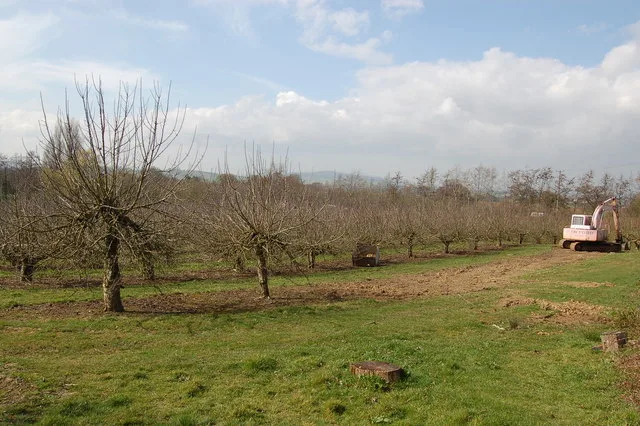
At the same time, the land area of passive-organic farms is strictly fixed. Moreover, technological operations for producing environmentally safe products have not been developed. Furthermore, the specific environmental features are not taken into account during the plant cultivation process. As a result, nature begins to restore its boundaries, for example, in the form of afforestation of territories, and plant productivity decreases sharply. a b
Figure 3 – Forest fruit species – Eastern apple (Abinsky District of Krasnodar Krai, August 2012) a – tree; b – fruits
Figure 4 – Passive-organic apple orchard (Seversky District of Krasnodar Krai, August 2008)
However, the main suppliers of environmentally safe products are intensive organic farms, the share of which reaches 95%. It is noteworthy that the term "intensification" in this case implies the mobilization of extensive knowledge and the achievement of a higher degree of organization per unit area. It enhances the beneficial effects of ecosystem functions and utilizes the self-regulation mechanisms of organisms.
Intensive organic farms are distinguished by the size of their territories and the degree of impact on them.
The first group of intensive organic farms consists of recreational-organic farms. They develop non-agricultural production in the form of agritourism and the construction of bio-hotels, and pay great attention to the revival of folk crafts. A significant part of the environmentally safe products obtained is used to serve agritourists.
The second group is agro-organic farms. They are characterized by well-established technological operations aimed at maximizing plant productivity and the complete prevalence of agricultural production over other types of activities. In this case, an inseparable connection between a particular technology and the preservation of the natural base is observed.
The third group includes semi-organic farms. They switched to organic farming after a chemical past, having abandoned the use of agrochemicals. It is noteworthy that semi-organic farms are often quite consciously transformed into organic ones. Sometimes this may be related to financial problems regarding the purchase of mineral fertilizers and pesticides.
Obviously, in the practice of organic horticulture in the south of Russia, the second group of intensive-type farms should become the most widespread. True, the technologies used in this case will be "gentler," as the anthropogenic load on the environment will decrease. Ways to implement these ideas have been proposed.
For example, the prospects of using medium-sized clonal and seed rootstocks of fruit crops in organic orchards have been shown, which are characterized by a weak reaction to additional mineral nutrition and resistance to high heavy metal content in the soil (Doroshenko, Kondratenko, 1998; Doroshenko, Bardin, Ostapenko, 2005).
It has also been determined that the cultivation of cultivars highly resistant to the action of biotic stressors leads to poor nutrition, slowed reproduction, and reduced survival of pests. The positive influence of the following factors on the optimization of the phytosanitary state and soil fertility has been noted:
- crop rotation;
- organic fertilizers;
- grasses (annual or perennial).
According to experts, a new concept of biological plant protection has emerged, adapted to regional conditions and based on the use of an expanding assortment of biological agents and the preservation of natural regulators of pest population density.
Many of these ideas have already found their application in global practice. According to available data (K. Lind, G. Lafer, 2003; Sansavini, 2004), in most European countries, organic production of apple, pear, strawberry, and other crops has been organized (though still in small volumes).
For instance, in the orchards of Northern Italy (Val Venosta valley) in 2001, 2000 tons (about 5% of the gross harvest) of apples were obtained, grown using organic technologies with a complete absence of chemical treatments and synthetic products. Moreover, there are intentions to gradually increase these volumes.
Based on literature data, certain successes have been achieved in organic strawberry production in Finland. In this process, the crop rotation is shortened. As a result, diseases and pests do not have time to spread in abundance. Harmful insects do not cause significant damage also because their natural entomophages are not destroyed by plant protection products.
The experience of producing organic fruit products (apricot, hazelnut, fig, viburnum, etc.) in Turkey deserves close attention. It is noteworthy that the organic industry in this country has existed since the mid-eighties of the last century.
Table 1 – Area of fruit and berry plantations in organic horticulture in Europe in 2002, ha
| Country | Apple | Pear | Strawberry | Other species |
| Austria | 298 | 28 | 120 | 56 |
| Denmark | 184 | - | - | - |
| France | 1060 | 195 | 15 | 1717 |
| Germany | 1600 | - | 600 | 400 |
| Greece | 29 | 27 | - | 224 |
| Italy | 2000 | 500 | 100 | 2130 |
| Netherlands | 310 | 36 | - | 15 |
| Portugal | - | - | - | 1000 |
| Switzerland | 244 | 49 | 34 | 27 |
| Spain | - | - | - | 3427 |
It is aimed at the production of environmentally safe fresh and frozen fruits, as well as concentrated fruit juices, sold in hypermarkets and exported abroad, mainly to European countries.
It is pertinent to note that environmentally safe fruits are in high demand among the populations of various countries. This is the case despite the fact that they are sold at prices 20–40% higher than the cost of traditional products. Evidently, in modern society, for a significant portion of consumers, product quality is more important than the cost of their purchase. These noted trends should be taken into account when choosing the optimal direction for gardening in the Russian Federation, including its southern regions.
As practice shows, organic farming practices ensure the rational use of natural resources and the efficient application of natural energy when growing agricultural crops, including fruit and berry crops. However, the following efficiency indicators are observed in this process:
| Indicator | Change |
| Labor costs | increase by 12–20% |
| Labor productivity | decrease by 20–45% |
| Yield of fruit crops | decrease by 20–40% |
It is also disappointing that the yield of fruit crops in organic orchards is significantly lower than in traditional ones (16 t per 1 ha for apple trees). Furthermore, to date, there are no reliable theories that explain the functioning mechanisms of a garden ecosystem and the limits of its stability under conditions of "biologization" of technologies (Chernikov et al., 2000; Doroshenko, 2002; Sansavini, 2004).
In the literature of recent years, another point of view has been formulated, expressed by staunch opponents of organic gardening. They argue that a sharp reduction in the use of fungicides or a complete refusal to use them contributes to an increase in the infection of fruits and berries with putrefactive or mold fungi, as well as bacteria that release mycotoxins and antibiotics that are highly toxic to humans and livestock animals, which do not break down during freezing and thermal sterilization of products (including juices) and pose a significantly greater danger than pesticides (Geryn, Szteke, 1995; Shearer et al., 2001). In their opinion, replacing mineral fertilizers with non-disinfected or non-composted manure and poultry manure leads to contamination of berries, primarily with intestinal infection pathogens and helminths. For this reason, and also due to the decline in harvest, a complete refusal to use synthetic agrochemicals in gardening is still hardly acceptable, especially given the deficit in fruit production.
The stated view on the microbiological contamination of fruits and berries arose, apparently, due to a misunderstanding of the essence of organic gardening and the specific functioning of intensive organic plantations. After all, if we follow the logic, it is precisely this fruit production system that involves a number of technological solutions that exclude the indicated negative consequences:
- cultivation preferably of absolutely resistant or highly resistant to fungal diseases cultivars;
- timely application of biological products that exclude or limit the development of pests;
- use of high-quality organic fertilizers in the necessary quantity (Kant, 1988; Chulkina et al., 2000; Matala, 2003; Doroshenko, Satibalov, 2005).
With such agrotechnical approaches, the environmental safety of the harvested fruits and berries is guaranteed. In this case, the quality indicators of the produced products should outweigh the quantitative ones on the scales. Moreover, organic farming cannot be economically inefficient, as the bio-producer is guided by natural principles, which in themselves are low-cost and involve low energy consumption, nutrient recycling, and synergistic effects.
In this regard, according to forecasts by experts, organic fruit and berry production will occupy a certain share of the total market potential in the near future.
Taking this into account, staff members of KubSAU are conducting special research on creating the scientific foundations for organic gardening. Within the garden ecosystem, structures and self-regulation mechanisms have been used. In the "Kuban" educational farm of KubSAU (Krasnodar), plantations have been established where these ideas are being implemented.
- Provide a description of the organic gardening system.
- Provide a classification of organic farms based on the degree of impact on the natural environment.
- Provide a description of recreational-organic farms.
- Provide a description of agro-organic farms.
- Which orchards belong to the "semi-organic farms" group?
Read next
Planting and propagation For agronomists
Methodology for accelerated selection of promising cultivar-rootstock combinations for intensive horticulture
Fruit growing For agronomists
A conceptual model of the functioning of a modern intensive organic orchard
Fruit growing For agronomists