
The role of natural feed base and phytoplankton in pond fish farming
19 min read
The natural food base of a water body is a key factor for the normal growth and development of fish. A complete diet containing proteins, fats, mineral salts, and vitamins is formed by organisms living in the water and additional feed. The basis of natural nutrition is plankton — sedentary plant and animal organisms inhabiting the water column.
Development and nutritional value of phytoplankton
Phytoplankton consists of microscopic algae: green, blue-green, diatoms, dinoflagellates, golden, and euglenids. Thanks to gas vacuoles, fat inclusions, and various outgrowths, cells reduce their density and remain in a buoyant state. The growing season of phytoplankton begins in March–April as water temperature rises.
The rate of microalgae reproduction depends on illumination, temperature, and chemical composition of the environment. Green and blue-green algae reproduce most intensively under round-the-clock lighting, whereas diatoms require a shorter photoperiod. Increased water turbidity due to mineral suspensions reduces the development of phytoplankton, especially blue-green algae, while diatoms and protococcoid algae are less sensitive to turbidity.
| Algae group | Temperature regime | Requirement for nutrients (nitrates, phosphates, silicates) |
|---|---|---|
| Diatoms | Low optimum (4–15 °С) | Preferential development in nutrient-rich water |
| Green and blue-green | Higher optimum | Less demanding of element content |
The greatest nutritional value in pond fish farming is provided by diatoms, green, and blue-green algae. Diatoms have a siliceous shell and a yellowish-brown color; they are important for zooplankton nutrition but contain little organic matter. Among green algae, protococcoid algae are mass-cultivated: Chlorella, Scenedesmus, and Ankistrodesmus. Their microscopic cells are rich in fats, carbohydrates, and vitamins, and are easily accessible to filter-feeding hydrobionts.
The protein of blue-green algae is complete in amino acid composition, but due to low solubility, it is poorly accessible to fish. In addition, the metabolic products of algae can cause antagonism and suppress the development of associated species.
Zooplankton and its role in the pond's food base
Zooplankton unites animals and large heterotrophic protists transported by water masses. It acts as a vital link in the food chain, connecting the primary production of phytoplankton with larger nektonic and benthic organisms. In ponds, zooplankton is represented by protozoa, rotifers, and small crustaceans that feed on algae, bacteria, detritus, or other planktonic organisms.
Depending on the characteristics of their life cycle, zooplankton organisms are divided into two types:
- Holoplankton: spend their entire life cycle as plankton;
- Meroplankton: inhabit the water column only for a part of their life (primarily at the larval stage or in the form of pelagic eggs).
Flagellates and ciliates, along with bacteria, serve as starter feed for lower crustaceans and fish larvae. Rotifers — the smallest multicellular organisms of freshwater bodies — are of particular value. They reproduce parthenogenetically, which allows for rapid biomass accumulation in the pond.
- Caloric value of protococcoid algae — 7 kcal/g
- Caloric value of blue-green algae — 5.4 kcal/g
- Sexual maturity of a female rotifer — 3rd day
- Life cycle of a rotifer — 2–3 weeks
Zooplankton crustaceans: diet and development features
Crustaceans form the basis of the natural food ration of fish, especially in the early periods of their life. In freshwater ponds, this group is represented by three key orders: cladocerans, copepods, and ostracods.
Cladocerans (branchiopods) are equipped with 4–7 pairs of legs and branched antennae. In summer, their population consists mainly of females reproducing parthenogenetically. Small males appear only 1–2 times a year. Sexual reproduction takes place in the autumn period, after which fertilized eggs go into hibernation, and most of the adult crustaceans die. By winter, only a few species remain in the plankton.
- Lifespan of cladocerans — from 1 to 6 months
- Size of nauplius larvae — up to 0.3 mm
- Caddisfly case construction time — 4–8 h
- Lifespan of mayfly larvae — up to 3 years
Peak volumes of cladocerans are observed in summer when water heating provokes the rapid growth of bacterial flora. Cladocerans actively filter phytoplankton and bacteria, becoming the main food source for fish fry.
| Indicator | Value |
|---|---|
| Lifespan of cladocerans | from 1 to 6 months |
Copepods form the second most important part of the plankton. Their elongated body consists of a cephalothorax and an abdomen with a caudal fork. Copepods reproduce exclusively by sexual means. Nauplius larvae, up to 0.3 mm in size with three pairs of limbs, hatch from the eggs and, along with adults, serve as food for fry. In ponds, the order is represented by cyclops and diaptomids.
When assessing the feed base, it is important to consider the biology of specific copepod species. Diaptomus are filter feeders that consume bacteria and algae. Cyclops, on the other hand, are predators: they hunt protozoa, rotifers, and cladocerans, and are capable of attacking fish larvae.
Unlike cladocerans, most copepods successfully survive the autumn, which is why the winter zooplankton of ponds consists almost entirely of them. The third order — seed shrimp (ostracods) — is enclosed in a bivalve shell from which only the antennae and 1–2 pairs of thoracic legs protrude. Their share in the fish diet is insignificant.
Zoobenthos: bottom fauna and its role in fish nutrition
Zoobenthos unites invertebrate organisms inhabiting the pond bottom: mollusks, arthropods, worms, and bryozoans. The bottom fauna performs the function of natural cleaners of the water body by eating decomposing organic residues. A significant part of the benthos consists of oligochaete worms (including tubifex, which feeds on detritus) and larvae of winged insects whose development is linked to water through egg, larval, or pupal phases.
For pond farming, the following groups are the most valuable among bottom organisms:
- Scuds (Amphipods): higher crustaceans with an arc-shaped body flattened from the sides, adapted for moving on their side. During mating, the male holds the female by the neck with its claw. The female lays eggs into the brood pouch on the front legs. The hatched reddish juveniles remain on the mother's legs until they grow up.
- Mayflies: winged insects, the adult form of which lives for only one day. They have no mouth and do not feed, dedicating this day to the nuptial dance and laying eggs on underwater stones or in the water. Larvae hatching from the eggs live in the pond for up to 3 years. They breathe through leaf-like gills and three tail filaments. Fish eat both bottom-dwelling larvae and adult mayflies that fall onto the water.
- Caddisflies: herbivorous insects whose adults look like moths. The female lays eggs in the water. Larvae with a hard chitinous covering on the head and thorax live in a common gelatinous shelter at first. When it becomes too crowded, the larva leaves it and, after 4–8 hours of construction work, creates an individual cone-shaped refuge from sand grains, leaves, and shells. As it grows, it extends the shelter at the wide end while dismantling the narrow one. Upon pupation, the caddisfly bites through the cocoon and climbs to the surface along plant stems. Caddisfly larvae serve as excellent feed for fish.
The benthic and planktonic community of the pond includes: 1 — cyclops; 2 — daphnia; 3 — rotifer; 4 — cladoceran; 5 — seed shrimp; 6, 7 — varieties of oligochaete worm; 8 — mayfly larva; 9 — midge larva (chironomid); 10 — pea clam; 11 — pond snail; 12 — corixid bug; 13 — water louse; 14 — scud.
The diet of benthivorous fish is also regularly supplemented by the larvae of dipterans (tendipedids/chironomids, non-biting midges, black flies), dragonflies, and stoneflies, which develop in the bottom silt and on underwater vegetation.
Pond feed resources: from detritus to chironomids
The basis of the bottom nutrition of many fish species is mosquito larvae (chironomids), better known as bloodworms. Emerging from eggs microscopically, they grow rapidly and reach a length of 15 mm. Adult larvae form tube-shaped shelters on the bottom out of silt or decaying leaves, binding them with secretions from their salivary glands, which harden and resemble silk threads. At early stages of development, fish larvae themselves also actively consume bacterial flora: for example, in the diet of juvenile bream, bacteria constitute a significant part of the natural food.
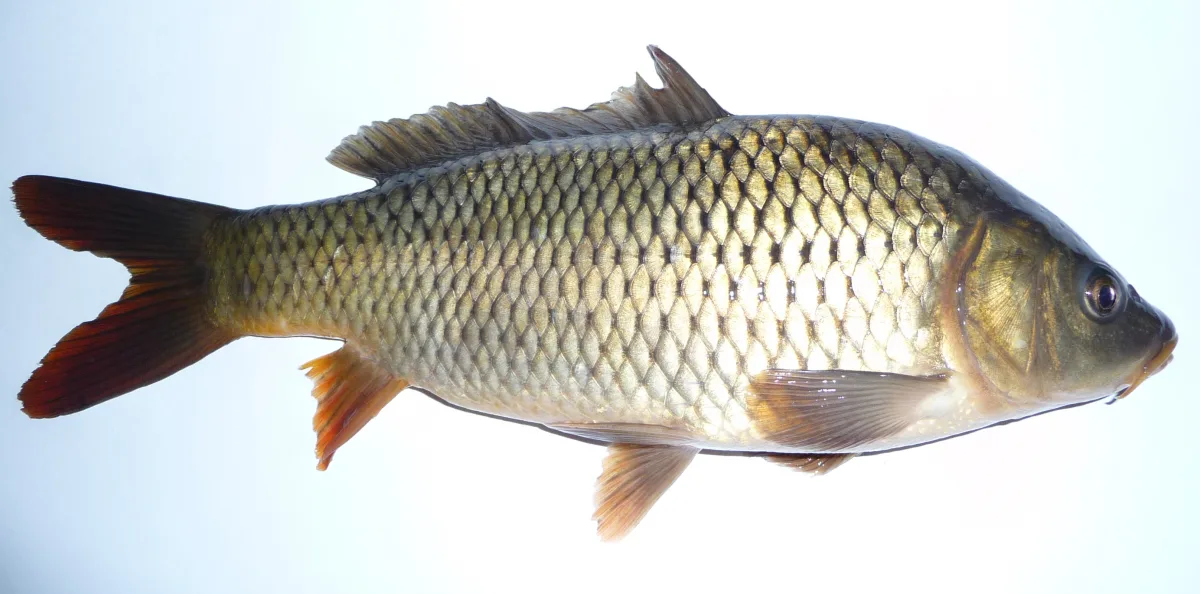
With age, the feeding pattern of fish changes significantly, which must be taken into account when assessing the feed base. For example, carp in the first year of life feeds mainly on zooplankton, but subsequently switches to the consumption of bottom organisms (benthos). At the same time, the intensity and nature of such a transition depend directly on the composition and quantity of plankton and benthos in a particular water body.
The most important, but still the least studied component of aquatic ecosystems is detritus — fine particles of decomposed organisms that have settled to the bottom or are suspended in the water column. Detritus particles represent independent micro-ecosystems at the interface of phases, combining dead organic matter and microorganisms living on it:
- fungi;
- bacteria;
- protozoa.
Cellulose and lignin, which are part of most living organisms, accumulate in detritus. It is a complex dynamic system in which the chemical composition, energy value, and the ratio of living and dead matter change continuously. Detritus serves as a kind of trophic reservoir of the pond: the significant energy reserves contained within it enter the general biotic cycle relatively slowly and through various pathways. The nutritional value of detritus depends on its origin and the degree of organic matter transformation.
Natural fish productivity and means of its enhancement
The total weight gain of fish per unit of pond area during one growing season due to natural food and additional feed provided is called total fish productivity. If one calculates the weight gain solely from the consumption of organisms inhabiting the water body, the indicator of natural fish productivity (NFP) is obtained. Natural and total fish productivity are traditionally expressed in kilograms or centners per 1 ha of water area.
- Maximum size of a chironomid larva — 15 mm
- Units of measurement for NFP — kg/ha or c/ha
- Excess of NFP of nursery ponds over grow-out ponds — 20–25 %
The formation of natural fish productivity is based on the biochemical cycle. The better the water and bottom soil are provided with mineral compounds, the more intensively higher and lower aquatic vegetation develops. Plants synthesize primary production from inorganic substances. The aquatic fauna developing due to this resource (zooplankton, zoobenthos, coastal organisms) forms intermediate production, which serves as food for fish.
The natural fish productivity of a pond depends not only on the volume and quality of the food base, but also on the efficiency of its consumption by fish. This indicator is influenced by water and soil quality, meteorological conditions, the cultural and technical state of the water body, as well as stocking density, species composition, age, and health status of the fish.
With an increase in fish stocking density up to certain limits, the natural fish productivity of a water body increases, as food resources are utilized more fully. However, when the optimal stocking density is exceeded, the NFP indicator begins to decline due to a shortage of natural food to support fish growth.
With overstocking, the natural fish productivity of a pond inevitably drops: a deficit in the natural food base hinders growth processes in the entire stock.
The value of NFP is also directly related to the age structure of the herd. In ponds with younger age groups (for example, in nursery ponds), natural fish productivity is higher, because juveniles transform food more efficiently and grow faster than adult fish. Other things being equal, nursery ponds exceed grow-out ponds in natural fish productivity by 20–25 %. An additional factor in increasing NFP is polyculture farming: keeping several species of fish with different feeding habits together ensures maximum utilization of all food resources of the water body.
Types of fish nutrition and their dietary specialization
The climatic factor directly influences the form of pond farming, the choice of intensification measures, and the selection of cultivated fish species. Climate fluctuations in different years cause changes in the natural and total fish productivity of water bodies even within the same zone. To competently manage the productivity of a pond, it is necessary to consider the nutritional characteristics of the raised objects.
During ontogenesis, fish undergo two types of nutrition:
- Endogenous — due to internal body reserves (yolk and fat in the yolk sac). It occurs in embryos and larvae immediately after hatching, as well as in adult fish during wintering, stay in drying water bodies, and during spawning migrations (sturgeons, salmon, some herrings, eels). In Far Eastern salmon and eels, this process is irreversible: the organism is depleted to the point of complete death after spawning.
- Exogenous — due to external food coming from the water body. It forms the basis of fish life throughout most of their life.
Based on the variety of consumed food, fish are divided into monophages (feed on one type of food), stenophages (narrow set of objects), and euryphages (omnivores). By the nature of feeding in pond farming, peace-loving fish and predators are distinguished:
- Planktophages: herring, some whitefish.
- Bentophagous: bream, certain whitefish.
- Phytophages: silver carp (consumes phytoplankton), grass carp, rudd, Amur bream (feed on higher aquatic vegetation).
- Detritophages: Trans-Caspian khramulya, etc.
- Predators: pike, perch, zander (eat fish and other vertebrates).
The boundary between peace-loving and predatory fish is conventional. In the absence of usual food, bentophagous fish can switch to plankton, omnivorous species (common carp, carp) easily change their diet, and peace-loving carnivorous fish begin to prey when food is scarce.
Age-related and seasonal dynamics of the ration
The transition to exogenous feeding occurs through a period of mixed feeding, when juveniles begin to consume external food before they have completely exhausted the yolk sac. Adaptation to a specific food is accompanied by a change in the structure of the digestive tract — the mouth, gill apparatus, pharynx, and intestine.
- Mixed feeding of cyprinids and percids — a few days after hatching
- Mixed feeding of salmonids — a few weeks after hatching
- Transition of juveniles to large plankton — 1–2 days after the start of feeding
- Daily mass of food — 2–25 % of the fish body weight
At the hatching stage, the fry of all fish species feed exclusively on zooplankton: first on the smallest forms, and after 1–2 days they begin to capture larger representatives as well. As they grow, the dietary requirements of the species diverge:
- Belica, sabrefish, and many whitefish remain planktivorous for life.
- Silver carp shift to phytoplankton, while grass carp and rudd shift to higher aquatic vegetation.
- Common carp and tench become benthivorous.
- Northern pike, perch, and zander switch to piscivory.
The Caspian roach serves as an example of a gradual expansion of the diet: it starts with small phytoplankton and zooplankton, then switches to large zooplankton, then to benthos (primarily chironomid larvae), and in adulthood, it feeds mainly on mollusks.
Changes in the diet throughout the year depend on water temperature, as well as on the composition, abundance, and availability of food organisms. Due to differences in the forage base of water bodies, the feeding habits of the same species can vary greatly: for example, the proportion of plankton, chironomid larvae, and detritus differs significantly in Prussian carp from different ponds.
The intensity of fish feeding directly depends on the water temperature and the current condition of the stock. Exhausted fish consume feed much more actively: for example, yearling carp after winter starvation feed much more intensively than fingerlings at the end of the summer. For each species, there are specific temperature limits at which food consumption reaches a maximum, weakens, or stops completely.
To quickly determine the fullness of the fish at a given moment, the gut fullness index is calculated — the ratio of the mass of food in the digestive tract to the body mass of the fish.
| Unit of measurement | Description |
|---|---|
| Percentages (%) | Mass of food to body mass |
| Pro-decimille (0/000) | Mass of food to body mass in ten-thousandths |
When comprehensively assessing feeding intensity, three main indicators are taken into account:
- the amount of food in the digestive tract at the current moment;
- daily feeding rhythm;
- the speed of food bolus movement through the tract.
Fish do not feed evenly throughout the day. At the mixed feeding stage, periods of active food intake alternate with a complete cessation of feeding at night. As they mature, complete emptying of the intestinal tract does not occur at night, but the intensity of feeding decreases significantly.
The daily rhythm is determined by the biology of the species, as well as the behavior and quality of the food objects. In peaceful and planktivorous fish, pauses between meals are short, whereas in predators they can last for more than a day. In most cyprinids, the daily feeding peak has two maxima — morning and evening. Sudden temperature drops, lack of feed, or daily migrations of planktonic organisms, chironomid larvae, and scuds can disrupt the established rhythm.
Optimization of food relationships and organization of polyculture
The nature of feeding is a specific property of a fish and determines the structure of its sensory organs, mouthparts, and digestive tract. In small closed ponds with limited resources, species with a broad dietary spectrum gain an advantage — they easily switch to alternative feed and occupy vacant ecological niches.
Populating a water body with fish of different feeding habits (polyculture) allows for the most complete use of all links in the natural food chain and increases the overall fish productivity of the pond.
Species composition for polyculture is selected individually for each water body, taking into account the nature of bottom sediments, developed flora, the composition of invertebrates, and the existing fish population. Under natural conditions, age, size, and sex differentiation of fish within a species contribute to the divergence of dietary spectra and the weakening of competition.
Overpopulation of a pond disrupts natural food relationships and inevitably leads to a decrease in the fish productivity of the water body, slowing down fish growth and resulting in smaller fish size.
Competent management of intraspecific and interspecific food relationships allows for maintaining the optimal dynamics of the stock's abundance and biomass in pond farming.
Read next
Agrochemistry For students
Fertilizer application for increasing the productivity of water bodies and rice systems
Fish farming For students
Increasing the fish productivity of ponds by the method of mixed stocking and polyculture
Fish farming For students