
Rationing and calculation of daily feeding rates for carp using compound feed
14 min read
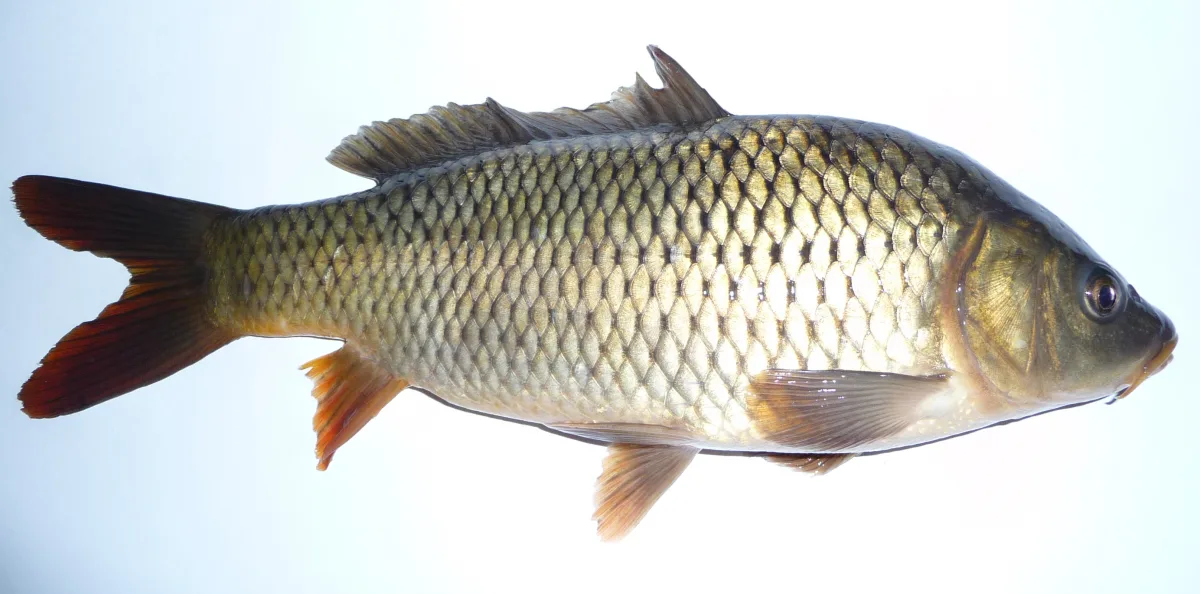
Amendments to feeding rates: feed quality, oxygen, and stocking density
The efficiency of carp farming directly depends on the precise calculation of the daily compound feed ration. Basic standards are calculated for ideal conditions, but in practice, they must be adjusted considering feed quality, oxygen levels in the water, and fish stocking density. Errors in feed allocation lead to the overuse of expensive feed, pollution of water bodies, and the development of dangerous diseases.
- Daily feed limit for still ponds (depth 1–1.2 m) — 100 kg/ha
- Daily feed limit for flow-through ponds (depth from 1.3 m) — 120–140 kg/ha
- Optimal oxygen content in water — 6–7 mg/L
- Reduction of the rate for carp biomass from 25–30 centners/ha — by 30%
The daily feeding rate for large carp weighing over 1000 grams is calculated individually. Depending on the activity of the fish, its physiological state, and growing conditions, the rate can be adjusted by ±15% from the base value. Standards for large specimens are presented in the table below.
| Fish weight, g | Daily feeding rate, % of fish body weight | |||
|---|---|---|---|---|
| over 1000 | 1.2 | 1.7 | 2.0 | 2.2 |
The quality of the compound feed significantly influences its consumption by the fish. The standard rate is calculated for pelleted compound feed with a crumbling rate of up to 8%. If the proportion of crumbs is higher, actual feed losses upon contact with water increase; therefore, the rate is multiplied by correction factors:
- 1.05 — with 20–25% crumbs;
- 1.10 — with 50% crumbs;
- 1.20 — for loose compound feed.
If the water resistance of the pellets is high and they do not disintegrate in water for 30 minutes or more, the tabulated rates should be reduced by 10% or multiplied by a factor of 0.9. The fish farmer can determine compound feed losses upon immersion in water independently directly at the farm. This allows for more precise adaptation of feed consumption for a specific batch.
When the level of dissolved oxygen in the water drops, the intensity of carp feeding decreases. If the average daily oxygen content drops to 3–4 mg/L (to 1.5–2 mg/L in the morning hours), the feeding rate is reduced by 40% (factor 0.6). With a critical drop in oxygen levels in the morning to less than 1 mg/L, the rate is cut by 65% (factor 0.35). In the event of a pre-suffocation state, feed distribution is stopped completely until a favorable oxygen regime is restored.
Exceeding daily feeding rates by 1.5–2 times (especially at the beginning of the season) leads to a steady decrease in oxygen concentration and the occurrence of a pre-suffocation situation after 25–30 days. The deterioration of the hydrochemical regime inhibits fish growth, reduces nutrient absorption, and provokes the development of gill diseases.
To prevent fish kills during a sharp and sustained decrease in oxygen content, it is recommended to apply chlorinated lime. Its dosage is 6 kg/ha for nursery ponds and 1–2 kg/ha for fattening ponds; the preparation is applied once or 3 times every other day. Such treatment improves the hydrochemical regime and creates favorable conditions for feeding. However, liming can cause the death of zooplankton, which will reduce fish growth and increase compound feed costs. In case of mass disease outbreaks, the amount of feed applied is reduced or feeding is stopped entirely, as sick individuals do not feed actively, and uneaten feed rots on the bottom and poisons the water.
Feed distribution regime and the use of pendulum self-feeders
The frequency of feeding and the size of a single portion of compound feed significantly affect the final results of carp farming. The frequency of distribution is determined by the value of the daily rate, the satiating volume, and the time required for the fish's appetite to recover. Single feeding is not allowed when the water temperature is above 20 °C.
| Fish age | Indicator | Water temperature, °C | ||
|---|---|---|---|---|
| 13–15 | 18–21 | 23–25 | ||
| Fingerlings | Single portion, % of fish body weight | 2–2.4 | 3–3.4 | 3.6–4.2 |
| Minimum feeding frequency, times/day | 1 | 1–2 | 2–4 | |
| Two-year-olds | Single portion, % of fish body weight | 1.2–2.4 | 2–2.4 | 2–2.4 |
| Minimum feeding frequency, times/day | 1 | 1–2 | 2–3 | |
During the main feeding period (July — August), compound feed should be distributed at least 2 times a day, regardless of the water temperature. Adherence to the schedule allows the fish to fully digest the feed and prevents it from washing away. Distribution is carried out in the following sequence:
- In the morning at 7–9 AM, apply the first portion, equal to half the amount of compound feed applied the previous day.
- After 1 PM, measure the water temperature, check the consumption of the first portion, and calculate the volume for the subsequent application.
- When applying multiple times, perform the next feeding no earlier than 3–4 hours after the fish have finished the remnants of the previous portion of feed.
Do not apply a portion of compound feed exceeding 3–4% of fish body weight at one time. In this case, losses of feed due to dispersion and nutrient leaching increase sharply, and uneaten remnants turn into difficult-to-mineralize fertilizers that consume a lot of oxygen.
It is possible to obtain maximum and economically viable fish growth in ponds using pendulum self-feeders. They provide feed distribution according to a regime chosen by the fish itself, which increases productivity and reduces feed costs. The design of the automatic feeders is simple: a hopper with feed is located above the water, and its lower locking mechanism is connected to a vertical rod lowered into the water. A ball is attached to the end of the rod — the fish pushes it, the rod moves the locking mechanism, and the next portion of feed is dropped into the water.
taking into account the configuration, relief of the pond, as well as in it and the given farm. Feeders are placed evenly over the pond area or along its shoreline around the perimeter. In Figure – 26 Self-feeder: all cases, it is necessary to give preference 1–hopper; 2– discharge mechanism; to the gathering places of feeding fish, identified by fish farming observations. Often such places are well-warmed dam slopes, borders of shallows and overgrown sections of the pond.
3 feeding tray; 4– discharge rod
The installation depth of the feeders can range from 1–1.5 to 2–2.5 m. At the same time, it is important to ensure that the distance from the feeding tray to the water surface is at least 40–50 cm to avoid water splashing onto it during fish feeding and wind-driven waves.
The immersion of the pendulums to a depth, as a rule, has no strict restrictions. However, it must be ensured that they do not touch the pond bottom, plants, or other objects. A desirable pendulum length depending on the feeder installation site can be considered 1.5–2 m, and the distance to the bottom – 10–15 cm. In the case of very dense fish stockings, the distance from the pendulum to the pond bottom does not matter.
The required number of self-feeders is determined based on 1–1.2 tons of fish per pendulum. This amounts to approximately 25–30 thousand fingerlings, 2.5–6 thousand two-year-olds (depending on weight) and up to 1 thousand three-year-olds.
Control of compound feed consumption. Checking its consumption is a mandatory element of the technology for feeding carp in ponds. The speed and low labor intensity of determination make it a convenient indicator for an operational assessment of the fish farming situation. The consumption of compound feed can be monitored in two main ways:
1) visual inspection of feed residues at the feeding sites;
2) accounting for the amount of feed remaining in the self-feeders.
Checking for feed residues directly at the feeding sites is carried out using a mesh scoop or some other device. Usually, this is done after a certain time after distributing the compound feed at specially marked feeding points (as a rule, at one of five to seven). Checking the next day before feeding is non-objective, as the main part of uneaten feed disperses throughout the pond within 24 hours, especially in windy weather.
With twice-a-day feeding with pelleted compound feed with a water stability of 15 min, cluster distribution and a single portion of 2–2.5% of the fish mass, and a normal oxygen regime under conditions of poor development of the natural food base, consumption should be checked at a water temperature of 23–25°C and above 30–60 min after the end of feeding, at 22–20 °C – after 1.5 h, up to 20°C after 2–3 h. After one-time feeding at a water temperature of 18–19°C, the check should be carried out after 4–5 h, at 20–21°C after 3–3.5 h.
Usually, after this time has elapsed, all groups of fish are well-fed. Uneaten residues quickly disperse throughout the pond, mix with silt, settle to the bottom and are lost. Therefore, if feed remains uneaten under these conditions, the single dose should be reduced while simultaneously monitoring the oxygen content in the water.
A certain influence on the rate of consumption is exerted by the availability of natural food. Thus, in the initial period (for fingerlings late June, for two-year-olds – April–May), when animal food prevails in the fish diet, the check should be carried out no earlier than after 3 h.
In the main feeding period (for fingerlings July – August, for two-year-olds June – August), when there is almost no natural food, the time between distribution and consumption verification is reduced depending on the water temperature to 1.0–1.5 h. In the autumn period, as the water temperature decreases, as well as the intensity of feeding and growth of fish with the usual one-time feeding for this period, the consumption time for introduced feed should be about 3 h.
Deviation of feed consumption times from the indicated values serves as a sign of a change in the fish farming situation, signaling the need for feeding correction. The reason for the slowing down of consumption may lie in the deterioration of the oxygen or hydrochemical regime, fish disease, or be related to incorrect rationing of compound feed due to insufficiently accurate determination of the average mass and number of feeding fish or an imperfect methodology for calculating feeding rates.
Calculation of carp stocking in ponds taking into account
The efficiency of fish feeding is most often evaluated by the feed conversion ratio, which shows how much feed (in kilograms) the fish must consume to provide 1 kg of weight gain. For example, if the feed conversion ratio of the feed is 4, it means that for the fish to increase its mass by 1 kg, it needs to eat 4 kg of this feed.
There is a term such as feed utilization, which shows the ratio of the weight of the feed given to the fish (and not eaten by them) to the total gain in fish biomass (production) for a certain period of time.
The feed conversion ratio and feed efficiency depend on the ratio of various groups of nutrients in the feed (proteins, fats, carbohydrates, vitamins, ash elements, etc.), i.e., on the nature of the feed for the fish species being fed, on the feeding method, etc.
Even for the same feed and the same fish species, these indicators do not remain constant. They depend on:
- age and physiological state of the fish;
- methods of feed preparation and distribution;
- pond preparation, temperature, and hydrochemical regimes;
- natural fish productivity;
- feed quality (whether it is fresh or stale) and many other factors.
Feeding using special devices (feeders) ensures lower (better) values of the feed conversion ratio and feed efficiency than providing feed directly into the water.
It is best to feed fish with feed mixtures, which (if properly formulated) are always more complete in terms of the content of individual nutrients (proteins, fats, and carbohydrates), minerals, and vitamins than individual feeds, no matter how good they may be.
The feed conversion ratio of individual feeds and their tabular data can be found in relevant reference books. The feed conversion ratio of compound feeds or specially prepared feed mixtures can be calculated using the following formula: 100 – (P1.P2.P3….Pn – content of individual feeds in the mixture in % equal to 100%); P1.P2.P3….Pn – content of individual feeds in the mixture in %; a1.a2.a3…..an – feed conversion ratio of the feeds included in the mixture.
Determine the quantity of yearling carp for a five-fold stocking in a grow-out pond with an area of 50 hectares, based on the following data:
| Average weight of yearlings at stocking | 33 g |
| Planned average weight of two-year-olds | 510 g |
| Yield of two-year-olds from grow-out ponds | 85 % of yearling stocking |
B – mass of carp at the end of the period (two-year-old); b – mass of carp at the beginning of the period (yearling).
In the given example, one-fifth of the fish weight gain will be obtained due to the natural food of the pond, and four-fifths due to the feed introduced into the pond. The amount of feed required to ensure the specified gain is determined by the type of feed and its feed conversion ratio. The values of ratios for individual feeds can be found in reference books on pond fish farming. Knowing the feed conversion ratio of a specific feed, one can determine the amount of feed required to obtain the target gain.
Determine the required amount of compound feed, the feed conversion ratio of which is 4, under the following conditions:
- average weight of yearlings at stocking – 33 g;
- planned average weight of two-year-olds – 510 g;
- yield of two-year-olds from grow-out ponds – 85 % of yearling stocking;
Calculate the carp weight gain from the entire pond area due to natural food:
Calculate the carp weight gain from the entire pond area with five-fold stocking:
Calculate the carp weight gain from the entire pond area due to the introduced feed:
Calculate the required amount of introduced feed:
The performed calculation can be summarized in the following formula:
K = P × G × a (N–1), where, K – required amount of feed (kg);
P – natural fish productivity of the pond (kg/ha);
K=210 × 50 × 4(5–1) = 168000 kg
There are cases when the amount of feed introduced into the pond is known, but it is necessary to calculate the quantity of yearling carp that needs to be stocked into it:
Determine the required quantity of yearling carp for stocking into a grow-out pond:
- average weight of yearlings at stocking – 33 g;
- planned average weight of two-year-olds – 510 g;
- yield of two-year-olds from grow-out ponds – 85 % of yearling stocking;
- and feed consumed during the season – 168000 kg;
Calculate yearling stocking based only on natural feed:
Calculate the carp weight gain that can be obtained due to the introduced feed:
Calculate the stocking of yearling carp due to the introduced feed:
Calculate the total stocking of yearling carp:
The provided calculation can be summarized in the following formula:
Determine the necessary amount of feed, the feed conversion ratio of which is equal to under the following conditions
Calculate the number of yearling carp for a _____ fold stocking in a grow-out pond according to the data in table 8.
Table 8 – Pond farm indicators for calculating the quantity
1 2 3 4 5 6 7 8 9
1 2 3 4 5 6
8 97 10 Pond area, ha 30 40 50 60 70 80
90 100 110 Natural fish productivity, kg/ha 200 200 205 206 207 210 215 215 215
Average weight of yearlings at stocking, g 30 30 30 30 30 30 30 30 30 Planned weight of two-year-olds, g 510 510 510 510 510 510 510 510 510 Yield of two-year-olds from grow-out ponds,
85 85 84 84 86 86 86 85 87 – percentage of yearling stocking Stocking multiplicity 2 3 4 5 6 5 4 3 2 Feed conversion ratio 2 3 4 5 6 6 5 4 3 Planned feed consumption, t 60 80 100 110 120 130 140 150 160
10 11 12 13 14 15 16 17 18 Pond area, ha 35 45 55 65 75 85 95 100 105 Natural fish productivity, kg/ha 202 208 210 212 213 214 215 216 217 Average weight of yearlings at stocking, g 33 33 33 33 33 33 33 33 33 Planned weight of two-year-olds, g 520 520 520 520 520 520 520 520 520
Continuation of table 8 Yield of two-year-olds from grow-out ponds
85 85 84 84 86 86 86 85 87 – percentage of yearling stocking Stocking multiplicity 6 5 4 3 2 2 3 4 5 Feed conversion ratio 3 3 4 4 5 5 5 6 6 Planned feed consumption, tons 30 35 40 50 60 70 80 80 80
19 20 21 22 23 34 25 26 27 Pond area, ha 25 26 27 28 29 30 31 32 33 Natural productivity, kg/ha 218 219 220 221 222 223 224 225 230 Average weight of yearlings at planting, g 35 35 35 35 35 35 35 35 35 Planned weight of two-year-olds, g 530 530 530 530 530 530 530 530 530 Yield of two-year-olds from fattening ponds
85 85 84 84 86 86 86 85 87 – percentage of yearling planting Planting frequency 2 2 3 3 4 4 5 6 5 Feed conversion ratio 5 5 5 4 4 4 3 3 3 Planned feed consumption, tons 23 23 23 24 24 24 25 25 25
Read next
Fish farming For students
Intensification of carp farming and requirements for the quality of artificial feed
Fish farming For students
Increasing the fish productivity of ponds by the method of mixed stocking and polyculture
Poultry For agronomists