
Growth patterns of fish and methods for determining their age
6 min read
Growth Factors and Regulation of Water Body Fish Productivity
Unlike warm-blooded animals, whose growth ceases upon reaching sexual maturity, fish grow throughout their entire life. However, the speed of this process is extremely uneven. Juveniles gain mass and length most intensively, while upon reaching sexual maturity, the growth rate slows down, and in old age, it gradually declines. Moreover, different species have different potential: tuna is considered a fast-growing fish, while rockfish is a slow-growing one.
The main external factors determining the growth rate are water temperature, its chemical composition, stocking density, and feed availability. The most intensive metabolism is possible only at an optimal temperature for a specific species. Excessive overheating or cooling of a water body disrupts metabolism and reduces growth speed. Seasonality also plays a key role: cyprinids in temperate climates grow actively in summer and hibernate in winter, whereas some gadids (burbot, polar cod), on the contrary, grow faster in winter.
Food availability directly determines the final mass of the fish. Individuals of the same age and species can differ in mass by tens of times depending on whether they are fed abundantly or poorly. In an overcrowded water body with a feed deficit, fish grow worse and become stunted. Properly organized fishing thins out the fish population, reduces competition for feed, and creates better conditions for the fattening of the remaining stock. This is also confirmed by natural observations: for example, the Azov stellate sturgeon grows faster than the Caspian one due to the richer feed resources of the Sea of Azov.
- Difference in mass with different feeding — tens of times
- Ratio of ether to gasoline for degreasing — 1:2
- Composition of the annual zone — wide and narrow bands
Methodology for Determining Age and Growth Rate via Bone Structures
Uneven growth throughout the year leads to the formation of layers (rings) on scales and bones. Investigating these structures allows for accurate determination of fish age and calculation of its growth rate over previous years. Analysis utilizes scales, otoliths, as well as skeletal bones: opercular bones, cleithrum, fin rays, and vertebrae. The maturation of reproductive products slows down growth, which is also recorded in bone tissues.
The choice of structure for analysis depends on the fish species. In most species, including carp, age is determined by scales. For sturgeons, catfish, and pikeperch, a cross-section of the pectoral fin ray is used, which is ground down and glued with balsam onto a microscope slide. In gadids, flatfish, and pikeperch, the cyclicity is clearly visible on otoliths — they are extracted from fresh fish (by cutting the head longitudinally or transversely in the nape area), broken in half, ground, and calcined.
Material for determining fish age that has been stored in formalin must not be used — it is unsuitable for quality processing and reading of annual rings.
For determining age in percids and burbot, it is convenient to use flat bones — opercular bones and the cleithrum. Their preparation requires strict adherence to a sequence of actions:
- Clean the bone of soft tissues by scalding it with boiling water.
- Degrease in a mixture of ether and gasoline in a 1:2 ratio.
- Thoroughly dry the prepared material.
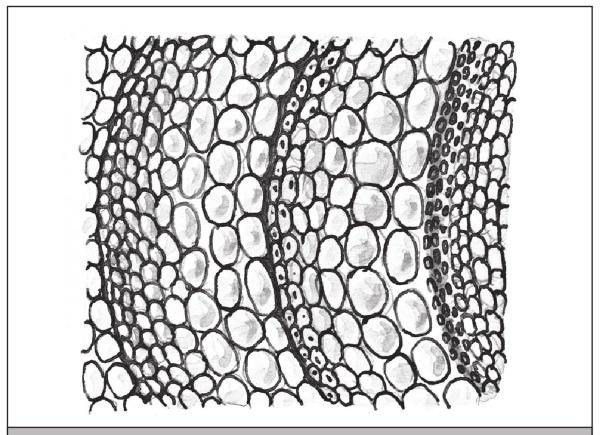
For greater reliability of results, it is recommended to determine age in parallel using scales and bones. When viewing the structure in incident light (top illumination), the bands of the slow-growth period appear dark, and in transmitted light (bottom illumination) — light, as they consist of small, densely packed cells. During the period of increased growth, the cells are larger and lie more loosely: a wide ring is formed, matte-light in incident light and dark in transmitted light. In temperate latitudes, rapid growth occurs in summer or autumn, in arctic ones — in winter, and for tropical fish, the rings reflect the alternation of droughts and heavy rains.
Narrow dark rings should not be called "winter" rings. If a fish does not feed in winter (like a carp), growth stops and a ring is not formed. Narrow bands correspond to any periods of growth retardation (in spring, summer, or autumn). Additionally, accessory rings are formed: the fry ring (during the transition of juveniles from plankton to benthos) and spawning marks (due to the cessation of feeding during spawning).
Why Fish Farmers Need to Consider the Age and Growth Rate of the Stock
With age, profound physiological rearrangements occur in the fish organism: the molecular structure of cells changes, as well as the ratio of proteins, lipids, and nucleic acids, the quality and quantity of enzymes, and the ability to produce antibodies. These processes directly affect energy and plastic metabolism. As a result, productivity and the adaptive capabilities of fish in different age groups turn out to be unequal.
Age-related changes also significantly affect the reproductive capacity of the stock. In the second half of life, the fecundity of fish gradually decreases, and then, due to gonad degeneration, reproduction ceases completely. This process is accompanied by a decline in the quality of gametes and a deterioration in the properties of the resulting offspring. For this reason, the age-based selection of broodstock is of key importance in pond fish farming, as it directly shapes the quality of nursery plants and the final productivity of marketable fish.
Systematic determination of age and growth rate provides the fish farmer with objective data for farm management:
- allows for the timely identification of overpopulation in a water body or underutilization of its feed resources;
- helps to accurately establish the most appropriate and cost-effective moment for harvesting;
- makes it possible to timely recognize the period of growth slowdown and avoid the economic disadvantage of further rearing.
The assessment of age and growth indicators often explains the reasons for annual fluctuations in the arrival of commercial fish and serves as a vital theoretical prerequisite when compiling fishery forecasts.
Read next
Fish farming For students
Features of reproduction and patterns of fertility in fish under aquaculture conditions
Pruning and training For students
Determining the age of fruit trees and individual branches by external features and cross-sections
Fish farming For students