
Photosynthesis as the main factor of crop productivity and yield
20 min read
How photosynthesis works at the field level
The term "photosynthesis" was proposed in 1877 and literally means the assembly of something under the action of light. For an agronomist, this is the basis of yield: the process represents the accumulation of solar energy by plastid pigments and its conversion into chemical energy. In this process, plants absorb carbon dioxide from the atmosphere, reduce it to organic compounds, and release free oxygen into the environment.
The net reaction of photosynthesis is described by the equation: CO₂ + H₂O → [CH₂O] + O₂ (under the action of light). The carbohydrates formed as a result of this reaction contain more energy than the initial carbon dioxide and water. Due to the Sun's energy, energy-poor substances are converted into energy-rich products — carbohydrates and oxygen.
Photosynthesis is the only process in the biosphere that leads to an increase in its free energy at the expense of an external source. Every year, this process results in the formation of 150 billion tons of organic matter and the release of about 200 million tons of free oxygen on Earth. This global cycle maintains the composition of the atmosphere and prevents the planet from overheating due to the greenhouse effect.
For plant development, it is fundamentally important how exactly they are supplied with carbon dioxide. Crops obtain the bulk of CO₂ from the air, and the remainder through the root system. However, the natural concentration of carbon dioxide in the atmosphere is extremely low, which constrains the productivity potential of crops.
- Optimal CO₂ content in the air — 1%
- Actual CO₂ content in the air — 0.03%
- CO₂ reserve in the one-meter surface layer — 5-6 kg/ha
- Plant requirement for CO₂ for development — up to 250-300 kg/ha
- Use of PAR for photosynthesis — about 2%
Since plants use only about 2% of photosynthetically active radiation (PAR) for photosynthesis, the rest of the absorbed energy is spent on transpiration and heat exchange. To compensate for the CO₂ deficit in the surface layer, the biological activity of the soil is critical: gas is constantly released during the decomposition of soil organic matter.
Key indicators of photosynthetic activity of crops
To assess the efficiency of plants in a specific field, several measurable parameters are used. The main one is the rate of photosynthesis (PI) — the amount of milligrams of CO₂ assimilated in 1 hour per one square decimeter of leaf surface. When the leaf area is difficult to determine (for example, in coniferous crops, on stems, or fruits), the indicators are calculated per unit of organ mass.
The following coefficients are used to characterize assimilation processes:
- Photosynthetic coefficient — the ratio of the volume of released oxygen to the volume of absorbed carbon dioxide.
- Quantum requirement — the ratio of the number of absorbed light quanta to the number of assimilated CO₂ molecules.
- Quantum yield — the ratio of the number of assimilated CO₂ molecules to the number of absorbed light quanta.
- Assimilation number — the ratio of the amount of absorbed carbon dioxide to the amount of chlorophyll in the leaf, indicating its activity.
Indicators of the rate of photosynthesis based on absorbed CO₂ and released O₂ may not match. This is because carbon dioxide participates in the dark phase, while oxygen is formed in the light phase of the process.
The leaf remains the main photosynthesizing organ of the plant, its flat structure ensuring maximum absorption area with minimal expenditure of building material. To assess the size of the photosynthetic apparatus, the leaf area index (LAI) is used — the ratio of the total leaf area to the soil area under the plants. This index allows for the assessment of the crop's efficiency in accumulating dry matter.
Crop productivity depends not only on the leaf area but also on the duration of their work. This period is characterized by net assimilation rate (NAR) and photosynthetic potential (PP). PP reflects the number of "working days" of the leaf surface during the growing season.
Photosynthetic potential is expressed in m²∙days/ha or dm²∙days/plant. It is determined by the formula: PP = 1/2 * (S1 + S2) * n, where S1 and S2 are the leaf areas at the beginning and end of the period, and n is the number of days in the recording period.
Net assimilation rate characterizes the work of the plant's photosynthetic apparatus and is measured by the amount of dry matter in grams synthesized by 1 m² of leaf surface per day. This indicator is the algebraic sum of the amount of assimilates formed during the day as a result of photosynthesis and the amount of substances absorbed as a result of mineral nutrition, minus the amount of substances spent by the plant on respiration, exoosmosis into the soil, and mechanical losses. NAR is expressed in g/m² and is determined by the formula:
V 2 - V1 (L1 + L 2) 12 n where: V1 and V2 are the dry matter mass of the plant at the beginning and end of the recording period;
W2 – W1 – increase in dry mass over the recording period;
L1 + L2 – leaf area of the plant at the beginning and end of the period;
(L1 + L2) 1/2n – average leaf area over the specified period of time; n – number of days in the recording period.
A plant leaf is an organ that provides conditions for photosynthesis. Functionally, this process is confined to specialized cell organelles – chloroplasts. Depending on the plant species and growth conditions, the number of chloroplasts in a cell can vary greatly – from one chloroplast to several tens or hundreds. Chloroplasts are lens-shaped or rounded bodies 4-10 μm in size, having a complex submicroscopic structure (Fig. 25; Hall D., Rao K., 1983). These cell organelles are surrounded by a double membrane, with the inner membrane extending into the chloroplast to form a complex system of lamellae. The latter, having two membranes each, form thylakoids. When thylakoids are layered, grana are formed. It is in these membranes that pigments and all compounds necessary for the fixation of light energy and photosynthetic electron transfer are localized. The remaining volume of the chloroplasts is filled by the stroma, where enzymes involved in carbon dioxide fixation are localized.
Fig. 25. Schematic representation of the internal three-dimensional structure of a chloroplast
Chloroplasts are capable of active movements – changing the orientation of their body and moving in space. They move, orienting themselves in relation to light. If the light flux falling on the leaf reaches a high intensity, the chloroplasts position themselves in profile to it and occupy the lateral walls of the cells, i.e., the phenomenon of phototaxis* is observed. If the light is weak, the chloroplasts orient themselves with their larger surface perpendicular to the light flux, thereby increasing the absorption area for diffused light. They also possess chemotactic sensitivity – they move in the direction of a higher CO2 concentration in the cell. An endogenous circadian rhythm of chloroplast movement has also been established: during the day they line up along the walls, at night they descend to the bottom of the cell.
Photosynthesis consists of several consecutive stages. A detailed presentation of these is not the task of this subject. However, the enormous importance of photosynthesis requires a brief discussion of its main features. Knowledge of the nature of this process is necessary to understand how various environmental factors, in particular fertilizers, affect it. Conventionally, photosynthesis can be divided into two phases: photochemical (light), which requires light, and chemical (dark), which proceeds in the dark (Fig. 26; Koval S.F., Shamanin V.P., 1999). As a result of the effect of light on a chlorophyll molecule, energy is released, due to which water is split with the formation of oxygen and the accumulation of ATP energy in reduced nicotinamide adenine dinucleotide phosphate (NADPH) – a coenzyme that serves as an electron acceptor in biosynthetic reduction reactions. In the dark phase, due to the energy of ATP and NADPH, a carbon dioxide molecule is attached to primary acceptors. For the assimilation of one carbon dioxide molecule, at least 8 quanta of light absorbed by plastid pigments are required. The energy of a "mole" of light quanta (or einstein) of red light (680 nm) is 176 kJ, and 8 moles amount to 1408 kJ. A gram-molecule of glucose contains 2818 kJ, i.e., 469 kJ per gram-molecule of assimilated carbon dioxide.
Fig. 26. Light and dark phases of photosynthesis
The first stage of photosynthesis is the absorption of light energy by pigment molecules. The pigments involved in photosynthesis include chlorophylls and carotenoids, which are packed into the thylakoids of chloroplasts in the form of photosynthetic units called photosystems (PS).
Two photosystems function in the plastids: PS I and PS II (Fig. 27; Goodwin T., Mercer E., 1986). The connecting link between them is a pool of plastoquinones**, a protein cytochrome complex, and plastocyanin. Each PS contains about 200-300 pigment molecules. All PS pigments absorb light energy, but only one chlorophyll molecule of a given PS can use the absorbed energy in photochemical reactions. This chlorophyll molecule is called the reaction center (RC) of the photosystem, and the other pigment molecules are called antenna pigments, since their function is to collect light. In PS, the reaction center is formed by a specific chlorophyll a molecule and is designated as P 700 in PS I and P 680 in PS II. The transfer of light energy is carried out in the direction of decreasing quantum energy: carotenoids (400-550 nm) – chlorophyll b (650 nm) – chlorophyll a (660-675 nm) – reaction center (P 680 or P 700). Chlorophyll b, as an accessory pigment, absorbs light of low intensities inaccessible to chlorophyll a and transfers the energy acquired in this way to it, which makes photosynthesis possible in a wider range of wavelengths.
* Phototaxis – a motor reaction of motile organisms in response to light stimulation. **
Plastoquinones are methylated derivatives of n-benzoquinones with varying lengths of the isoprenoid chain. They are a vital part of the electron transfer system and participate in the phosphorylation reaction.
Fig. 27. Organization and interaction of pigments of PS I, PS II, and the corresponding light-harvesting complex (LHC)
Carotenoids absorb light in the blue and violet parts of the spectrum, which are inaccessible to chlorophylls. Furthermore, these pigments act as light filters, protecting chlorophyll molecules from irreversible photo-oxidation, and participate in the redox reactions of photosynthesis. Energy transfer from one chlorophyll molecule to another can occur hundreds of times until it is accepted by the RC, which carry out photochemical reactions. The action of each PS involves the absorption of one quantum of energy by each reaction center, which is then said to be in an "excited" state. In PS I, the "excited" reaction center P 700 donates an electron to an electron acceptor, which is an iron-sulfur protein, and then the electron travels, lowering its energy level, to ferredoxin ("fer" signifies iron, and "redoxin" emphasizes participation in redox reactions) and participates in the reduction of the coenzyme NADP to NADPH; in this process, the P700 molecule is oxidized (Fig. 28; Koshkin E.I., Pilshchikova N.V., 1998).
Electrons of the P 700 molecule are replaced by electrons from PS II. In PS II, excited electrons of the RC P 680 are transferred in pairs to an acceptor molecule – pheophytin – and then, through a series of electron carriers, including plastoquinone, iron-sulfur protein, cytochromes, and plastocyanin, to the excited chlorophyll P 700 of PS I. The P 680 molecule, having lost its electrons, can replace them with electrons from a water molecule. When electrons from water move to P 680, the water molecule dissociates into protons and oxygen. This light-dependent oxidative splitting of water is called photolysis. The oxygen-evolving complex of photosynthesis is localized on the inner side of the thylakoid membrane. Manganese is a key cofactor of enzymes within this complex.
Thus, the photolysis of water contributes to the creation of a proton gradient across the membrane. Along the electron transport path in the electron transport chain connecting PS II with PS I, a portion of their energy is spent on the formation of ATP from adenosine diphosphate (ADP) via phosphorylation. In this case, non-cyclic electron transport occurs; therefore, this path of photosynthetic phosphorylation is called non-cyclic. Water is the electron donor, and NADP is the final acceptor. Electron transfer occurs with the participation of two PS, so two quanta of light are consumed to transfer each electron. In the segment between PS II and PS I, electron transport proceeds along a decreasing redox potential gradient, releasing energy and storing it in ATP. Phosphorylation also occurs during cyclic electron transfer, bypassing PS II. In this process, one of the electrons of the P 700 pigment moves to a higher level. In this state, it is captured by an iron-sulfur protein and then transferred to ferredoxin and, through a series of intermediate carriers, including flavoproteins and cytochromes, returns to P 700. This return of the electron to a positive redox potential is an exergonic process* and is accompanied by the formation of ATP. During this process, no reducing equivalents for the dark reaction are formed, and no oxygen is released; the only product is ATP.
Similar to oxidative phosphorylation occurring in mitochondria, photophosphorylation in chloroplasts is also a chemiosmotic process. When electrons are transferred along the electron transport chain from PS II and PS I, protons are pumped from the stroma into the thylakoid space, creating an electrochemical potential of H+ ions, which includes a chemical, or osmotic, gradient and an electrical gradient. When protons overcome this gradient, moving from the thylakoid space back into the stroma, the stored potential energy becomes the driving force for ATP synthetase, which catalyzes the phosphorylation of ADP or adenosine monophosphate (AMP) to ATP or ADP. Dark reactions, which occur in the chloroplast stroma, utilize the NADPH and ATP formed in light reactions to reduce CO2 to organic carbon. There are different pathways for CO2 reduction in photosynthesis (Figs. 29 and 30; Kramer P.J., Kozlowski T.T., 1983). The first, known as the Calvin cycle, consists of three periods: carboxylation, reduction, and regeneration.
Fig. 28. Scheme of non-cyclic and cyclic electron transport in chloroplasts. PS I generates reducing power in the form of NADPH; PS II splits water with the release of O2 and generates a reductant. A proton gradient across the thylakoid membrane is generated when O2 is released and when the electron flow passes through the electron transport chain connecting the two photosystems. ATP synthesis, as in oxidative phosphorylation, is triggered by a proton gradient. ATP can also be formed without the simultaneous formation of NADPH. ATP and NADPH formed under the influence of light are subsequently used for the reduction of CO2 to carbon in a series of dark reactions called the Calvin cycle. These reactions occur in the indicated component of the chloroplasts.
An exergonic process is a process that occurs with the release of energy.
Fig. 29. C3 carbon fixation pathway, or the Calvin cycle
Fig. 30. C4 carbon fixation pathway, or the Hatch–Slack cycle
Carboxylation. At this stage, CO2 is attached to ribulose-1,5-diphosphate. This reaction is catalyzed by the enzyme ribulose diphosphate carboxylase. As a result, ribulose-1,5-diphosphate is carboxylated, and its carbon chain is extended by one carbon atom. This creates a six-carbon chain, which then directly converts into the first stable product of photosynthesis, namely two molecules of 3-phosphoglyceric acid.
The energy cost of glucose: how a plant builds sugars
For an agronomist, the dark reactions of photosynthesis are the process of directly forming the dry matter of crops. It is at this stage that chemical energy, accumulated by leaves in the light, is spent on creating simple sugars, which are then converted into starch, fats, and amino acids. The process occurs in a cyclic mode, where a key role is played by the constant regeneration of the primary carbon dioxide acceptor — ribulose-1,5-diphosphate.
The synthesis of organic matter begins with the reduction phase, in which 3-phosphoglyceric acid converts into 3-phosphoglyceraldehyde. First, phosphoglycerate kinase, with the participation of ATP, phosphorylates it into 1,3-diphosphoglyceric acid. Then, phosphoglyceraldehyde dehydrogenase, with the help of NADPH, reduces the compound to 3-phosphoglyceraldehyde. When carbon dioxide is reduced to the level of triose phosphate, energy storage is complete, and the cell begins the regeneration of the primary CO2 acceptor.
Upon fixation of three CO2 molecules, six molecules of reduced 3-phosphotrioses are formed. Five of them are spent on the regeneration of ribulose-5-phosphate, and one molecule goes toward the synthesis of glucose.
The regeneration of the carbon dioxide acceptor and the synthesis of carbohydrates occur in a strict sequence:
- Isomerization of 3-phosphoglyceraldehyde into phosphodihydroxyacetone under the action of the enzyme triose phosphate isomerase.
- Condensation of the aldehyde and phosphodihydroxyacetone using aldolase into fructose-1,6-diphosphate and the cleavage of one phosphate by fructose-1,6-diphosphatase.
- Creation of a chain of sugar phosphoric esters with 4, 5, and 7 carbon atoms with the participation of the enzymes transketolase and aldolase.
- Transfer of the phosphodihydroxyacetone residue to erythrose-4-phosphate with the synthesis of sedoheptulose-1,7-diphosphate, cleavage of phosphoric acid, and formation of xylulose-5-phosphate and ribose-5-phosphate under the action of transketolase.
- Conversion of xylulose-5-phosphate and ribose-5-phosphate into three molecules of ribulose-5-phosphate with the participation of ribulose phosphate epimerase and ribose phosphate isomerase.
- Phosphorylation at the expense of light-generated ATP with the formation of ribulose-1,5-diphosphate to close the cycle. From the remaining sixth molecule of 3-phosphoglyceraldehyde, when the cycle repeats, fructose-1,6-diphosphate is synthesized, from which glucose, sucrose, or starch are built.
To create one molecule of glucose, six full turns of the Calvin cycle are required. The energy costs for this process consist of resources from the light phase:
| Indicator (synthesis stage) | ATP consumption, molecules | NADPH consumption, molecules |
|---|---|---|
| One turn of the Calvin cycle | 3 (two for activating two molecules of phosphoglyceric acid, one for the regeneration of ribulose-1,5-diphosphate) | 2 (for the reduction of phosphoglyceraldehyde) |
| Synthesis of one glucose molecule (6 turns) | 18 | 12 |
C3 and C4 plants: why photorespiration reduces crop productivity
Agricultural crops differ significantly in their mechanism of carbon assimilation. Plants in which the first stable product of fixation is the three-carbon 3-phosphoglyceric acid belong to the C3 type. These are wheat, barley, beet, and soybean. Their main vulnerability under field conditions is the presence of photorespiration, which occurs in chloroplasts parallel to photosynthesis in the light, consumes oxygen, releases CO2, and does not produce ATP.
The essence of the problem lies in the enzyme ribulose diphosphate carboxylase (Rubisco), which binds not only CO2 but also oxygen. Under high temperatures or drought, stomata close, the concentration of carbon dioxide inside the leaf drops, while that of oxygen increases. Under these conditions, the enzyme switches to the oxidation of ribulose diphosphate with the formation of glycolic acid. In the course of further transformations, glycolate converts into glycine, which is then oxidized to serine with the release of carbon dioxide.
Due to photorespiration, C3 plants in the field lose from 20% to 50% of the primary products of photosynthesis. The competition between oxygen and carbon dioxide for Rubisco leads to the formation of a CO2 compensation point, below which the balance of CO2 assimilation becomes negative.
C4 plants (maize, millet, sorghum, sugarcane) use the more efficient Hatch–Slack pathway. For them, the primary carbon dioxide acceptor is phosphoenolpyruvic acid (PEP), and the carboxylating enzyme is PEP carboxylase. As a result, four-carbon compounds are formed — oxaloacetate and orthophosphate. PEP carboxylase is not sensitive to oxygen and efficiently binds carbon dioxide even at its low concentration, which minimizes losses from photorespiration.
- Photorespiration losses in C3 crops — 20–50%
- ATP consumption per glucose molecule — 18 units
- NADPH consumption per glucose molecule — 12 units
- Number of cycle turns for glucose synthesis — 6
PEP+CO2+H2O → oxaloacetate + Pi
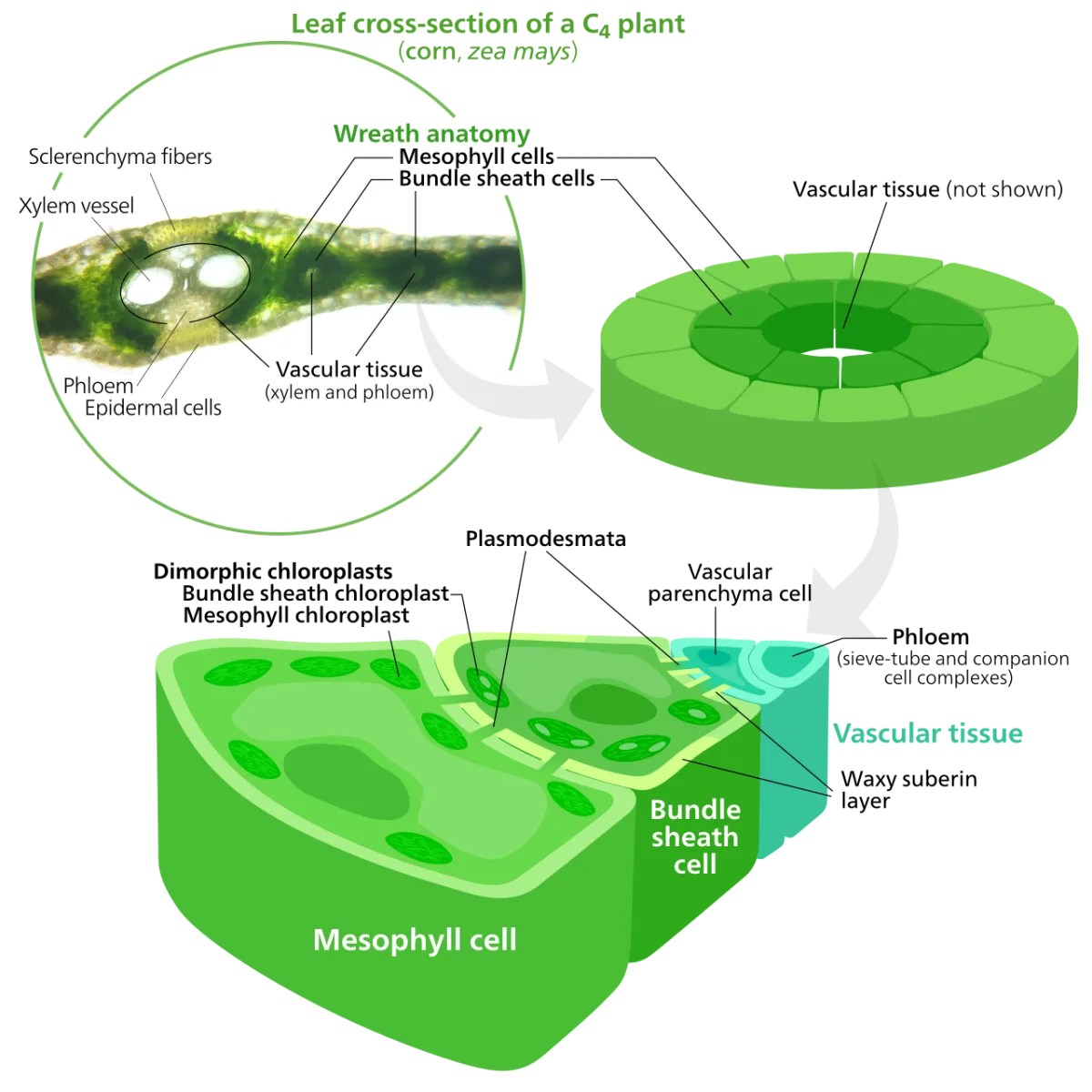
C4 plants are characterized by the following structural features: a) numerous air cavities, through which air from the atmosphere enters directly into the photosynthetic cells, thereby ensuring efficient carbon dioxide absorption; b) a double layer of bundle sheath cells, densely packed around the vascular bundles; c) mesophyll cells arranged in much less dense layers around the bundle sheath cells; d) a large number of plasmodesmata between the bundle sheath cells and mesophyll cells.
The first products of photosynthesis detectable in the mesophyll cells of C4 plants are not three-carbon compounds, but four-carbon compounds, mainly aspartic, malic, and oxaloacetic acids. In this form, the assimilated carbon is transported from the mesophyll cells into the chloroplasts of the bundle sheath cells, where CO2 is released again and then re-assimilated in photosynthesis via the C3 pathway. However, decarboxylation releases only half of the reducing potential required for the assimilation of one molecule of carbon dioxide.
Thus, C4 plants are forced to expend an additional two molecules of ATP to fix one molecule of CO2 and, consequently, more quanta of absorbed light than C3 plants. The C4 pathway creates a CO2 pump and ensures a higher concentration for the final C3-pathway photosynthesis compared to that established by its diffusion into the leaf from the air. As a result, CO2 ceases to limit photosynthesis, and the formation of glycolic acid and photorespiration are suppressed. The consequence is an increase in the apparent intensity of photosynthesis in C4 plants compared to C3 plants under identical lighting conditions. C4 plants can reuse photorespiratory CO2 when stomata are closed. Closing the stomatal aperture during hot hours reduces evaporation and significantly lowers the transpiration coefficient of C4 plants. Plants that assimilate carbon via the Hatch-Slack cycle are well adapted to intense insolation, elevated temperatures, and drought.
It is known that out of approximately 300 families of flowering plants, photosynthesis follows the C4 pathway in only 16 families and in specific representatives. This includes 2 families of monocotyledons: Poaceae (Grasses), Cyperaceae (Sedges) and 14 families of dicotyledons: Acanthaceae, Aizoaceae, Amaranthaceae, Asteraceae, Boraginaceae, Capparidaceae, Caryophyllaceae, Chenopodiaceae, Euphorbiaceae, Nyctaginaceae, Polygonaceae, Portulacaceae, Scrophulariaceae, Zygophyllaceae. None of the families belong entirely to C4 plants.
Plants with C4 photosynthesis grow well at a temperature of 25–35°C, whereas C3 plants grow at 15–25°C. Among the most harmful weeds, C4 plants include bermudagrass, barnyard grass, pigweed, couch grass, common lambsquarters, and proso millet. A number of crops, primarily of tropical and subtropical origin, are classified as C4 plants – maize, millet, sorghum, and sugarcane. There is no consensus among domestic and foreign scientists regarding rice and wild rice. For example, P.A. Genkel (1975) classifies rice as a C3 plant. In particular, characterizing C4 plants, he writes: "This pathway is typical for xerophytic tropical plants, and only plants of moist habitats do not have this cycle (rice, bamboo)." A similar opinion is held by N.S. Mamushkina (1990), G. Edwards and D. Walker (1986). True, the latter two authors refer to data by C.C. Black, T.M. Chen, R.H. Brown (1969) and H.L. Shantz, L.N. Piemeisel (1927). The renowned Russian physiologist V.I. Kefeli (1991) holds the opposite view on this issue. In particular, describing the C4 pathway of photosynthesis, he writes: "This pathway is common in some tropical plants, for example, in panicoid grasses, xerophytes from the Amaranthaceae family, bamboo, and rice." Leading plant physiologists V.V. Polevoy (1988), E.I. Koshkin and N.V. Pilshchikova (1999) leave this question open. There is no information in the literature regarding the classification of wild rice into one or the other type of photosynthesis.
Anatomical studies of leaf cross-sections have shown that in terms of their structure, wheat, peas, and alfalfa are typical C3 plants, while maize, rice, and wild rice are C4 plants (Fig. 31; Sheudzhen A.Kh., Kharitonov E.M., Fanyan G.G. et al., 2000).
Fig. 31. Structural features of leaf anatomy in C3 and C4 plants:
C3 plants – alfalfa, peas, wheat; C4 plants – rice, wild rice, maize;
1 – phloem; 2 – xylem; 3 – sheath; 4 – mesophyll
For corn, rice, and wild rice (Zizania), the following was characteristic: the presence of numerous air cavities, through which air from the atmosphere flows directly to photosynthesizing cells, thereby ensuring efficient absorption of carbon dioxide; a double layer of vascular bundle sheath cells, densely packed around the conducting bundles; mesophyll cells, which are arranged in much less dense layers around the vascular bundle sheath cells; and a large number of plasmodesmata between the vascular bundle sheath cells and the mesophyll cells. Thus, corn, which is a classic C4 plant, along with rice and wild rice, have identical structural features of leaf anatomy, which clearly differ from those of typical C3 plants such as peas, alfalfa, and wheat. This provides a basis for classifying rice and wild rice as C4 plants. This is also confirmed by the higher values of photosynthetic intensity we observed in rice, corn, and wild rice compared to wheat, peas, and alfalfa.
Knowledge of the photosynthesis mechanism, ways to regulate this vital metabolic process, and the search for techniques aimed at significantly increasing the utilization efficiency of the Sun's electromagnetic energy are the most important ways to increase the productivity of agricultural crops.
Read next
Agrochemistry For students
Factors of photosynthesis intensity and the influence of the light regime on plant development
Agrochemistry For students
Application of carbon fertilizers to increase crop yield
Agrochemistry For students