
Flowing solution method in plant mineral nutrition studies
3 min read
When growing plants in water or sand cultures chemical composition and the acidity (pH) of the substrate change rapidly. This occurs because roots selectively absorb anions and cations — with nitrogen fertilizer ions being absorbed particularly unevenly. To study mineral nutrition at a strictly constant salt concentration and a stable medium reaction, the flowing solution method is used. This technology allows for the continuous renewal of the nutrient mixture in the root zone, preventing its acidification or alkalinization.
The method is especially effective when researching the consumption dynamics of NO3–, NО2– and NH4+ ions by corn and sugar beet at various pH values. In conventional vegetation experiments, a single application of nitrogen quickly distorts the experimental conditions. With a constant fluid flow, a fresh solution is continuously supplied to the vessel, and the used one is removed through the drainage. For plant nutrition, a highly diluted Hellriegel or Knop mixture is used, prepared immediately in a large volume.
- Solution tank volume — 16–20 l
- Maximum flow rate — 4 l/day per vessel
- Distilled water consumption — hundreds of liters per vessel
Setup design and methods for eliminating its drawbacks
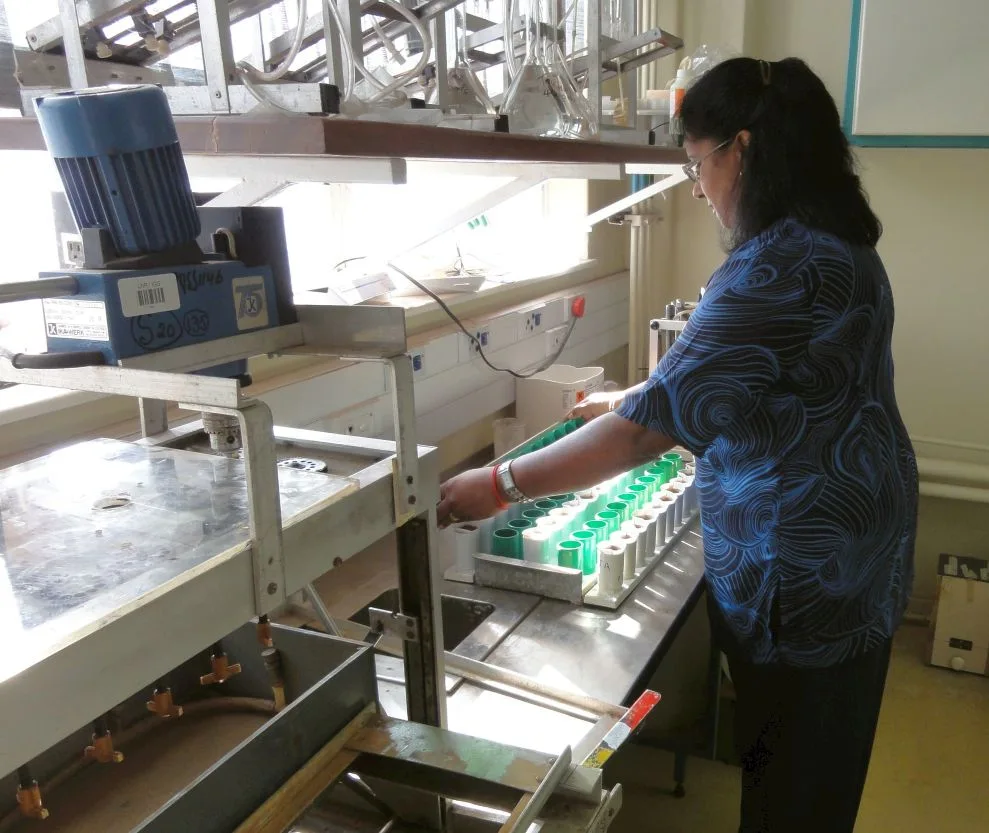
A multi-tier rack or a trolley is used to implement the method. A storage tank with nutrient solution is placed on the top shelf, from which the liquid flows via a siphon into an intermediate vessel that maintains constant pressure based on the principle of communicating vessels. From there, the solution drips in metered doses into vegetation vessels with sand, installed on the lower tier. Excess moisture is drained through a glass tube mounted in the stopper of the tubus at the bottom of the vessel.
The classic gravity-fed setup has three critical drawbacks. Adjusting the uniform flow with screw clamps is unstable because rubber tubing changes its elasticity in the sun. The dripping solution flushes only a narrow zone under the siphon, leaving the rest of the substrate without renewal. Additionally, the method requires a massive consumption of distilled water.
To avoid these problems, the design is modernized. To ensure uniform moisture distribution throughout the entire volume of sand, oscillating tubes and oscillating cuvettes are installed instead of simple siphons. Expensive distilled water is replaced with tap water that has undergone special preparation to stabilize its chemical properties.
Preparation of tap water includes the following technological operations:
- Shifting the water reaction to the slightly acidic side using sulfuric acid to neutralize the excess of calcium and magnesium bicarbonates.
- Prolonged aeration of the prepared water to completely remove carbon dioxide.
Read next
Agrochemistry For students
Method of isolated plant nutrition in agrochemical research and experiments
Agrochemistry For students
Preparation and use of sand substrate in agrochemical research
Agrochemistry For students