
Characteristics and application features of magnesium mineral fertilizers
4 min read
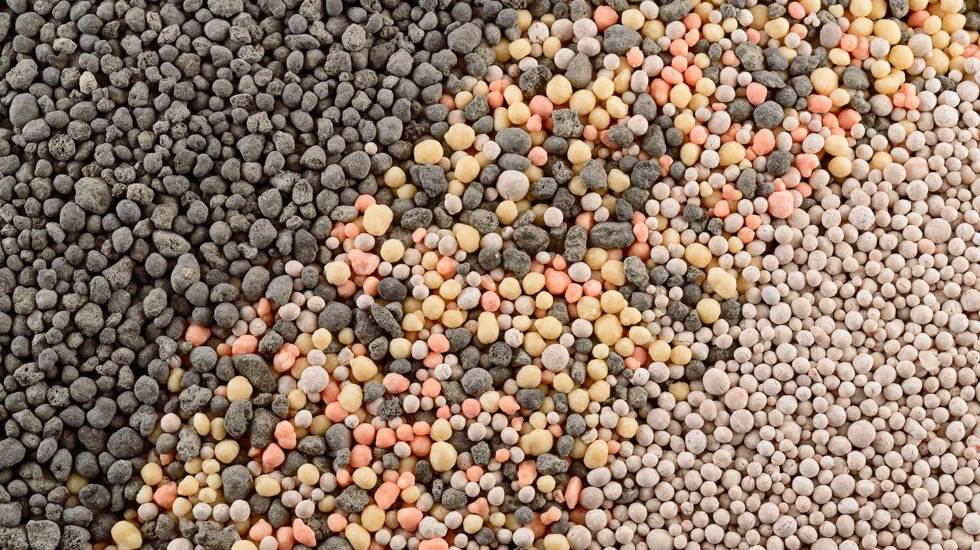
Characteristics of mineral magnesium fertilizers
To compensate for magnesium deficiency in the soil, a wide range of compound and complex mineral fertilizers is used. They differ in the concentration of active ingredients, solubility, and influence on soil acidity. The table below presents the key physical and chemical properties and application features of the main mineral forms.
| Fertilizer | Composition and formula | Nutrient content | Properties and application features |
|---|---|---|---|
| Ammoniated magnesium sulfate | (NH4)2SO4·MgSO4·6H2O | Not less than 7% N, 10% MgO | Crystalline product ranging from light brown to gray. Water solubility is low — 18 g/l. Magnesium is well assimilated by plants. Supplied in waterproof, three-layer, bitumen-impregnated paper bags. |
| Dolomite ammonium nitrate | NH4NO3+CaCO3·MgCO3 | 17% N, 10% MgO, 14% CaO | A mechanical mixture of dolomite flour and ammonium nitrate (1:1 by weight), which is prepared directly on farms. Does not acidify the soil. Applied according to the rates for nitrogen fertilizers. Abroad, it is produced in the form of a granulated alloy. |
| Magnesium ammonium phosphate (MAP) | — | 10.9% N, 45.7% P2О5, 25.9% MgO | Concentrated fertilizer. Phosphorus is in a citrate-soluble form, so it should be applied as a powder. Nitrogen is insoluble in water, which allows MAP to be applied in advance during primary tillage, including on irrigated lands and in conditions of excessive moisture. |
| Fused magnesium phosphate (FMP) | Ca3(PO4)2+MgSO4·SiO3 | 19–21% P2О5, 8–14% MgO | By-product of metallurgy. Highly effective when used as a basal application on all soil types. Described in detail in the "Phosphorus fertilizers" section. |
| Dimagnesium phosphate | MgNH4PO4·nH2O | 10.9% nitrogen, 45.7% phosphorus, 25.9% magnesium | Complex concentrated fertilizer. |
| Dunite superphosphate | Ca(H2PO4)2 4 | 16% phosphorus, 24% calcium, 4% magnesium | Complex phosphorus-magnesium fertilizer. |
| Kainite | 4·3H2O | 10–12% K2О, 22–25% Na2O, 6–7% MgO, 15–17% S2О3, 32–35% Cl | The mineral contains 45–47% NaCl impurities by total mass. It is a non-concentrated fertilizer, mainly used on hayfields and pastures, where it has an advantage over potassium chloride due to its magnesium content. |
| Potassium magnesium sulfate | K2SO4·MgSO4·6H2O | 28–30% K2О, 8–10% MgO | An intermediate product of kainite processing used to obtain potassium sulfate. Described in detail in the "Potassium fertilizers" section. |
| Vermiculite (hydromica) | — | 14–30% MgO, up to 5% K2О | The exchangeable form accessible to plants constitutes only 1.3–1.7% of the mineral's mass. The remaining magnesium decomposes under the influence of soil acid. |
| Potassium-magnesium concentrate | Based on langbeinite K2SO4·2MgSO4, also contains polyhalite, halite, gypsum | Grade 1: not less than 19% K2О, 9% MgO, Cl not more than 8% Grade 2: less than 17.5% K2О, 8% MgO |
Obtained by flotation of kainite-langbeinite ore. On average, it contains 30–38% K2SO4, 39–40% MgSO4, 4–5% KCl, and 8–10%. Humidity is no more than 5%. Chlorine content is not standardized (except for Grade 1). |
| Polyhalite | K2SO4·MgSO4·2CaSO4·2H2O | 8–12% MgO, up to 11% K2О | Dissolves slowly, but the potassium and magnesium from it are well accessible to plants. |
| Potassium chloride electrolyte | — | 40% potassium, 1% magnesium | Described in the "Potassium fertilizers" section. |
| Carnallite | 2·3Н2О | 16% potassium, 14% magnesium | One of the most important minerals in potassium salt deposits. |
When applying magnesium ammonium phosphate (MAP) at a rate of 45–60 kg/ha of P2О5, plant requirements for magnesium are fully met.
Organic fertilizers and the magnesium balance in soil
Organic fertilizers serve as a vital source for replenishing exchangeable magnesium stocks in the soil and improving plant nutrition. Systematic application of organic matter promotes the accumulation of absorbed magnesium, which directly leads to an increase in yield in crop rotation, especially on sod-podzolic, sandy, and sandy loam soils. At the same time, the application of manure reduces the effectiveness of mineral magnesium fertilizers, confirming its high self-sufficiency as a source of nutrition. To accurately calculate the income side of the magnesium balance, rely on the actual volumes of organic matter application on the farm.
- Magnesium from semi-liquid cattle manure (40 m³/ha) — 40 kg/ha
- Magnesium from poultry manure (20 m³/ha) — 40 kg/ha
- Magnesium from bedding manure (30 t/ha) — 40 kg/ha
- Excess of the magnesium application rate over its losses on light soils — 100–110 kg/ha
The use of organic fertilizers alone, even at sufficiently high rates, does not allow for long-term maintenance of magnesium content in the soil at the required level. On sandy loam soils under conditions of magnesium deficiency, maximum yields can only be obtained through the combined use of organic fertilizers and mineral forms of magnesium.
Read next
Agrochemistry For students
Characteristics and application features of simple potash fertilizers
Agrochemistry For students
Application of magnesium sulfate fertilizers in modern crop production
Agrochemistry For students