
Morphological characteristics and poisonous properties of castor bean seeds
2 min read
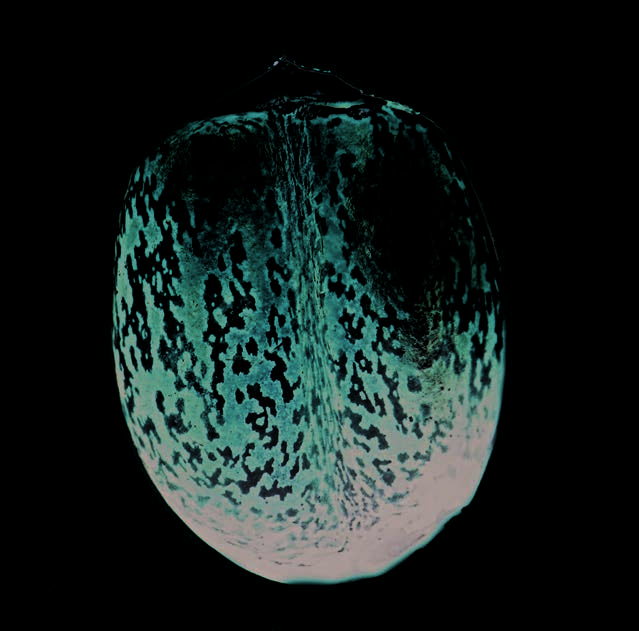
Euphorbiaceae contaminate crop products with seeds, or less frequently with entire or partially destroyed fruits — schizocarps (regmas). The capsules are trilocular, containing one, rarely two seeds in each locule, and dehisce into three valves. The fruits are glabrous or spiny, spherical or elongated capsules (up to 4 cm long). Seeds are ovoid, with an easily deciduous caruncle, convex on the dorsal side, with a shiny surface. The coloration is mottled: a mosaic pattern of white, gray, light brown, or pink on a gray, blue, light brown, or dark red background. Seed size varies depending on the cultivar: large-seeded ones are 16–20 mm long, 9–11 mm wide, and 7–9 mm thick. Small-seeded ones are 10–12 mm long, 6–7 mm wide, and 4–5 mm thick. Distribution. Widely cultivated across the Russian Federation. Toxic properties. Seeds (oil cake) contain the glycoprotein ricin and the alkaloid ricinine. Ricin is a protoplasmic poison that inhibits protein synthesis at the ribosomal level. Poisoning occurs upon ingestion of seeds, which resemble beans or fava beans, as well as through contamination of hands with oil cake during castor oil production. The amount of ricin in a single seed is lethal to a child (eight seeds for an adult). Main symptoms: nausea, vomiting, pain and burning in the esophagus and stomach, diarrhea, headache, drowsiness, and possible convulsions. Anuria and leukocytosis are observed. Ricin causes erythrocyte agglutination. In severe cases, collapse occurs, and a fatal outcome is possible.
Read next
Seeds and varieties For agronomists
Lobelia inflata: morphological characteristics and toxic properties of the plant
Seeds and varieties For agronomists
Caucasian dittany: biological characteristics of the weed and safety precautions
Seeds and varieties For agronomists