
Control of phytoparasitic nematodes in greenhouse vegetable production
19 min read
Phytoparasitic nematodes: biology and symptoms of infestation
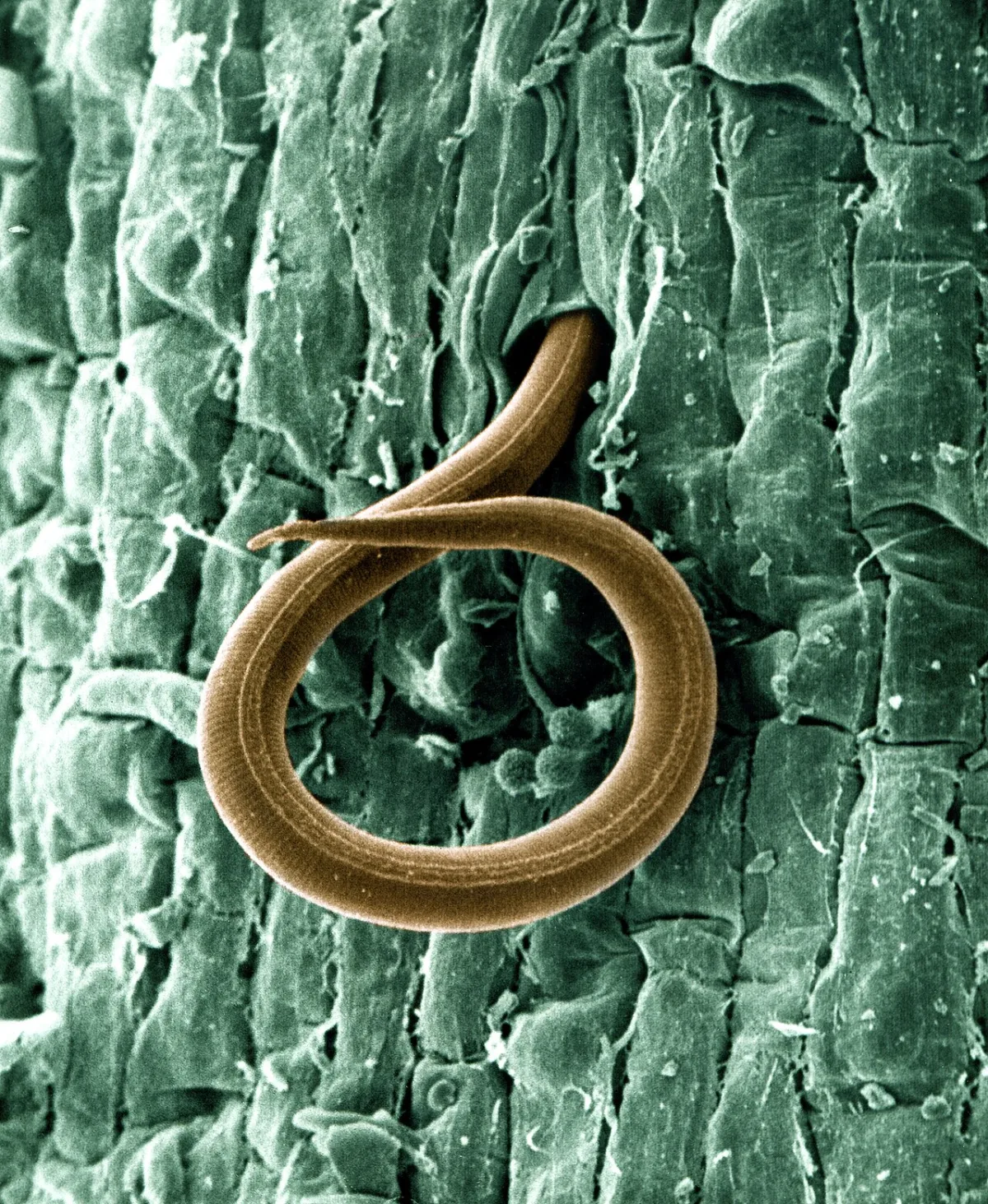
Phytoparasitic nematodes of the order Tylenchida (roundworms) are dangerous pests of protected ground capable of causing severe damage to the harvest. Unlike fungi, bacteria, and viruses, nematodes are multicellular animals. By their nature, they are closer to harmful arthropods (insects and mites), however, the damage they cause is traditionally called nematodosis.
Please note: in case of nematode infestation, there is an absence of rough mechanical tissue damage typical for phytophagous insects. Symptoms of nematodosis are easily confused with infectious diseases or physiological disorders.
Three main ecological-morphological groups of nematodes parasitize vegetable and ornamental crops in greenhouses. The first includes the most harmful root-knot nematodes (Meloidogyne spp.). The second group consists of stem nematodes of the genus Ditylenchus and leaf nematodes of the genus Aphelenchoides. The third group is represented by migratory root nematodes of the genus Pratylenchus, which are particularly dangerous for perennial ornamental crops.
Infestation manifests as general chlorosis of plants, formation of spots, necrosis, and drying of leaf margins. Deformations of vegetative and generative organs, as well as the appearance of characteristic growths and galls on roots, are also observed. Almost all phytoparasitic nematodes in protected ground are obligate parasites. An exception is the representatives of the genus Aphelenchoides, which can be both facultative and obligate.
- Number of host plant species for root-knot nematodes — over 4000
- Generations of root-knot nematode per year — up to 13
- Maximum fecundity of a single female — up to 2500 eggs
- Total species of root-knot nematodes — about 60
Protection and prevention methods in protected ground
Root-knot nematodes (family Meloidogynidae Skarbilovich, 1959, genus Meloidogyne Goeldi, 1892) possess tremendous invasive potential. They are perfectly adapted to endoparasitism and are capable of surviving for a long time in soil and plant residues even in the absence of a host plant. Pests spread rapidly through the greenhouse via irrigation water, tillage machinery, tools, and on the footwear of staff.
Currently, there are no highly effective and safe nematicides approved for use on actively growing plants. All main extermination measures must be carried out strictly during the period between crop rotations.
To reduce the nematode population density in the soil, plant residues, and overwintering vegetative organs, the agronomist should follow a strict sequence of protective measures.
- Complete removal and destruction of all plant residues after the end of the season.
- Thermal treatment of the soil (steaming or freezing) or chemical soil sterilization.
- Thermal treatment of planting material (bulbs, tubers, rhizomes).
- Planting trap crops followed by their destruction.
As additional control measures, humus or powder preparations of Agravertin and Fitoverm are applied to the soil. To minimize losses, it is recommended to initially plant resistant cultivars and hybrids of vegetable and flower crops. It is also worth considering the species composition of the pest: in the Russian Federation, only two species of root-knot nematodes live in natural conditions. These are the northern root-knot nematode M. hapla (parasitizing wild legumes, asteraceae, apiaceae, and rosaceae in river floodplains), which is of low danger in greenhouses, and the birch nematode M. aragoensis (infesting only silver birch).
The greatest danger to greenhouses is posed by introduced Meloidogyne species: southern (Meloidogyne incognita), Javanese (M. javanica), and peanut (M. arenaria). They do not occur in the wild in the Russian Federation, but they are widespread in protected ground. The history of their penetration into domestic greenhouse enterprises is presented in the table.
| Year of introduction | Pathway of entry and object | Host plant |
|---|---|---|
| 1937 | Introduction to greenhouse complex | Ornamental plants |
| 1951 | Arrival at exhibition site | Palm root system |
| 1955 | Introduction to state farm | Tomato transplants |
Furthermore, the introduction of root-knot nematodes occurred with soil on bulb onions from Central Asia. In addition to meloidogynosis of vegetables, agronomists of protected ground should be wary of Ditylenchus-induced onion rot, as well as a complex of nematodoses (meloidogynosis, ditylenchosis, aphelenchoidosis, pratylenchosis) on perennial ornamental crops. Succulents are often affected by cactoderosis.
Life cycle and behavior of root-knot nematodes in the greenhouse
For a protected ground agronomist, temperature regime is the main factor governing the development of root-knot nematodes (Meloidogyne spp.). These pests reproduce parthenogenetically. Males in greenhouses are rare, live from 3 to 5 weeks, and do not participate in the reproduction of the population. Depending on soil temperature, the pest's development cycle can accelerate by almost three times.
- Larval activity in soil — from 5 to 40 °C
- Optimum for M. hapla — 15–25 °C
- Optimum for M. javanica and M. incognita — 25–30 °C
- Development cycle of M. javanica at 14 °C — 56 days
- Development cycle of M. javanica at 26 °C — 21 days
The development of the pest follows one of two scenarios. In the classic cycle, second-stage larvae must emerge from the egg sac into the soil to find a new root. In greenhouse conditions on vegetable crops, the second variant is more common: the larvae do not emerge but migrate and develop directly inside the root (or gall), where they turn into egg-laying females.
In the classic infection cycle, the process follows strict stages:
- Penetration of the larva into the root just above the growth point (takes from 6 to 24 hours).
- Migration inside the root (up to 3 days) and secretion of substances that stimulate the growth of giant feeding cells.
- Sexual differentiation of the nematode (on the 12th day).
- Formation of the female (on the 20–24th day) and appearance of the egg sac (on the 26–27th day).
- Start of egg-laying (2–3 days after sac formation).
The female's reproduction period lasts from 2 to 3 months, after which it enters a post-reproductive phase and lives for about another month. During this time, its reproductive system is no longer functional, but the formed egg sacs remain a source of infection.
Infective second-stage larvae are capable of maintaining virulence in the soil without a host plant for 8 to 12 months. In this cryptobiotic stage, the pest is extremely resistant to adverse environmental conditions, which greatly complicates the decontamination of greenhouses.
Diagnostic signs: how to identify the pest species
Nematode infection can be detected in practice at any stage of the parasite's development. The presence of mobile males and larvae in the soil, as well as the discovery of immobile females with egg sacs on the roots, is a direct signal for action. For precise identification of the pest, researchers use morphometric parameters of development stages and the structural features of the female perineal pattern.
| Development stage | Length, µm | Width / Diameter, µm | Stylet length, µm | Structural features |
|---|---|---|---|---|
| Female | 510–1100 | 300–700 | 12–18 | White or grayish spherical body with a protruding head, esophageal bulb with valve |
| Male | 900–2000 | 30–40 | 17–27 | Vermiform shape, spicules 29–36 µm long, often found in egg sacs |
| Larva (infective) | 390–500 | 10–15 | 10–11 | Transparent (hyaline) tail tip, usually found in egg sacs |
| Egg | 76–110 | 30–45 | — | Oval shape |
The primary method for species identification of Meloidogyne is the analysis of the female perineal pattern. It is formed by cuticular striae, lateral lines, and the anal and vulvar openings.
During microscopic analysis, root-knot nematode species are distinguished by the pattern of the perineal plate. Each species has its own characteristic markers for lateral fields and cuticular striae:
- Meloidogyne hapla: has a characteristic punctate structure between the anus and the tail rudiment. The lateral field appears as one broken line along which the striae curl into a whorl.
- Meloidogyne javanica: has a clearly defined lateral field in the form of a double line, at the borders of which the cuticular striae are interrupted.
- Meloidogyne arenaria: there are no clear lateral field lines. Instead, a light band is visible, formed by the intermittent ends of striae that overlap each other.
How to distinguish M. incognita during microscopic analysis
Accurate identification of the root-knot nematode species is necessary for the correct selection of resistant hybrids and the planning of protective treatments in the greenhouse. When identifying the pest, the main reference point is the structure of the female perineal pattern. In the M. incognita nematode, the cuticular striae on the dorsal arch form a characteristic, highly visible U-shaped pattern.
When using microscopy, take into account that the lateral field of M. incognita may be indistinct or completely match the structure of the M. arenaria lateral field.
Read next
Plant protection For agronomists
Biological plant protection of vegetable crops against diseases and nematodes
Plant protection For agronomists
Strawberry aphelenchoides: symptoms of pest damage and methods of nematode control
Veterinary medicine For students