
Calculation of greenhouse natural ventilation parameters for air exchange optimization
7 min read
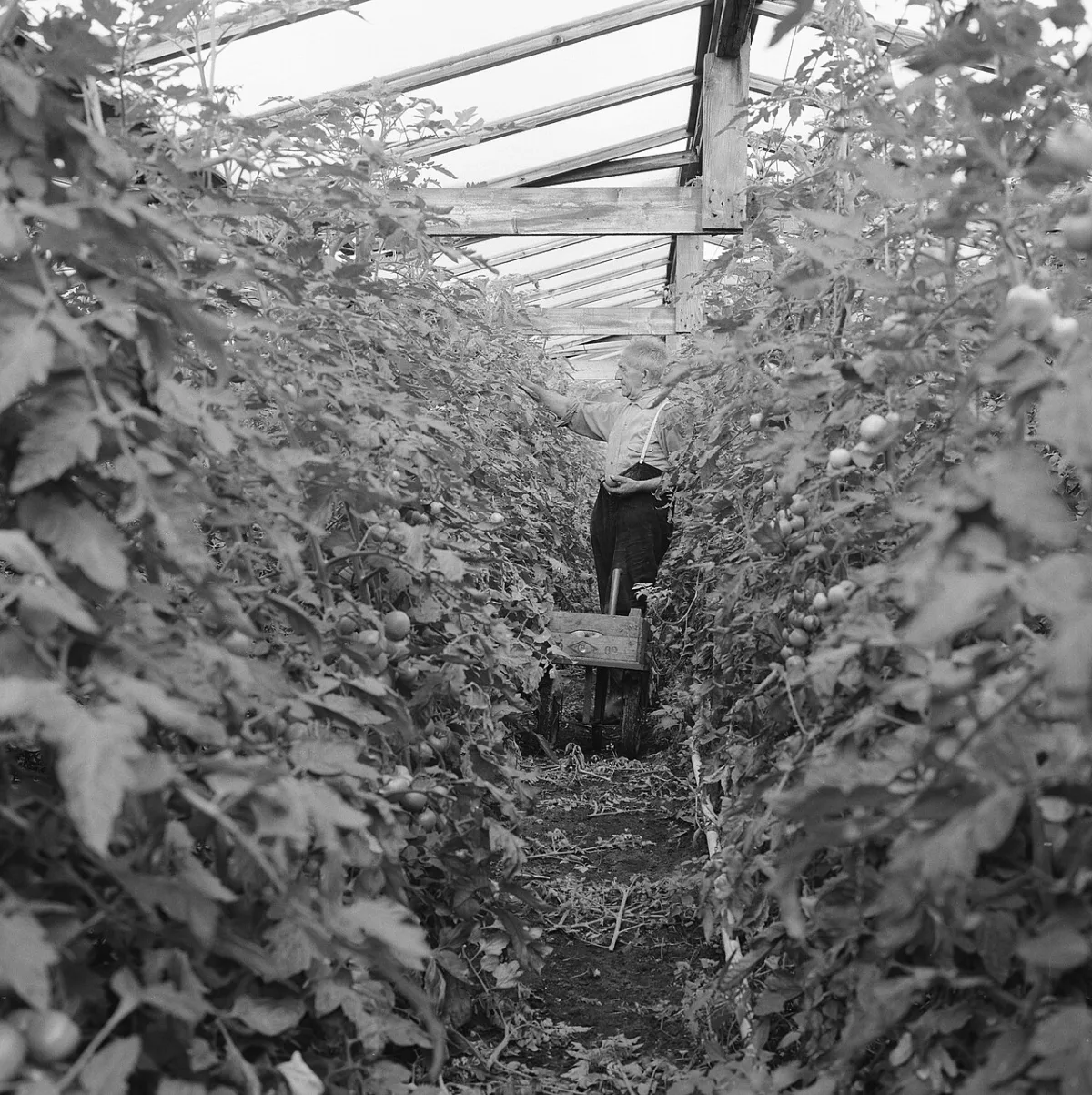
Air from the greenhouse can be exhausted either outside, i.e., by providing ventilation to the exterior, or into a residential house. In the latter case, the air warmed in the greenhouse, firstly, heats the residential house, i.e., functions as a solar energy storage unit, secondly, maintains the air temperature in the greenhouse within desired limits by moving heat to create reserves, and thirdly, is used as replacement air for the residential house, i.e., greenhouse functions as a pre-heater for fresh air.
In all cases, it is necessary to have a calculation method that allows for selecting the sizes of ventilation openings either between the greenhouse and the outside air or between the greenhouse and the apartment.
The formula provided below can be used to determine the dimensions of ventilation openings, windows, and doors to ensure natural ventilation (the influence of wind is not taken into account in the formula):
- opening, m; A — temperature difference at the upper and lower openings (based on existing experience); H — height difference (from the center of the upper to the center of the lower opening), m.
In summer, overheating of the air in the greenhouse can be prevented by organizing sufficient ventilation, where a single air exchange is ensured per min-
Assume that the outside air temperature is 30°C and the temperature in the upper part of the greenhouse is 38.5°C. The minimum ventilation opening area A is equal to 0.6 m2, the distance between the ventilation openings is 2.5 m, and the greenhouse volume is 45 m3. It is necessary to ensure the exchange of this amount of air every minute.
In this case, according to the formula provided above, with A=0.6 m2, ΔT=8.5°C, H=2.5 m, we obtain an air flow rate equal to 6.25 x 0.60 √8.5 x 2.5 = 17.3 m3/min. Thus, the air flow rate turned out to be less than necessary (45 m3/min).
If a ventilation duct is used, the height of which is 5 m higher than the location of the upper ventilation opening, then the height difference H will increase to 5.5 m. At the same time, the temperature difference ΔT will also increase. According to temperature measurement data in the greenhouse of the "Helsingin Puistola" park, the temperature will increase by 6.5°C compared to the air temperature in the upper part of the greenhouse, i.e., by approximately 2°C per 1 m of height difference (in summer during insolation).
In this case, according to the formula provided above, with A=0.6 m2, ΔT=15°C, H=5.5 m, we obtain an air flow rate equal to 6.25 x 0.6 √15 x 5.5 = 34.0 m3/min.
Consequently, the air flow rate still remains less than necessary. By increasing the ventilation opening by approximately 33% or increasing the height of the ventilation duct by approximately 2 m, the desired air flow rate can be achieved.
Calculation of ventilation duct sizes and fans
Calculation of ventilation duct sizes. When choosing the sizes of ventilation ducts, the determining factors are the shape, surface, and length of the duct.
The sizes of cylindrical ducts, in which air is driven by fans, are selected in accordance with the table:
Duct diameter, mm | Air flow rate, m3/s | Resistance | Air velocity, m/s | 100 | 0.014 | 0.5 | 0.9 | 125 | 0.028 | 0.6 | 1.2 | 160 | 0.070 | 0.8 | 2.0 | 200 | 0.120 | 1.0 | 4.0 | 250 | 0.260 | 1.3 | 5.2 | 315 | 0.550 | 1.8 | 7.0 | 400 | 1.200 | 2.0 | 9.0
Calculation of fan parameters. For calculation, the following rule of thumb can be used: the fan power value, in kW, is numerically equal to the air flow rate value, in m3/s.
- Example. With a ventilation duct diameter of 160 mm, the amount of transported air is 0.07 m3/s. Then the fan power must be at least 0.07 kW, or 70 W.
If air is to be supplied to a heat accumulator that has high resistance, for example, to a stone heat accumulator, then with an increase in resistance in the system with the heat accumulator, it is necessary to increase the fan power. For a system with a stone heat accumulator, it is recommended to triple the fan power, i.e.
Read next
Greenhouses and covers For gardeners
Effective solar energy accumulation in modern greenhouse structures
Greenhouses and covers For gardeners
Energy exchange and heat accumulation mechanisms in greenhouse structures
Greenhouses and covers For agronomists