
A system for evaluating the production and economic performance indicators of agricultural enterprises
3 min read
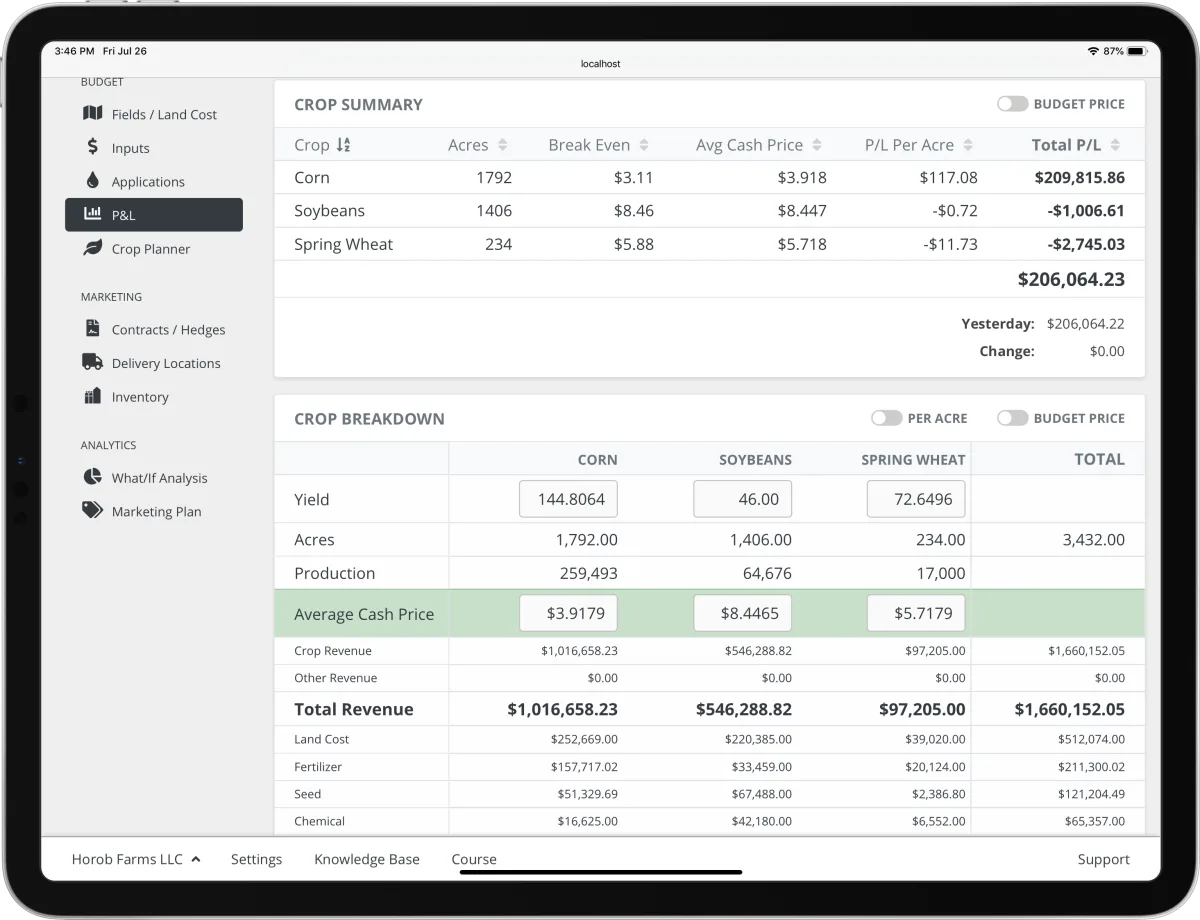
The evaluation of industry performance results is carried out using a system of production and economic indicators.
Production indicators characterize the results in crop and livestock production in physical terms: crop yield (centners per hectare); feed output (centners of feed units per 1 hectare of forage area); livestock productivity (average annual milk yield per cow; average annual egg production of laying hens; average annual wool clip per sheep; average daily weight gain; livestock rearing production calculated per head on an annual average basis; offspring output per 100 head of breeding stock by livestock species).
Economic indicators are calculated based on physical production indicators. They take into account not only yield and productivity, but also production and sales costs, prices, and other conditions for marketing products, and are determined for all production in the enterprise as well as for marketable, i.e., sold, products.
Gross output (GO) is the total production of an enterprise over a year, including the gross harvest of agricultural products and the output of livestock products at current prices that actually occurred during the sale of products.
Gross income (GI) represents the difference between gross output and material costs (MC):
Net income (NI) represents the difference between gross output and production costs, i.e., the cost of production (CP):
NI = GO - CP, and can also be determined as the difference between gross income and labor costs (LC):
Thus, gross income represents the sum of labor costs (expenditures on labor) and net income.
The enterprise's net income is calculated for the entire gross output. Profit (P), or realized net income, is determined by the realized products, i.e., revenue from sales (RS):
P = RS - TC, where TC is the total (or commercial) cost of realized products.
Profitability is an important indicator of the economic efficiency of an enterprise. The profitability level (PL) is defined as the percentage ratio of profit to the total (commercial) cost:
for the enterprise as a whole, its sectors, and individual marketable products. This indicator can also be used to evaluate the profitability of costs for specific measures aimed at increasing the economic efficiency of production.
1. How do sectors of the economy differ? 2. Which spheres constitute the agro-industrial complex? 3. What functions and in what sequence do the sectors of
the AIC perform to bring the final product from agricultural raw materials to the consumer? 4. What does the concept of "food complex" mean and what is its connection with agriculture? 5. Define food security. 6. How is per capita production of basic food products changing in Russia? 7. How is per capita food consumption changing in
Russia? 8. What is the socio-economic significance of agriculture? 9. What is food security? 10. How is seasonality of production and labor use manifested in agriculture? 11. How do agricultural producers depend on the market for means of production and their prices? 12. Which production indicators are used to evaluate performance results in agriculture? 13. Which indicators for evaluating agriculture are classified as economic? 14. By which indicator is the profitability of costs in agricultural
Read next
Economics For students
Economic efficiency of agricultural production and ways to improve it

Economics For students
Key drivers for increasing the economic efficiency of agribusiness and production
Economics For students